bring 'starvation'
p. 107 · Read in the full issue
The starfish could bring 'starvation' to the Pacific
The dangers of the crown of thorns starfish are greater than even the most pessimistic re
searchers believe, according to
Mr. Theo Brown who, as a marine research associate, has carried out work on the Great Barrier Reef and, more recently, in French Polynesia.
He believes that the death of coral reefs may bring a sizeable proportion of South Pacific natives, who rely on fish for their staple diet, to the brink of starvation. And he considers the metropolitan governments should take immediate action to prevent this hap pening.
He was recently in Sydney where he held a Press conference to gather public support for criticism of the Queensland Government for, he claims, ignoring the dangers of the starfish, and to raise funds for a new research project into the star fish on the Great Barrier Reef.
Pollution cause
Mr, Brown told PIM that the most likely reason for the upsurge of the starfish was pollution caused by the presence of man in the area. Even the smallest interruption to small plankton and cell life on the reef, such as the diesel from an outboard motor, could affect the balance of nature.
If, as it appeared, that the starfish had a certain immunity in the larvae stage to man’s pollution, then it could grow unchecked by larvae which usually preyed upon it.
Unknown to man, Mr. Brown added, many other forms of life in the ocean could have been affected by pollution. Little was known about how the refuse of man was overcome by oceanic life.
Meanwhile in Australia the argu ment among the academics still con tinues. Dr. Endean’s latest statement (he is Reader in Zoology at the Uni versity of Queensland) is that the Great Barrier Reef may be completely wiped out in 20 years unless some thing is done soon about the starfish.
If that is true, how long can we give the reefs of the Pacific?
On the other hand, a recent state ment from the Australian Academy of Science says that the geological structure of the Great Barrier Reef
is not in danger and the coast of Queensland will not suffer adverse effects as a result of the coral destruc tion. Special attention, it says, should be paid to the theory that the starfish plague is a cyclic phenomenon “which has occurred on previous occasions and been followed by regeneration and recolonisation with coral polyps.”
It also adds one interesting point: If Triton shells are bred in large numbers to control the starfish plague (as was suggested in PIM, Feb, p. 37) what if the shells become a plague problem themselves. After all, what is known of the biology of the Triton?
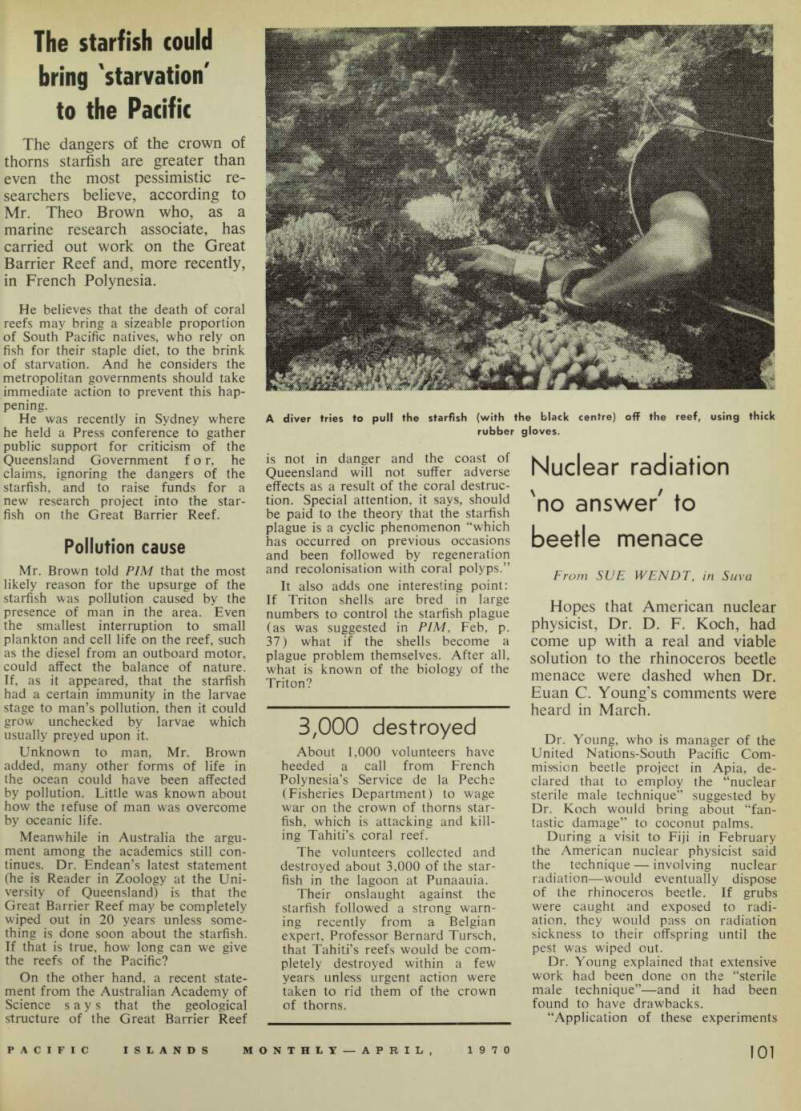
A diver tries to pull the starfish (with the black centre) off the reef, using thick rubber gloves.