Learning to live with sharks
pp. 103-106 · Read in the full issue


By John Eccles
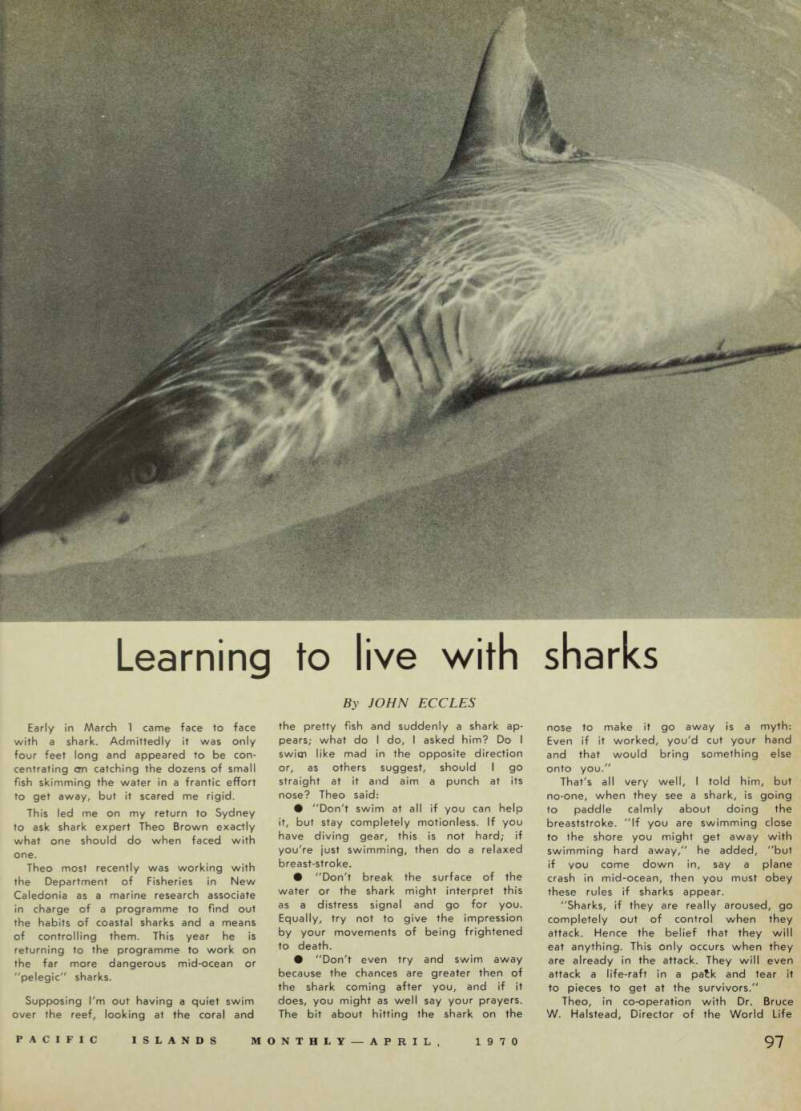
Early in March 1 came face to face with a shark. Admittedly it was only four feet long and appeared to be concentrating cm catching the dozens of small fish skimming the water in a frantic effort to get away, but it scared me rigid.
This led me on my return to Sydney to ask shark expert Theo Brown exactly what one should do when faced with one Theo most recently was working with the Department of Fisheries in New Caledonia as a marine research associate in charge of a programme to find out the habits of coastal sharks and a means of controlling them. This year he is returning to the programme to work on the far more dangerous mid-ocean or "pelegic" sharks.
Supposing I'm out having a quiet swim over the reef, looking at the coral and
the pretty fish and suddenly a shark appears; what do I do, I asked him? Do I swim like mad in the opposite direction or, as others suggest, should I go straight at it and aim a punch at its nose? Theo said: " Dor,,t swim at al > if you can help if ' but sta y completely motionless. If you have divin 9 9 ear ' this is not hard; if you're just swimming, then do a relaxed breast-stroke. • "Don't break the surface of the water or the shark mi 9 ht interpret this as a distress signal and go for you.
Equally, try not to give the impression b V y° ur movements of being frightened to death - • "Don't even try and swim away because the chances are greater then of the shark coming after you, and if it does, you might as well say your prayers.
The bit about hitting the shark on the
nose to make it go away is a myth: Even if it worked, you'd cut your hand and that would bring something else onto you."
That's all very well, I told him, but no-one, when they see a shark, is going to paddle calmly about doing the breaststroke. "If you are swimming close to lhe shore y° u mi 9 ht get away with swimming hard away," he added, "but if you come down in, say a plane crash in mid-ocean, then you must obey these rules if sharks appear, "Sharks, if they are really aroused, go completely out of control when they attack. Hence the belief that they will eat anything. This only occurs when they are already in the attack. They will even attack a life-raft in a patk and tear it to pieces to get at the survivors."
Theo, in co-operation with Dr. Bruce W. Halstead, Director of the World Life
Research Institute, finished late last year a programme to look into the shark problem and if possible find a shark repellent.
The programme, on Rangiroa Atoll, the largest natural lagoon in the world, had several aims: • To develop an underwater transmis sion of sonic and ultrasonic sound frequencies as an all-purpose shark repellent. • To find the effects of sound signals on bony fish (in particular the commercial species), and on crustaceous animals, aimed at controlling their movements. © To study various specimens of sharks. • To tag sharks to determine their migratory habits, rate of growth, age, etc. • To study suspected toxic fish and crabs in preparation for detailed laboratory work.
Main result of the programme, as far as Theo was concerned, was the mixed success of attempts to find a sound to repel all sharks. After underwater testing of various sound transmissions, it was found that certain species of sharks were repelled, but not others. When an attempt was made to combine the separate frequencies to repel a number of species, if was found that the repellent combinations became ineffective.
Said Theo: "When such a repellent sonic signal is achieved, it will have unlimited scope. Harbours and beaches could be given year round protection by establishing a sonic barrier across the harbour entrance or beach headland, and the survivors of a tragedy at sea could be protected by small portable transmit ting units which would transmit an omni directional underwater signal barrier to protect them from shark attack."
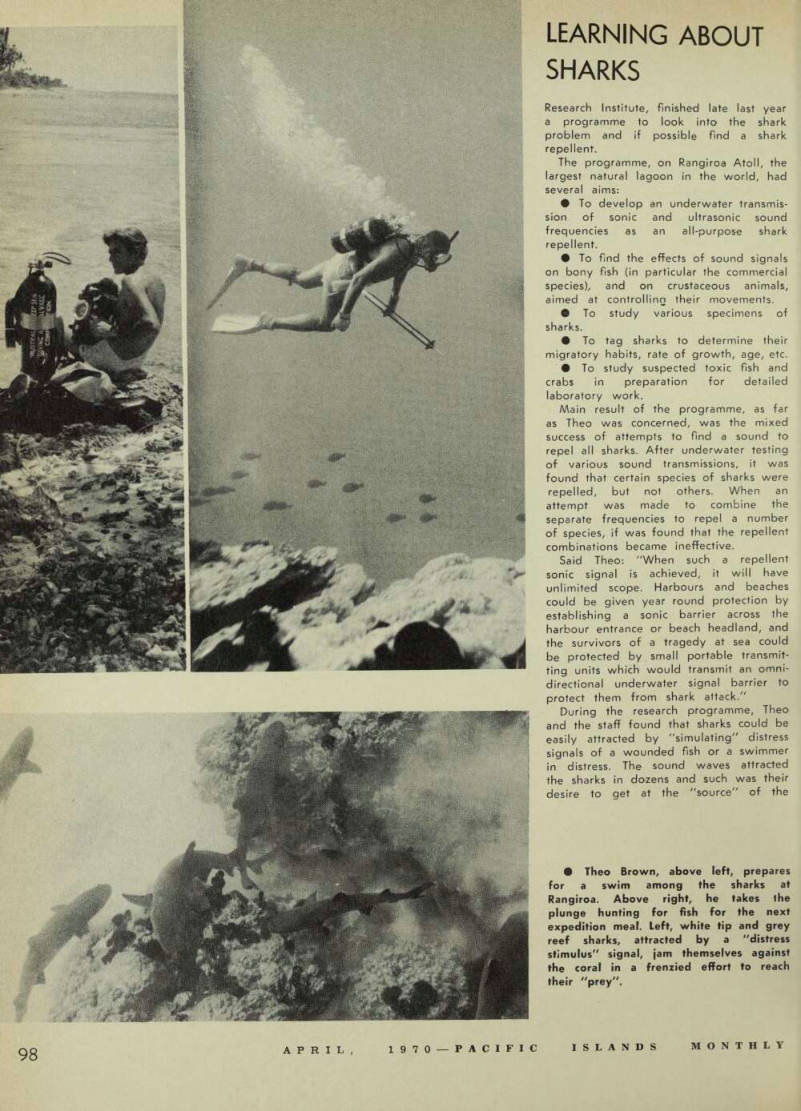
During the research programme, Theo and the staff found that sharks could be easily attracted by "simulating" distress signals of a wounded fish or a swimmer in distress. The sound waves attracted the sharks in dozens and such was their desire to get at the "source" of the
• Theo Brown, above left, prepares for a swim among the sharks at Rangiroa. Above right, he takes the plunge hunting for fish for the next expedition meal. Left, white tip and grey reef sharks, attracted by a "distress stimulus" signal, jam themselves against the coral in a frenzied effort to reach their "prey".
distress, that many were killed by jamming themselves against the coral overhang where the unit was concealed.
At present, says Theo, little is known about the shark, its movements and its habits. In the Pacific the only govern ments taking any interest at all in the problem are the French in New Caledonia and, to a lesser extent, Americans, who are following a naval programme.
The research programme starts again in a few months and this time Theo and the staff will be out worrying the big ones in mid-ocean.
"It's a lot of fun and at the same time a very satisfying experience to work with sharks," Theo added. "If we can find a way of keeping sharks from killing people without having to butcher them ourselves, I will be happy."
• Divers assemble a cage to observe sharks in Rangiroa Lagoon, above right.
Below left, working on the dreaded stone fish to examine toxicity; below centre, a manta ray glides through the lagoon; below right, Theo checks the toxicity of this shark.
Shark girl
This pretty young lass is Dana Danielson, a marine biologist, employed by the World Life Research Institute at last year's Rangiroa experiments on shark behaviour and toxic fish. Dana, from the US, is seen here helping to prepare an expedition member for a dive.