Book Reviews
pp. 95-97 · Read in the full issue

Do facts support Hawaii's claim to racial harmony?
Hawaii’s fame as a “Pacific melting pot”, that has turned out something unique in the way of racial harmony, is often held up as an example to other Pacific territories. The validity of the idea, what led up to it and Hawaii’s racial future are all discussed in a small book by Andrew W. Lind, Professor of Sociology, University of Hawaii.
It has become traditional, as the author says, for visiting big-wigs, political, literary or academic, to make public exclamations about the lack of tension in a population composed of half-a-dozen racial in gredients.
This attitude has been intensified in recent years when great areas of the world have entered a period of their greatest racial disharmony ever.
What then is so special about Hawaii? Professor Lind dismisses as “insidious and misleading” the idea that it came about simply as aloha spirit, missionary altruism or Ameri can democracy. In his small book, Hawaii—The Last of the Magic Isles he goes on to examine, in consider able detail, the whole racial structure and comes up with some interesting facts, not the least of which is that Hawaii has not been continually free from racial tensions nor is it likely to be in the immediate future.
Scholarly
This is a scholarly examination of the past and present, with the usual number of footnotes and a lot of equally scholarly fence-sitting—or, perhaps more correctly, seeing every thing from all angles.
If one may have a conclusion of one’s own, based on the informa tion in the book, it’s that economic opportunities in Hawaii for all races have kept pace with individual aspirations, and this has been a big factor in taking a lot of the heat out of racial tensions.
It is interesting to note, however, that in an economic sense, Hawaiians and part-Hawaiians are down at the
... r r * j„ n L t bottom of the fist, no doubt because m this section of the community aspirations were at a lower ebb than m c.ny otner.
The sole purpose of migrant groups going to Hawaii was to make as much money as possible, as quickly
as possible. The opening for migrant
labour was caused in the first place, by the devasting decline in the Hawaiian population and, at the same time, the establishment of European-owned plantations.
Between 1778 to 1823 it is esti-
mated that the Hawaiian population declined from about 300,000 to 134,750; by the middle of the century it was less than 80,000 and by the beginning of this century 30,000.
With this sudden decline in in digenous people, more land became available for expatriate plantations but, at the same time, there was far less labour to work them. The first migrants imported for plantation labour were Chinese, but this solu tion was short-lived. Within 30 years, almost one-third of the Chinese migrants had taken up permanent residence in Honolulu and had be come tradesmen and shopkeepers; by the middle 1880’s, over 60 per cent, of the retail business of Hawaii was in Chinese hands.
Agitation for the limitation of Chinese migration* that had been go ing on for 25 years, culminated in 1886 with the legislation prohibiting further importation of such labour.
Meantime, the Japanese had taken the place on the plantations formerly occupied by the Chinese, but they in their turn were also moving out.
Between 1884 and 1900 the Japanese community increased from 116 to over 24,000 and although their first move away from the plantation was into domestic service, by the be ginning of this century they, too, were invading trade and the skilled
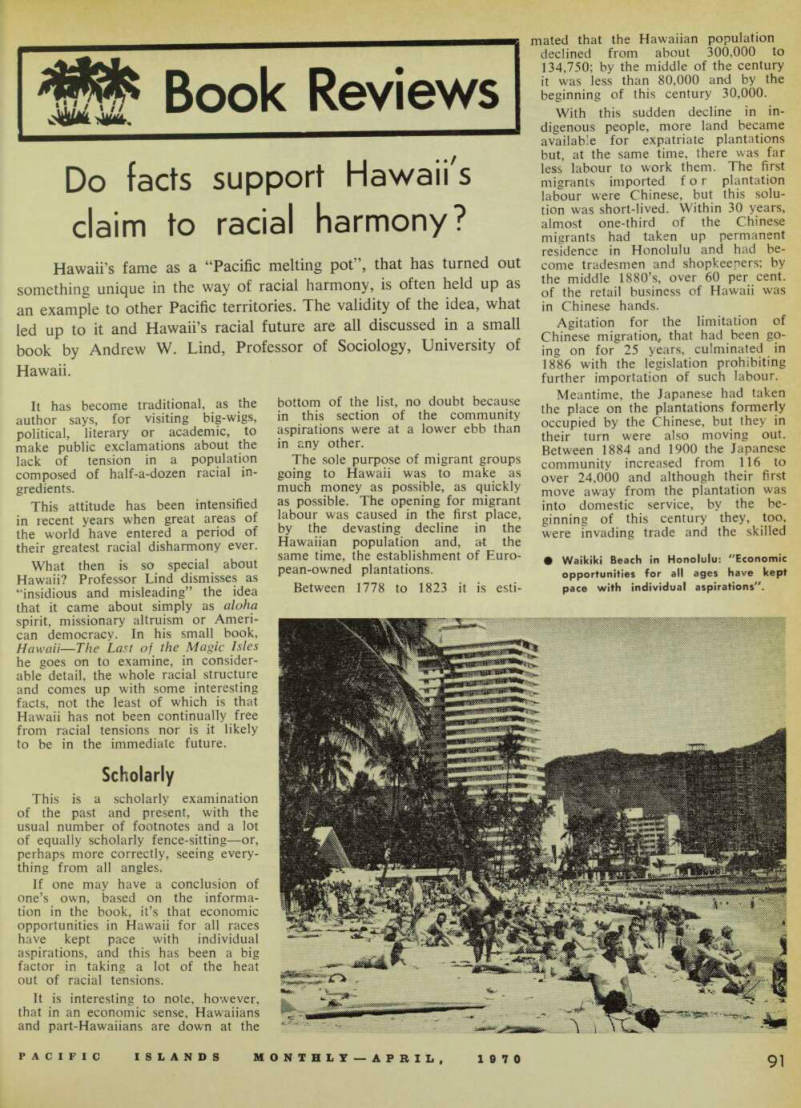
• Waikiki Beach in Honolulu: "Economic opportunities for all ages have kept pace with individual aspirations".
occupations, and this was causing con siderable alarm.
White employers, at that stage, began to be opposed to having Jap anese on their staffs—“for fear of training someone who would turn out to be a future competitor”.
Later migrations followed the Jap anese Filipinos, Koreans, Puerto Ricans, Portuguese. All groups, over the generations, underwent a change in the number of their population engaged on purely labouring work— the Chinese moving further from this than any other group, with the last arriving group —the Filipinos— still providing a higher proportion of labourers than any other.
A higher and higher proportion of people in the professions are now being drawn from second and third generations of the migrant groups, with the Chinese far exceeding the average. At the same time, there are many stories of Chinese who, since
World War 11, have succeeded in big business and have entered the millionaire class.
A simple survey conducted a couple of years ago of heads of families in Oahu showed that the average in come was $9,372 for a Chinese, $8,877 for a Japanese, $7,246 for a European (military personnel were counted and gave a somewhat false impression), $6,250 for a Portuguese; $6,850 for a part-Hawaiian; $6,087 for a Filipino and $5,583 for a Hawaiian.
Hawaii has not experienced any of the recent black/white troubles of the mainland states, possibly be cause the Negro population is small.
The last census, taken in 1960, showed only 5,000 Negroes and these mostly in the armed forces; nor does there appear to have been any large scale influx since.
Over 90 per cent, of the Negroes are concentrated on Oahu where they are generally accepted but, as the last ethnic group to emerge within the Hawaiian setting, are treated with reserve and some mistrust by the rest of the community.
While some people feel that the last word has not yet been said on the matter of racial harmony in Hawaii and that tensions are likely to grow rather than diminish. Pro fessor Lind seems to feel that the in creasingly large proportion of the racial groups that inter-marry may produce the ultimate solution.
Inter-marry solution?
Surveys have shown that 37.6 per cent, of people in Hawaii now marry outside their own racial group (the figure was 11.5 per cent, in 1916).
This large proportion of the popula tion, he says, “cannot now or in the future be unscrambled”.
There is much in this book to in terest those in authority in other Pacific Islands although none of them have the same fundamentals or the same background history as Hawaii, and are unlikely to come up with the same solutions.
Professor Lind and others have a lot to say about the impact of the tourist industry on Hawaii and its mixed population and, in this direc tion, a number of territories, now entranced with the short-term benefits of this industry without considering its long-term implications, might learn a lot.—JT.
(Hawaii: The Last Of The Magic
ISLES. Oxford University Press. $2.35).