Yesterday
p. 93 · Read in the full issue
Papeete saw some of its wildest waterfront fighting in early 1950 when the Egyptian crew of a French-chartered ship took on dozens of Tahitians in a free-for-all melee starting at the colourful Quinns Bar. Chairs, tables, bottles, knives and razors were used and bicycles were thrown by the seamen into a watching crowd.
Word spread rapidly and the Tahitians, marshalling their forces, soon outnumbered the Egyptians and drove them back to the docks. A day later the Egyptians’ leader re turned to Quinns, and, in PlM’s correspondent’s words, “numbers of Tahitians set upon him and beat him to a pulp”.
Other, less dramatic news for PIM, April, 1950, included the following: The first South Pacific Conference, at which representative Islanders met for the first time under the auspices of the South Pacific Commission, opened in Noumea on April 24. PIM reported that it would thereafter be convened every three years. Mean while, from Suva, a correspondent reported that the general attitude of Europeans there towards the con ference was one of “cynicism and in difference”.
Mr. Percy Spender was making his first trip to Papua-New Guinea as Minister for External Territories, PIM thought that he was displaying “energy and vision” in statements that he was making there.
The Copra Agreement between the British Ministry of Food and planters in British South Pacific territories was under fire from many directions.
The agreement, framed in 1948, started in 1949 with a price of £Stg.4B per ton f.o.b. It was to be re viewed upwards or downwards, not more than 10 per cent., in each of the succeeding years. At the end of 1949 the MOF wanted to review it downwards, although the free market price was rising. Further, sterling had been devalued by 30 per cent, in 1949 by the British Labour Gov ernment which infuriated planters still more.
Ceylon, which originally had been covered by the agreement broke away at that point. Many Pacific planters would have been happy to follow that lead. They had, it was stated, “experienced something resembling a confidence trick at the hands of the
Mof”.
Captain C. Andersen, smallships officer, master and coconut planter
in Eastern Papua for over 50 years, died. He had arrived originally in the mid-1890’s aboard the SS Ysabel, then owned by the German New Guinea Company, later getting his master’s certificate. With another identity, “German Harry”, he ran a schooner between Cooktown, Queens land, and Woodlark Island, Papua.
Captain Brett Hilder of the Burns Philp Line, finally got his 3,352-ton freighter Mongola off the reef at the entrance to Port Moresby Harbour, following an unscheduled grounding of 19 hours. Apart from a slight leak, Mangola seemed none the worse for her mishap.
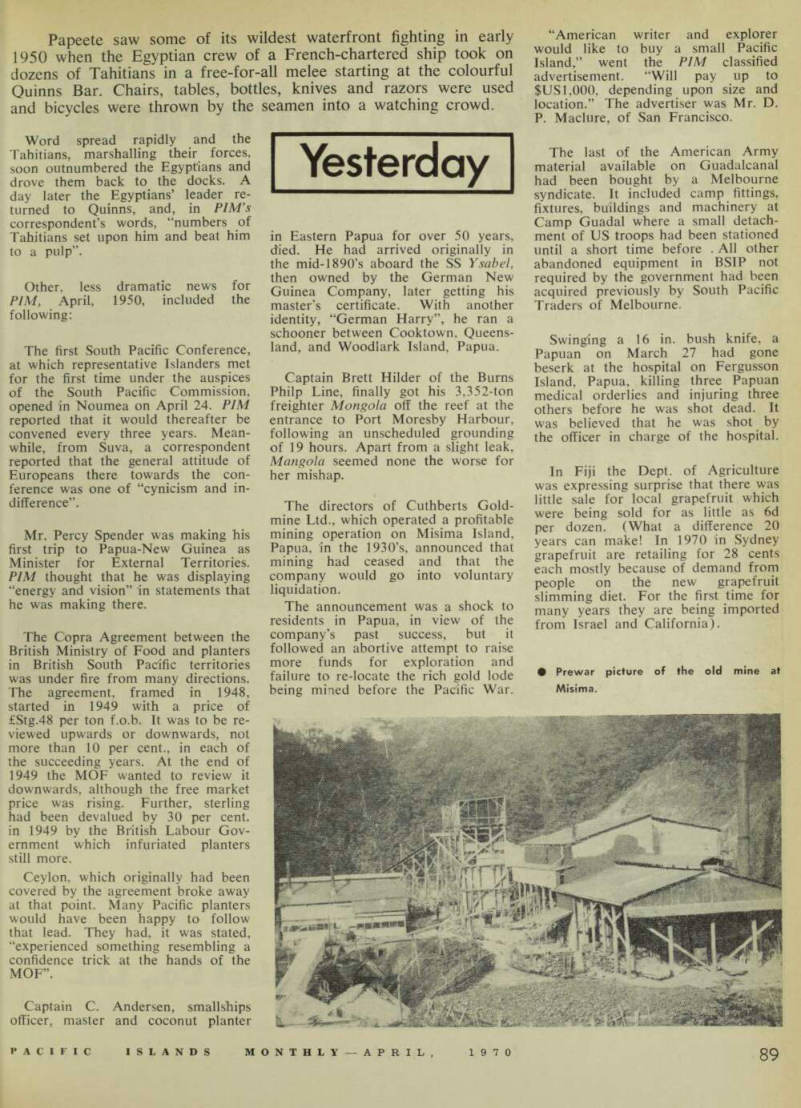
The directors of Cuthberts Gold mine Ltd., which operated a profitable mining operation on Misima Island, Papua, in the 1930’5, announced that mining had ceased and that the company would go into voluntary liquidation.
The announcement was a shock to residents in Papua, in view of the company’s past success, but it followed an abortive attempt to raise more funds for exploration and failure to re-locate the rich gold lode being mined before the Pacific War.
“American writer and explorer would like to buy a small Pacific Island,” went the PIM classified advertisement. “Will pay up to SUS 1,000, depending upon size and location.” The advertiser was Mr. D.
P. Maclure, of San Francisco.
The last of the American Army material available on Guadalcanal had been bought by a Melbourne syndicate. It included camp fittings, fixtures, buildings and machinery at Camp Guadal where a small detach ment of US troops had been stationed until a short time before . All other abandoned equipment in BSIP not required by the government had been acquired previously by South Pacific Traders of Melbourne.
Swinging a 16 in. bush knife, a Papuan on March 27 had gone beserk at the hospital on Fergusson Island, Papua, killing three Papuan medical orderlies and injuring three others before he was shot dead. It was believed that he was shot by the officer in charge of the hospital.
In Fiji the Dept, of Agriculture was expressing surprise that there was little sale for local grapefruit which were being sold for as little as 6d per dozen. (What a difference 20 years can make! In 1970 in Sydney grapefruit are retailing for 28 cents each mostly because of demand from people on the new grapefruit slimming diet. For the first time for many years they are being imported from Israel and California).
• Prewar picture of the old mine at Misima.