(1) It's a vital, young cabinet
pp. 52-53 · Read in the full issue
• The independent state of Western Samoa has a new cabinet, a new set of men to dictate the country's domestic and foreign policies.
In Samoa itself after the elections there is widespread interest in how the new, comparatively inexperienced cabinet will fare. Here we have two points of view; first by Professor J. W. Davidson, Professor of Pacific History at the Australian National University’
Canberra, and a more pessimistic report from a PIM correspondent in Apia, R. F. Rankin.
By J. W. DAVIDSON, in Canberra
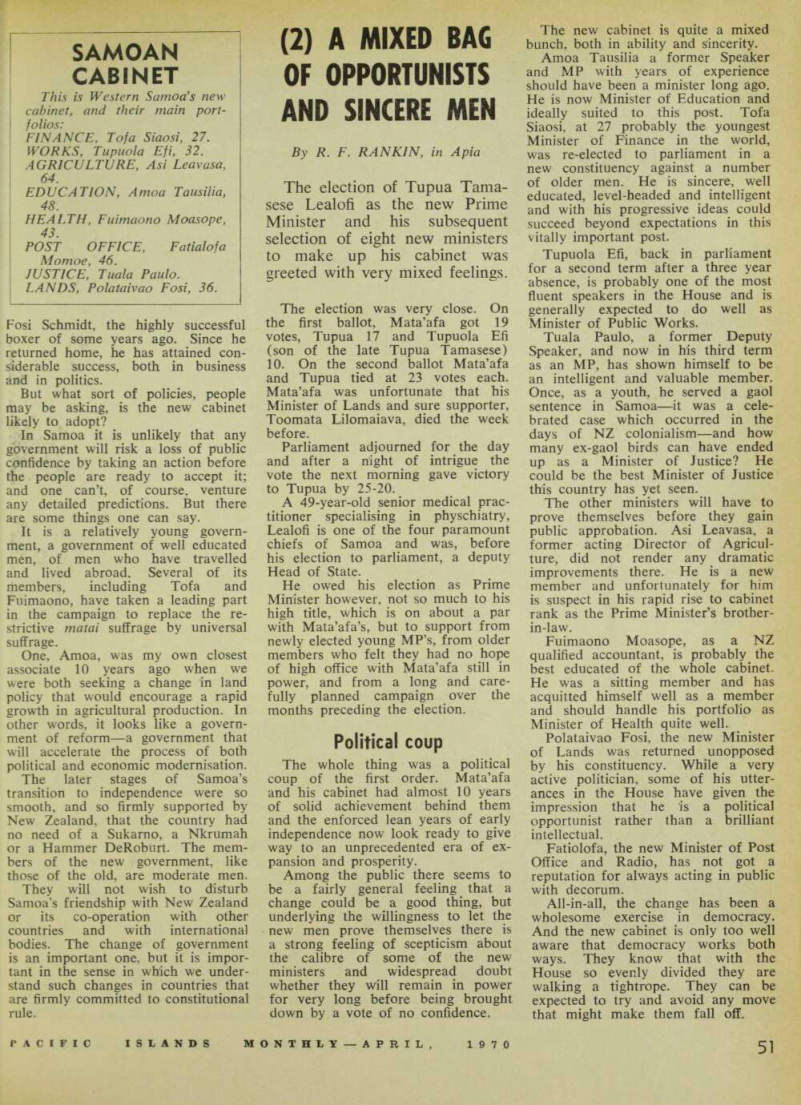
Fiame Mata’afa, who has lost office, became Samoa’s first Prime Minister in 1959 and he remained in office until February. He and his fellow ministers guided the country through its transition to in dependence, and maintained sound procedures of government something not too common in newly independent states.
They also took positive, if not always sufficiently radical, action to promote economic development. In this time of their defeat, their record of work well done should be recog nised.
But the time had come for a change. When I was in Samoa last year, the government seemed a tired government, mainly intent on remain ing in office. It had adopted, or was considering, a few very dubious policies. It had failed to respond to a number of important challenges.
Before I say anything about the new cabinet, I should like to make another general point. Western Samoa, of course, adopted a parlia mentary system of government; but so far it has failed to develop an organised party system. This raised doubts about the way in which a change of government might take place.
Democratic procedures
It seemed possible that a Prime Minister could keep himself in office more or less indefinitely by making concessions first to one group of MP’s and then to another. It seemed difficult for those who opposed his administration to defeat and replace him without the help of a party organisation and party discipline. The events of the last week have removed these doubts. As a result, democratic procedures are more firmly en trenched.
Moreover, the omission of all the former ministers from the new cabi net may well lead to the crystallisa tion of something like a party system in the new parliament.
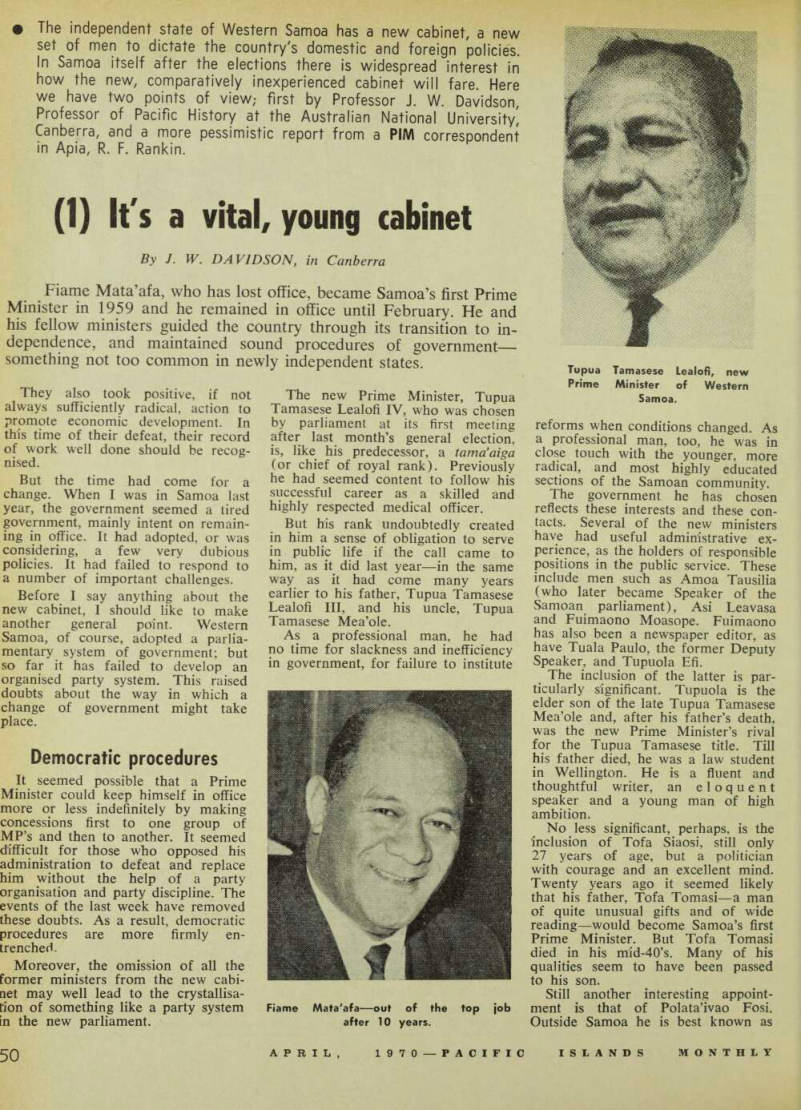
The new Prime Minister, Tupua Tamasese Lealofi IV, who was chosen by parliament at its first meeting after last month’s general election, is, like his predecessor, a tama’aiga (or chief of royal rank). Previously he had seemed content to follow his successful career as a skilled and highly respected medical officer.
But his rank undoubtedly created in him a sense of obligation to serve in public life if the call came to him, as it did last year—in the same way as it had come many years earlier to his father, Tupua Tamasese Lealofi 111, and his uncle, Tupua Tamasese Mea’ole.
As a professional man, he had no time for slackness and inefficiency in government, for failure to institute
reforms when conditions changed. As a professional man, too, he was in close touch with the younger, more radical, and most highly educated sections of the Samoan community.
The government he has chosen reflects these interests and these con tacts. Several of the new ministers have had useful administrative ex perience, as the holders of responsible positions in the public service. These include men such as Amoa Tausilia (who later became Speaker of the Samoan parliament), Asi Leavasa and Fuimaono Moasope. Fuimaono has also been a newspaper editor, as have Tuala Paulo, the former Deputy Speaker, and Tupuola Efi.
The inclusion of the latter is par ticularly significant. Tupuola is the elder son of the late Tupua Tamasese Mea’ole and, after his father’s death, was the new Prime Minister’s rival for the Tupua Tamasese title. Till his father died, he was a law student in Wellington. He is a fluent and thoughtful writer, an eloquent speaker and a young man of high ambition.
No less significant, perhaps, is the inclusion of Tofa Siaosi, still only 27 years of age, but a politician with courage and an excellent mind.
Twenty years ago it seemed likely that his father, Tofa Tomasi—a man of quite unusual gifts and of wide reading—would become Samoa’s first Prime Minister. But Tofa Tomasi died in his mid-40’s. Many of his qualities seem to have been passed to his son.
Still another interesting appoint ment is that of Polata’ivao Fosi.
Outside Samoa he is best known as
Tupua Tamasese Lealofi, new Prime Minister of Western Samoa.
Flame Mata'afa—out of the top job after 10 years.
Fosi Schmidt, the highly successful boxer of some years ago. Since he returned home, he has attained con siderable success, both in business and in politics.
But what sort of policies, people may be asking, is the new cabinet likely to adopt?
In Samoa it is unlikely that any government will risk a loss of public confidence by taking an action before the people are ready to accept it; and one can’t, of course, venture any detailed predictions. But there are some things one can say.
It is a relatively young govern ment, a government of well educated men, of men who have travelled and lived abroad. Several of its members, including Tofa and Fuimaono, have taken a leading part in the campaign to replace the re strictive matai suffrage by universal suffrage.
One, Amoa, was my own closest associate 10 years ago when we were both seeking a change in land policy that would encourage a rapid growth in agricultural production. In other words, it looks like a govern ment of reform—a government that will accelerate the process of both political and economic modernisation.
The later stages of Samoa’s transition to independence were so smooth, and so firmly supported by New Zealand, that the country had no need of a Sukamo, a Nkrumah or a Hammer Deßoburt. The mem bers of the new government, like those of the old, are moderate men.
They will not wish to disturb Samoa’s friendship with New Zealand or its co-operation with other countries and with international bodies. The change of government is an important one, but it is impor tant in the sense in which we under stand such changes in countries that are firmly committed to constitutional rule.