Today's Moresby Is Over The
pp. 48-51 · Read in the full issue
Hills And Far Away
O After four years absence, Denis Fisk, of the New Guinea News Service, finds Port Moresby both changed and unchanged. Now back in Papua-New Guinea more or less permanently, his eye has been sharpened by absence, and here he gives some random impressions.
Describing Port Moresby adequately for everyone is the devil’s own job. It’s too many different things to too many people; so these are impressions that strike me.
Open minded people who live in Moresby can be fascinated by its topography. In the wet, Moresby’s as green as any part of green, green Papua-New Guinea. But the rest of the year, it turns shades of brown— lightly burnished as the greens fade, crinkly brown as the leaves are seared, dead brown as the earth comes through.
In the dry, particularly in bad years, Moresby’s skeleton shows, not bleached white, but mottled brown.
Stand on Mt. Eriama, a hill on which Moresby’s domestic water purification plant is built, 11 miles from the port; stand there just be fore sunset and you see them—bones, I mean. Hill after hill to the harbour and sea; lumps on other lumps, feminine, like a sun-baked matron; with a hollow or two to live in or put a road through.
Behind the hills
And behind the hills at your back are the bluffs which are the begin ning of the Owen Stanley Range to which parched Australian Moresby ites still drive for the relief of a little altitude and shade.
The sea. Have I forgotten it’s all around the town? No, but it’s much more around the New Guinea Islands to the north, and isn’t particularly characteristic of Moresby which, almost alone, has its hills.
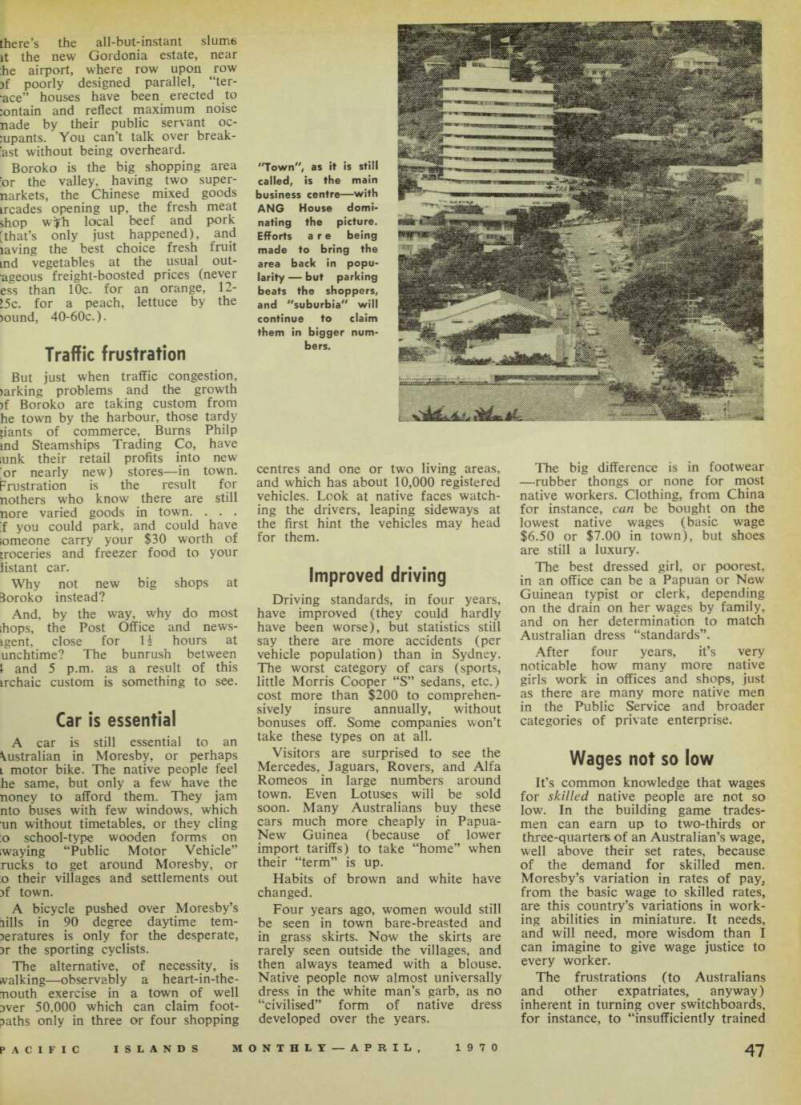
I must mention the port, Fairfax Harbour, beside which the town business “centre” has always been, and which is now more impressive, with ANG House (11 storeys) and the new Overseas Telecommunica tions, Reserve Bank, National Bank and Bums Philp buildings, all with air conditioning—four years ago virtually non-existent in big build ings.
To a lucky few, the harbour is Moresby, to those who see the sun rise and set across it—the villagers of Hanuabada. Porebada and a few
other villages, and the inhabitants of expatriate residences climbing steeply away from the water.
But most Moresby-ites, brown and white, live over 3-Mile Hill, its peak three miles from the Post Office which sits a few yards from the wharves. An irrevocably lumpy bitumen road goes over the hill, jammed with traffic, at 8 and 4 each work day, from the govern ment offices at Konedobu (which are also on the harbour and next to Hanuabada, but they can’t see the water from their offices).
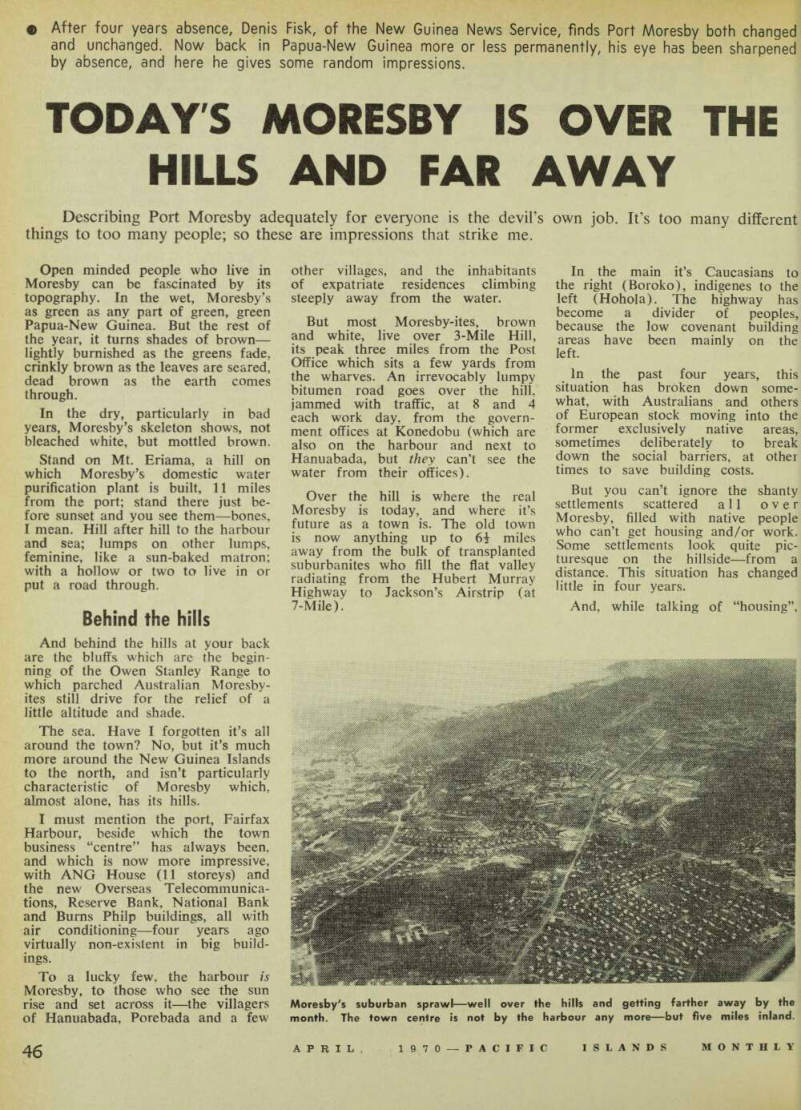
Over the hill is where the real Moresby is today, and where it’s future as a town is. The old town is now anything up to 6i miles away from the bulk of transplanted suburbanites who fill the flat valley radiating from the Hubert Murray Highway to Jackson’s Airstrip (at 7-Mile).
In the main it’s Caucasians to the right (Boroko), indigenes to the left (Hohola). The highway has become a divider of peoples, because the low covenant building areas have been mainly on the left.
In the past four years, this situation has broken down some what, with Australians and others of European stock moving into the former exclusively native areas, sometimes deliberately to break down the social barriers, at other times to save building costs.
But you can’t ignore the shanty settlements scattered all over Moresby, filled with native people who can’t get housing and/or work.
Some settlements look quite pic turesque on the hillside—from a distance. This situation has changed little in four years.
And, while talking of “housing”.
Moresby's suburban sprawl—well over the hills and getting farther away by the month. The town centre is not by the harbour any more —but five miles inland.
there’s the all-but-instant slums it the new Gordonia estate, near he airport, where row upon row if poorly designed parallel, “ter ■ace” houses have been erected to :ontain and reflect maximum noise nade by their public servant oc cupants. You can’t talk over break ?ast without being overheard.
Boroko is the big shopping area ‘or the valley, having two super narkets, the Chinese mixed goods ircades opening up, the fresh meat shop wijth local beef and pork [that’s only just happened), and laving the best choice fresh fruit md vegetables at the usual out ageous freight-boosted prices (never ess than 10c. for an orange, 12- >sc. for a peach, lettuce by the jound, 40-60 c.).
Traffic frustration
But just when traffic congestion, larking problems and the growth if Boroko are taking custom from he town by the harbour, those tardy »iants of commerce, Burns Philp md Steamships Trading Co, have lunk their retail profits into new [or nearly new) stores —in town.
Frustration is the result for nothers who know there are still nore varied goods in town. . . . ;f you could park, and could have lomeone carry your $3O worth of groceries and freezer food to your iistant car.
Why not new big shops at Boroko instead?
And, by the way, why do most ihops, the Post Office and news igent, close for U hours at unchtime? The bunrush between 1 and 5 p.m. as a result of this irchaic custom is something to see.
Car is essential
A car is still essential to an \ustralian in Moresby, or perhaps i motor bike. The native people feel he same, but only a few have the noney to afford them. They jam nto buses with few windows, which un without timetables, or they cling ;o school-type wooden forms on waying “Public Motor Vehicle” rucks to get around Moresby, or o their villages and settlements out >f town.
A bicycle pushed over Moresby’s iills in 90 degree daytime tem- Deratures is only for the desperate, Dr the sporting cyclists.
The alternative, of necessity, is walking—observably a heart-in-the nouth exercise in a town of well aver 50,000 which can claim foot paths only in three or four shopping
centres and one or two living areas, and which has about 10,000 registered vehicles. Look at native faces watch ing the drivers, leaping sideways at the first hint the vehicles may head for them.
Improved driving
Driving standards, in four years, have improved (they could hardly have been worse), but statistics still say there are more accidents (per vehicle population) than in Sydney.
The worst category of cars (sports, little Morris Cooper “S” sedans, etc.) cost more than $2OO to comprehen sively insure annually, without bonuses off. Some companies won’t take these types on at all.
Visitors are surprised to see the Mercedes, Jaguars, Rovers, and Alfa Romeos in large numbers around town. Even Lotuses will be sold soon. Many Australians buy these cars much more cheaply in Papua- New Guinea (because of lower import tariffs) to take “home” when their “term” is up.
Habits of brown and white have changed.
Four years ago, women would still be seen in town bare-breasted and in grass skirts. Now the skirts are rarely seen outside the villages, and then always teamed with a blouse.
Native people now almost universally dress in the white man’s garb, as no “civilised” form of native dress developed over the years.
The big difference is in footwear —rubber thongs or none for most native workers. Clothing, from China for instance, can be bought on the lowest native wages (basic wage $6.50 or $7.00 in town), but shoes are still a luxury.
The best dressed girl, or poorest, in an office can be a Papuan or New Guinean typist or clerk, depending on the drain on her wages by family, and on her determination to match Australian dress “standards”.
After four years, it’s very noticable how many more native girls work in offices and shops, just as there are many more native men in the Public Service and broader categories of private enterprise.
Wages not so low
It’s common knowledge that wages for skilled native people are not so low. In the building game trades men can earn up to two-thirds or three-quarters of an Australian’s wage, well above their set rates, because of the demand for skilled men.
Moresby’s variation in rates of pay, from the basic wage to skilled rates, are this country’s variations in work ing abilities in miniature. It needs, and will need, more wisdom than I can imagine to give wage justice to every worker.
The frustrations (to Australians and other expatriates, anyway) inherent in turning over switchboards, for instance, to “insufficiently trained
"Town", as it is still called, is the main business centre —with ANG House domi nating the picture.
Efforts are being made to bring the area back in popu larity— but parking beats the shoppers, and "suburbia" will continue to claim them in bigger num bers.
Rap id r ise to
indigenes” are being spoken of indulgently, impatiently, or grimly, depending on the speaker’s outlook.
The frustrations will be more ap parent to the native educated elite soon enough.
The same attitudes are there towards the native public servants, getting to the top quite rapidly indeed in some places these days. Many of these “newly arrived” executives seem to feel very strongly the weight of “the white man’s burden” and their responsibility to their own people.
But when the time comes for fewer of the colonial masters to have positions above them, their minds might be set free.
Ela Beach, Moresby’s only main land beach, today is used at times more by the young native people than by Australians. Four years ago, Sundays found the whites largely mixing with themselves at the “fashionable” town end of the beach.
Whether this was because of the social mores of the time, I can only guess. Social mixing by the races was only done in very progressive or official government circles, either because there was little in common between them, or because neither side was interested enough to find whether there was. And, of course, there were the racists.
Beach scandal
A very few Australian youngsters, and a few European older women, were daring to wear two-piece swim ming costumes on the beach, scandal ising many; shorts in public, where natives could gaze on women’s erotic upper leg, were frowned upon; every Australian woman was warned to guard against rape in her home by sexually frustrated natives living away from their villages.
Whether a sample of thigh is still shocking to the native eye or not, those days are largely gone. Bikinis are as brief as you like, and women of junoesque proportions frequently enough shop or stroll in stretch towelling jumpsuits or shorts. Rape isn’t a topic anymore, although all house holders lock up securely against burglars—usually out-of-work native people.
Port Moresby is still keen on sport, although sport doesn’t seem to be emphasised as it once was. Perhaps fewer people I know are active in it or maybe it’s an aftermath of the South Pacific Games being held here.
One of the healthiest and most obvious signs of growing racial har mony in Moresby is the great increase
in inter-marriage between whites, Papuans and New Guineans, Chinese, and mixed race people from past generations.
When the frightful glare of pub licity fell on the young Tolai foot baller, John Kaputin, and his marriage to Australian Christine Lake, in 1961, it was the first between a native man and a white woman. Today the fourth union like this took place in March between Australian Broadcasting Commission journalist, Carolus Ketsimur, 27, from Tinputz on Bougainville, and Tasmanian teacher, Mary O’Loughlin, 28, from Hobart.
There have, of course, over decades been many more between Australian men and local women. No one knows the count today.
But local men don’t capture white women in large numbers, it seems, largely because few of them can afford “the manner to which she has been accustomed” . . . the difference in wages again. Money does count in most marriages when it comes to basic living standards.
Just the same, these on both sides of the colour “line” who are offended at mixed marriages are finding them selves more and more unsupported.
I would not go so far as to say there’s a majority in favour yet, but there’s a very solid minority now which accepts without thinking, or positively is in favour.
The growing Chinese community in Port Moresby (who were moving
out of Rabaul and into other ter ritory towns in large numbers about four or five years ago) is absorbing through marriage a number of Australians too, an event which once was very unpopular.
It could be said that the business community in Port Moresby began to be competitive only with the arrival of Chinese shops and other businesses from 1957 offering an alternative to “Beepees” and “Steamies”. Before that, there was one Chinese shop, the tailoring and haberdashery of Luk Poi Wai (known affectionately to long-term residents as Luke Warm Pie), at Koke, near the native produce market, which these days is cleaner than I remem bered it.
Chinese doing well
From the trade stores selling basic foods and clothing, the Chinese moved into bigger stores selling Japanese electrical goods and Nationalist Chinese imports, and in the four years I’ve been away, into the supermarket and first-class restaurant field.
There’s nothing else like the Mandarin Room in town for atmosphere and service, except the Gateway Hotel, perhaps.
Both share one fault. They serve instant coffee in a place renowned for its high grade locally-grown coffee! But that’s Port Moresby— still a town of mixed cultures and variable standards.
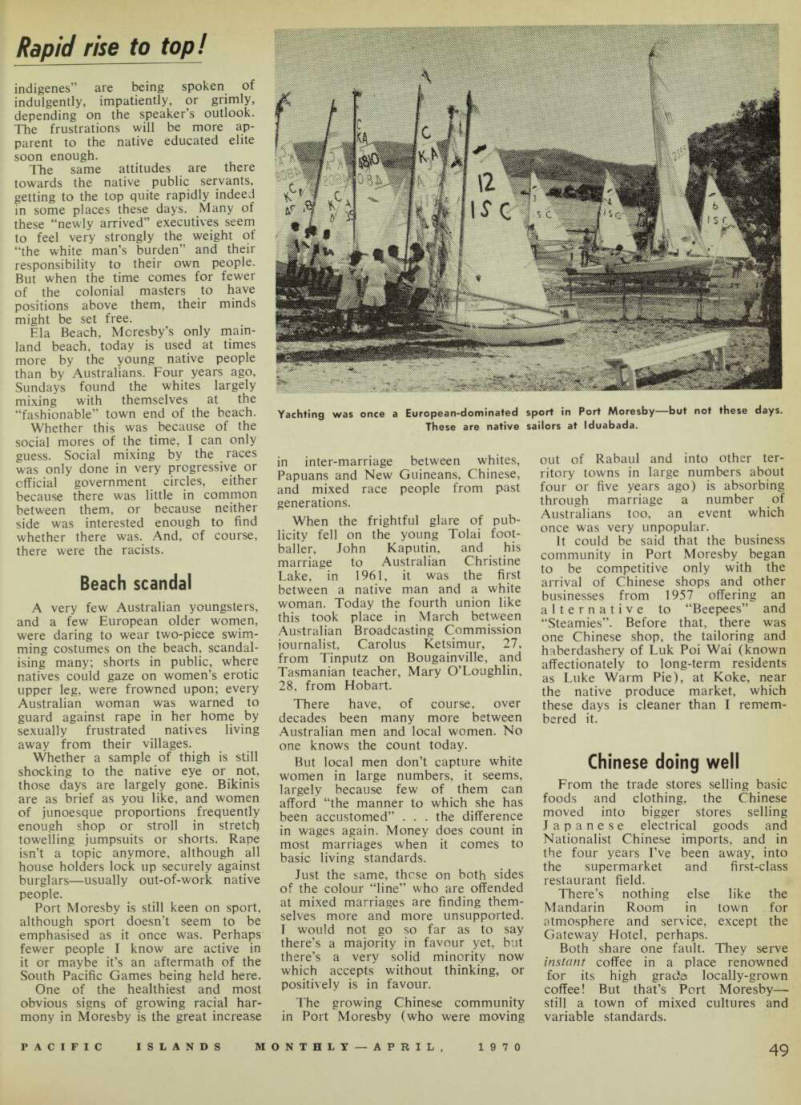
Yachting was once a European-dominated sport in Port Moresby—but not these days.
These are native sailors at Iduabada.