Tropicalities
pp. 38-41 · Read in the full issue
It has all the features of a first class romance— the arrival in Australia of Dr. Helen Wallis and the story of the little idol that stowed away on Captain Cook’s ship and was discovered in the British Museum almost 200 years later.
Dr. Wallis has worked in the British Museum in London since graduating from university and has made a special study of Cook and his achievements. She came to Aus tralia from that hallowed place laden down with six tons of priceless artifacts, originally collected by Cook on his three Pacific voyages.
The artifacts are now housed in the Australian Museum and have gone on show at an exhibition honouring Cook as part of his bi centenary celebrations in Sydney.
Dr. Wallis stayed with the aitifacts all the way from London, followed them off the plane and accompanied them to the museum. There, she let out a sigh of relief, and you could see why when the crates were opened.
Within were 70 of the most highly prized items collected by Cook.
Together with other Cook possessions of the Australian Museum, they form the largest exhibition of Cook relics ever shown, and a fitting display in the bi-centenary year.
Unique helmet
Among the best are a feather gorget from the Society Islands, a unique feather-covered helmet from Hawaii, the earliest recorded wooden shield taken from New South Wales, manuscripts and paintings made on board the Resolution and the Endeavour, and, of course, the little idol. This is the story; Captain Cook was presented, during his second voyage, with the highly revered dress of a chief mourner by the Tahitians. The mourning dress, Dr. Wallis tells us, was strapped to an artist’s easel by the Tahitians, and such was Cook’s regard for native presents that he left it alone until his arrival back in England.
The chief mourning dress, richly decorated with feathers, was taken from the ship and eventually found its way into the archives of the British Museum. Then only three years ago the dress was carefully unfolded by experts for the restcra-
An Idol
That
Stowed
Away
tion work needed after 200 years.
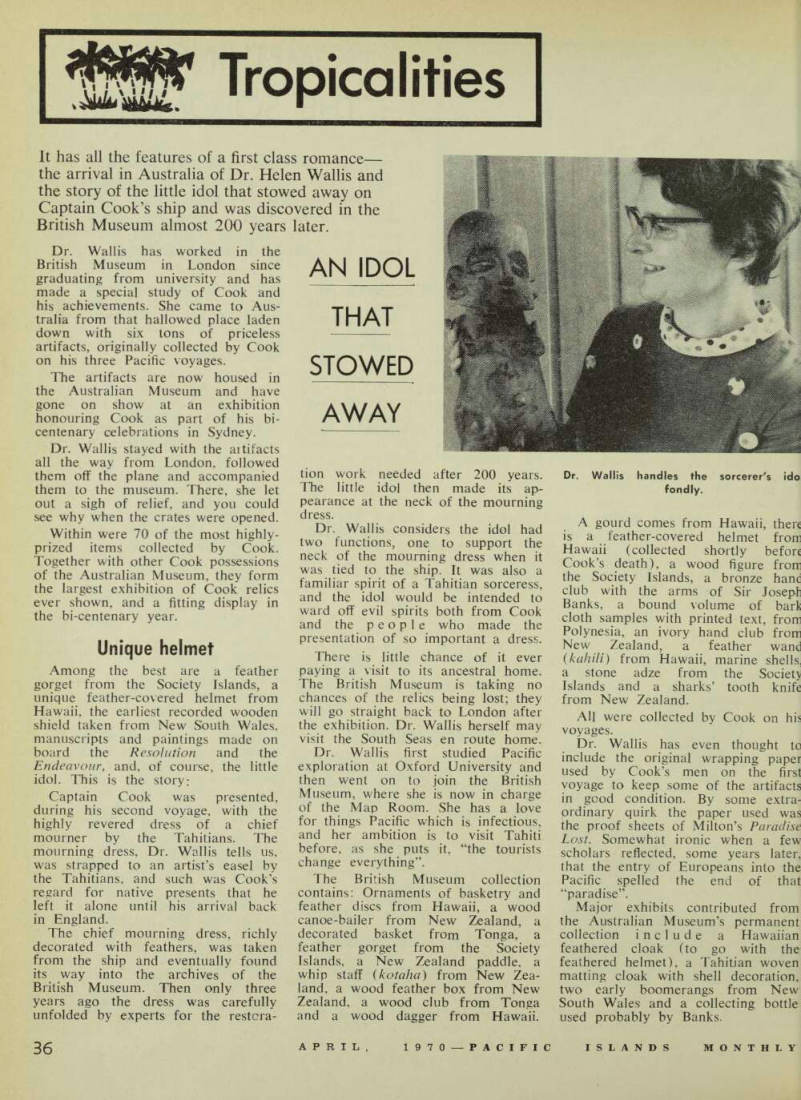
The little idol then made its appearance at the neck of the mourning dress Dr'. Wallis considers the idol had two functions, one to support the neck of the mourning dress when it was tied to the ship. It was also a familiar spirit of a Tahitian sorceress, and the idol would be intended to ward off evil spirits both from Cook and the people who made the presentation of so important a dress.
There is little chance of it ever paying a visit to its ancestral home.
The British Museum is taking no chances of the relics being lost; they will go straight back to London after the exhibition. Dr. Wallis herself may visit the South Seas en route home.
Dr. Wallis first studied Pacific exploration at Oxford University and then went on to join the British Museum, where she is now m charge of the Map Room. She has a love for things Pacific which is infectious, and her ambition is to visit Tahiti before, as she puts it, the tourists change everything .
The British Museum collection contains: Ornaments of basketry and feather discs from Hawaii, a wood canoe-bailer from New Zealand, a decorated basket from Tonga, a feather gorget from the Society Islands, a New Zealand paddle, a whip staff ( kotaha ) from New Zealand, a wood feather box from New Zealand, a wood club from Tonga and a wood dagger from Hawaii.
■ A , fro . m t her£ S ® N ü be , l w° m r , c ,, s^ or i y before
V 8 t rol s
, , -.- cs ’ a bronze hand l u n \T‘‘ h ‘ h °, , of Sir - Jo “Pj “ , boUn l vol Tf , > ,ark ' h T 1 6,? ‘fY’ 1™“ £ e ' y z ’ aland> ry ( kahili ) from Hawaii, marine shells, a stone adze from the Society Islands and a sharks’ tooth knife from New Zealand, AII were col ected by Cook on his voyages Dr . Wallis has even thought to include the original wrapping paper used by Cook . s men on t e F fi F rst voyage to keep some of the artifacts j n g 00( j condition. By some extra ordinary quirk the paper used was the proof sheets of Milton . s Lost. Somewhat ironic when a few scholars reflected, some years later, that the entry of Europeans into the Pacific spelled the end of that “paradise”.
Major exhibits contributed from the Australian Museum’s permanent collection include a Hawaiian feathered cloak (to go with the feathered helmet), a Tahitian woven matting cloak with shell decoration, two early boomerangs from New South Wales and a collecting bottle used probably by Banks.
Dr. Wallis handles the sorcerer's ido[?] fondly.
Agent 007 on the
job in Truk
PIM got a mysterious, anonymous letter last month —this time signed by “Agent 007”. As the rest of it consisted of a clipping from a local newsheet issued in Moen, Truk District, of the US Trust Territory, it’s presumably safe to publish it without raising the same sort of ire in high places as we recently raised in Tahiti.
We quote from the clipping: “The Moen police have arrested Charles P. Miller, an American, and Georgina Molina, a Filipino girl, on a charge of murder in connection with the death of a Mr. Wilhelm, previously of Kwajalein.
“Wilhelm allegedly set out with Miller and Miss Molina from Truk on Miller’s vessel last year. Some time thereafter, Miller’s vessel ran aground on a reef near Ocholuk.
After spending about 40 days on the reef Miss Molina and Miller were rescued by a Navy seaplane. The other passenger did not accompany them into Truk.
“The field trip ship, the Truk Islander, went to where Miller’s vessel had run aground and reported that at that time a body was on the vessel.
“On February 10 a Navy seaplane picked up the body and brought it back into Moen for an autopsy.
According to reliable sources a bullet had been fired into the body.
“Miller and Miss Molina were questioned by a special Navy investi gator at the Legal Office. Reports indicate that the pair refused to answer many of the questions at that time by invoking the Fifth Amend ment.”
Agent 007 has promised to keep us appraised of the progress of the case.
We can hardly wait.
No golf course, so
Cobby built one
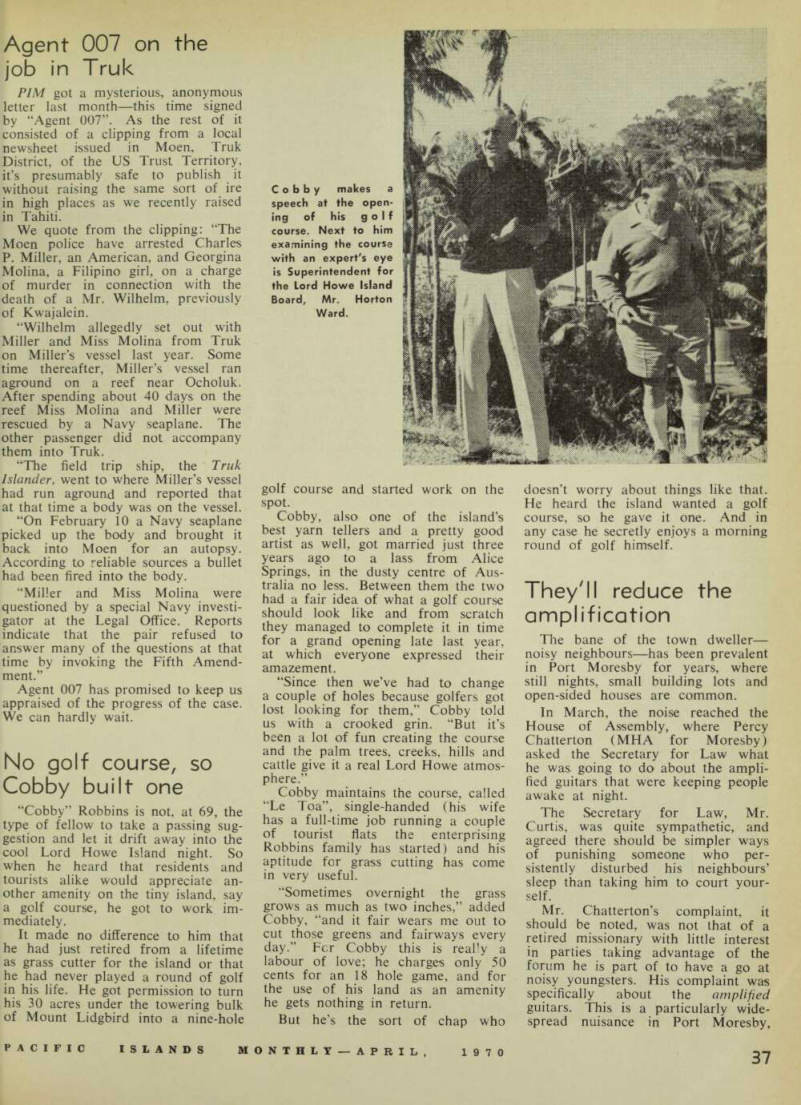
“Cobby” Robbins is not, at 69, the type of fellow to take a passing sug gestion and let it drift away into the cool Lord Howe Island night. So when he heard that residents and tourists alike would appreciate an other amenity on the tiny island, say a golf course, he got to work im mediately.
It made no difference to him that he had just retired from a lifetime as grass cutter for the island or that he had never played a round of golf in his life. He got permission to turn his 30 acres under the towering bulk of Mount Lidgbird into a nine-hole
golf course and started work on the spot.
Cobby, also one of the island’s best yarn tellers and a pretty good artist as well, got married just three years ago to a lass from Alice Springs, in the dusty centre of Aus tralia no less. Between them the two had a fair idea of what a golf course should look like and from scratch they managed to complete it in time for a grand opening late last year. at which everyone expressed their amazement.
“Since then we’ve had to change a couple of holes because golfers got lost looking for them,” Cobby told us with a crooked grin. “But it’s been a lot of fun creating the course and the palm trees, creeks, hills and cattle give it a real Lord Howe atmosphere.”
Cobby maintains the course, called " Le T °a” single-handed (his wife has a full-time job running a couple RnhhiTfl i® n T, Ti P 2T g Robbins family has started) and his aptitude for grass cutting has come in useful - ‘ Sometimes overnight the grass grows much as two inches,” added Cobby, ‘ and it fair wears me out to cut those greens and fairways every day. For Cobby this is reahy a labour of love; he charges only 50 cents for an 18 hole game, and for the use of his land as an amenity he gets nothing m return.
But he’s the sort of chap who
doesn’t worry about things like that, He heard the island wanted a golf course, so he gave it one. And in any case he secretly enjoys a morning round of golf himself, Tho\/ll rorli i res fho i Icy 11 icUULt; trie
QmplifiCQtion
The bane of the town dweller— noisy neighbours—has been prevalent in Port Moresby for years, where still nights, small building lots and open-sided houses are common, in March, the noise reached the House of Assembly, where Percy Chatterton (MHA for Moresby) asked the Secretary for Law what he was going to do about the ampli fied guitars that were keeping people awake at night The for LaWj Mr , Curti was ite sympathetic , and a B reed ‘here should be simpler ways 0 f punishing someone £ ho sisten P tl dis f urbed his neighbours’ sleep than taking him to court your self.
M r . Chatterton’s complaint, it sho uld be noted, was not that of a retire d missionary with little interest i n parties taking advantage of the f oru m he is part of to have a go at noisy youngsters. His complaint was specifically about the amplified guitars. This is a particularly wide spread nuisance in Port Moresby,
Cobby makes a speech at the open ing of his golf course. Next to him examining the course with an expert's eye is Superintendent for the Lord Howe Island Board, Mr. Horton Ward.
where the amplified version of the South Pacific’s adopted instrument is taking over rapidly.
String bands, formed all over Papua-New Guinea during the past decade to perform old and new songs with a local sound, are being drowned by the wash of electrified sounds from copies of Australian, American and British pop groups. Judging by the number of groups and individuals who practise not only their amplified guitars but amplified voices also until dawn, their numbers are growing.
As Mr. Curtis explained, the law at present is that a “nuisance” is caused if the noise interferes with comfort or health, or affects the en joyment of property so as to lower its value. Which leaves the owner or lessee having to sue through one of the courts, if he is personally affected.
If the noise is persistent so it affects public safety or health, the noise-maker may be guilty of causing a “common nuisance”, and can be gaoled for up to two years. But a lot of people have to be affected be fore this one is any good, and it’s a Supreme Court action—very expen sive if it fails.
Mr. Curtis told Mr. Chatterton that within a few months he hoped to make “common nuisance” a summary offence on which the police could act and bring offenders before the lower courts.
He said he wasn’t crushing the party spirit—occasional late parties would not get their throwers into trouble with the law. As he put it, “I think late parties must be accepted as a fact of life, especially in Pert Moresby”.
Paying $lO a day to
see the real Fiji
Sydney-based Major Warwick Deacock, promoter of tours to places like Mount Everest, the New Guinea Highlands and Portuguese Timor, has set his sights on the mountainous hinterland of Fiji’s Viti Levu.
After undertaking a 60-mile, five day trek through the Nadarivatu Highlands in February, through lush jungle, spectacular valleys, rushing rivers, caves and old village sites, he’s convinced that his kind of client — “the one who seeks off-beat holidays and who has a liking for the out doors and, of course, people”—will be equally enthused about Fiji safaris.
The safaris are the brainchild of Manasa Sauturaga, a hard-working Fijian who has been trying to get them off the ground for almost two years. Although he has his own Suva travel agency, Senirosi Travel (the first to be run by a Fijian), Manasa hasn’t had the money to spend on advertising. So he’s had to watch the tourist boom somewhat from the sidelines.
Now, however, Manasa has high hopes.
Major Deacock said he found Fiji
an exciting country—and the trip itself a “very human experience”, undoubtedly because of the genuine interest the remotely-placed villagers showed in their visitors.
“The trek has been so cleverly worked out that at practically every meal stop you make, you are at a settlement. And eating Fijian food is part of the adventure,” he said.
“For me, there was great satisfaction in seeing this unspoiled country—it slightly resembles the New Guinea highlands and the rolling hills of England.”
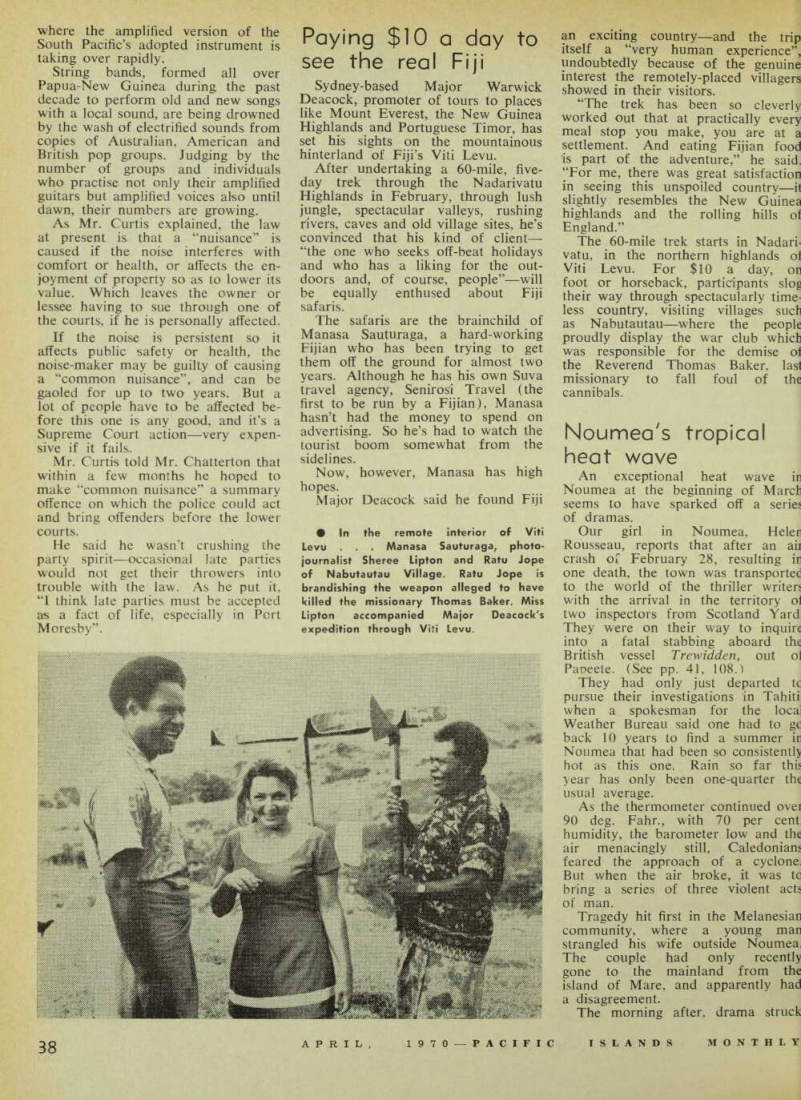
The 60-mile trek starts in Nadari vatu, in the northern highlands of Viti Levu. For $lO a day, on foot or horseback, participants slog their way through spectacularly time less country, visiting villages such as Nabutautau—where the people proudly display the war club which was responsible for the demise of the Reverend Thomas Baker, last missionary to fall foul of the cannibals.
Noumea's tropical
heat wave
An exceptional heat wave in Noumea at the beginning of March seems to have sparked off a series of dramas.
Our girl in Noumea, Helen Rousseau, reports that after an ah crash of February 28, resulting in one death, the town was transported to the world of the thriller writers with the arrival in the territory ol two inspectors from Scotland Yard They were on their way to inquire into a fatal stabbing aboard the British vessel Trewidden, out oi Papeete. (See pp. 41, 108.1 They had only just departed tc pursue their investigations in Tahiti when a spokesman for the loca] Weather Bureau said one had to gc back 10 years to find a summer in Noumea that had been so consistently hot as this one. Rain so far this year has only been one-quarter the usual average.
As the thermometer continued over 90 deg. Fahr., with 70 per cent, humidity, the barometer low and the air menacingly still, Caledonians feared the approach of a cyclone.
But when the air broke, it was to bring a series of three violent acts of man.
Tragedy hit first in the Melanesian community, where a young man strangled his wife outside Noumea.
The couple had only recently gone to the mainland from the island of Mare, and apparently had a disagreement.
The morning after, drama struck
• In the remote interior of Viti Levu . . . Manasa Sauturaga, photo journalist Sheree Upton and Ratu Jope of Nabutautau Village. Ratu Jope is brandishing the weapon alleged to have killed the missionary Thomas Baker. Miss Lipton accompanied Major Deacock's expedition through Viti Levu.
the Army. Two young national servicemen were killed during a shooting exercise south of Noumea, when a mortar shell exploded pre maturely.
As if this wasn’t enough in the usually quiet town, that same even ing, March 11, there was a car chase and shooting in the middle of Noumea.
“Was it a movie episode, or a joke?” La France Australe inquired.
“No-one seemed to show any surprise on witnessing this rodeo, which was actually a ‘settling of accounts’ be tween two men.”
This third drama was over a woman, and ended with an Alfa Romeo pursuing a Morris through the heart of town until the pursuer in the Alfa Romeo fired three revolver shots at his rival in the Morris. All this just near the police station.
The victim, a Customs agent, was reported in hospital with three shot wounds. The assailant and his driver, perpetrator of the so-called “punitive expedition”, were in custody.
While Noumea’s two main news papers began to report improved sales, the local inhabitants were nevertheless relieved as the thermo meter began to drop, and frayed nerves were soothed by the return of the regular “Alize” sea breeze.
Nauru's white
elephant just sits
There has still been no mention of plans on Nauru, government or private, on the future of the hotel abandoned before completion when
Pacific Sporting Pools Ltd. and Central Pacific Hotels Ltd., were wound up in October last year.
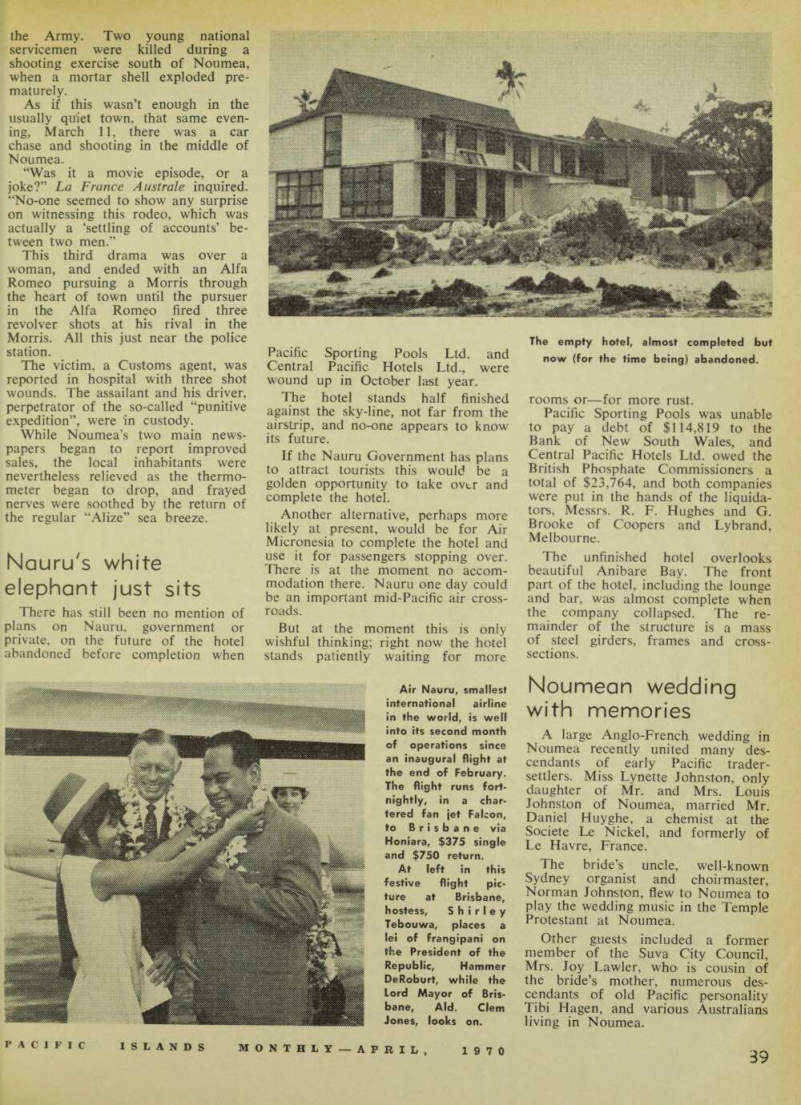
The hotel stands half finished against the sky-line, not far from the airstrip, and no-one appears to know its future.
If the Nauru Government has plans to attract tourists this would be a golden opportunity to take ovtr and complete the hotel.
Another alternative, perhaps more likely at present, would be for Air Micronesia to complete the hotel and use it for passengers stopping over.
There is at the moment no accom modation there. Nauru one day could be an important mid-Pacific air cross roads.
But at the moment this is only wishful thinking; right now the hotel stands patiently waiting for more
rooms or—for more rust.
Pacific Sporting Pools was unable to pay a debt of $114,819 to the Bank of New South Wales, and Central Pacific Hotels Ltd. owed the British Phosphate Commissioners a total of $23,764, and both companies were put in the hands of the liquida tors, Messrs. R. F. Hughes and G.
Brooke of Coopers and Lybrand, Melbourne.
The unfinished hotel overlooks beautiful Anibare Bay. The front part of the hotel, including the lounge and bar, was almost complete when the company collapsed. The re mainder of the structure is a mass of steel girders, frames and cross sections,
Noumean wedding
with memories
A large Anglo-French wedding in Noumea recently united many des cendants of early Pacific trader settlers. Miss Lynette Johnston, only daughter of Mr. and Mrs. Louis Johnston of Noumea, married Mr.
Daniel Huyghe, a chemist at the Societe Le Nickel, and formerly of Le Havre, France.
The bride’s uncle, well-known Sydney organist and choirmaster, Norman Johnston, flew to Noumea to play the wedding music in the Temple Protestant at Noumea.
Other guests included a former member of the Suva City Council, Mrs. Joy Lawler, who is cousin of the bride’s mother, numerous des cendants of old Pacific personality Tibi Hagen, and various Australians living in Noumea.
Air Nauru, smallest international airline in the world, is well into its second month of operations since an inaugural flight at the end of February.
The flight runs fort nightly, in a char tered fan jet Falcon, to Brisbane via Honiara, $375 single and $750 return.
At left in this festive flight pic ture at Brisbane,
hostess, Shirley
Tebouwa, places a lei of frangipani on the President of the Republic, Hammer DeRoburt, while the Lord Mayor of Bris bane, Aid. Clem Jones, looks on.
The empty hotel, almost completed but now (for the time being) abandoned.