Something For
p. 37 · Read in the full issue
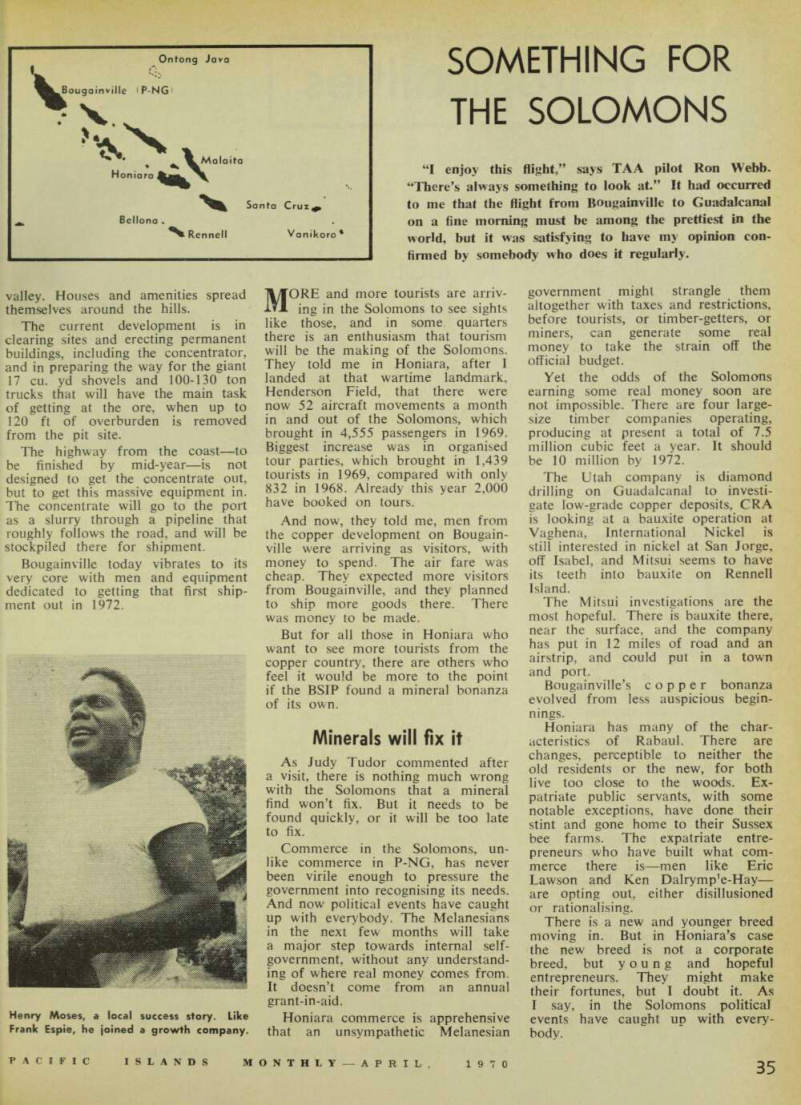
The Solomons
“I enjoy this flight/’ says TAA pilot Ron Webb.
“There’s always something to look at.” It had occurred to me that the flight from Bougainville to Guadalcanal on a fine morning must be among the prettiest in the world, but it was satisfying to have my opinion con firmed by somebody who does it regularly.
MORE and more tourists are arriv ing in the Solomons to see sights like those, and in some quarters there is an enthusiasm that tourism will be the making of the Solomons.
They told me in Honiara, after I landed at that wartime landmark, Henderson Field, that there were now 52 aircraft movements a month in and out of the Solomons, which brought in 4,555 passengers in 1969.
Biggest increase was in organised tour parties, which brought in 1,439 tourists in 1969, compared with only 832 in 1968. Already this year 2,000 have booked on tours.
And now, they told me, men from the copper development on Bougain ville were arriving as visitors, with money to spend. The air fare was cheap. They expected more visitors from Bougainville, and they planned to ship more goods there. There was money to be made.
But for all those in Honiara who want to see more tourists from the copper country, there are others who feel it would be more to the point if the BSIP found a mineral bonanza of its own.
Minerals will fix it
As Judy Tudor commented after a visit, there is nothing much wrong with the Solomons that a mineral find won’t fix. But it needs to be found quickly, or it will be too late to fix.
Commerce in the Solomons, un like commerce in P-NG, has never been virile enough to pressure the government into recognising its needs.
And now political events have caught up with everybody. The Melanesians in the next few months will take a major step towards internal self government, without any understand ing of where real money comes from.
It doesn’t come from an annual grant-in-aid.
Honiara commerce is apprehensive that an unsympathetic Melanesian
government might strangle them altogether with taxes and restrictions, before tourists, or timber-getters, or miners, can generate some real money to take the strain off the official budget.
Yet the odds of the Solomons earning some real money soon are not impossible. There are four large size timber companies operating, producing at present a total of 7.5 million cubic feet a year. It should be 10 million by 1972.
The Utah company is diamond drilling on Guadalcanal to investi gate low-grade copper deposits, CRA is looking at a bauxite operation at Vaghena, International Nickel is still interested in nickel at San Jorge, off Isabel, and Mitsui seems to have its teeth into bauxite on Rennell Island.
The Mitsui investigations are the most hopeful. There is bauxite there, near the surface, and the company has put in 12 miles of road and an airstrip, and could put in a town and port.
Bougainville’s copper bonanza evolved from less auspicious begin nings.
Honiara has many of the char acteristics of Rabaul. There are changes, perceptible to neither the old residents or the new, for both live too close to the woods. Ex patriate public servants, with some notable exceptions, have done their stint and gone home to their Sussex bee farms. The expatriate entre preneurs who have built what com merce there is—men like Eric Lawson and Ken Dalrymp’e-Hay— are opting out, either disillusioned or rationalising.
There is a new and younger breed moving in. But in Honiara’s case the new breed is not a corporate breed, but young and hopeful entrepreneurs. They might make their fortunes, but I doubt it. As I say, in the Solomons political events have caught up with every body.