Mountains That Vibrate
pp. 33-37 · Read in the full issue
To Their Very Core
On previous flights from Rabaul, down the island chain to Kieta, on the east coast of Bougainville, I felt I was leaving a metropolis for a sleepy, charming island backwater where I could relax. This time I knew it would be different.
Even the gateway to Bougainville, the airstrip at Buka, was humming with earth-moving machinery that would lengthen and strengthen it to take the big increase in air traffic that has followed Conzinc Riotinto’s vast copper development in the mountains behind Kieta. Ansett Airlines had finally to be given rights to fly into Bougainville, for TAA couldn’t handle the upsurge in business.
Half-a-dozen natives, the inevitable airline bags over their shoulders, climbed aboard the aircraft, headed for Kieta, where the big money is.
Some of them may have left plantations, which today in Bougainville can’t keep labour in competition with better conditions and pay in the
copper area. District Commissioner Des Ashton already fears a squatter problem, similar to Port Moresby’s.
Aropa airstrip, a few miles south of Kieta and the closest you can get by conventional aircraft to the copper project, was a sea of mud and bulldozers when our DC3 landed in a tropical downpour. Soon even a DC3 will be too big to land at Aropa, as the dozers make their final attack on the strip, to bring it to Fokker standard. A Fokker a day will then come in direct from Moresby.
I didn’t recognise the road from the airstrip to Kieta. Three years ago, when I was last here, it was a wheel track. Now, bridges are being widened or replaced, new
grades have been found. Ten years ago there was not a single bulldozer on the whole of Bougainville; now equipment jams the new roads, and 60 new motor vehicles of all kinds are being registered every month, We passed by a new Administra tion town, temporarily named St.
Michael’s, with houses rising from the scrub. This is Kieta’s first suburb, for it will eventually link with the old town.
Further towards Kieta, the over seas w harf, hardly completed, is already inadequate. Burns Philp’s Islands trader, Tulagi, whose arrival was once an event, is not seen these days—but ships come in from all compass points and compete for berths. Although there is no wharf
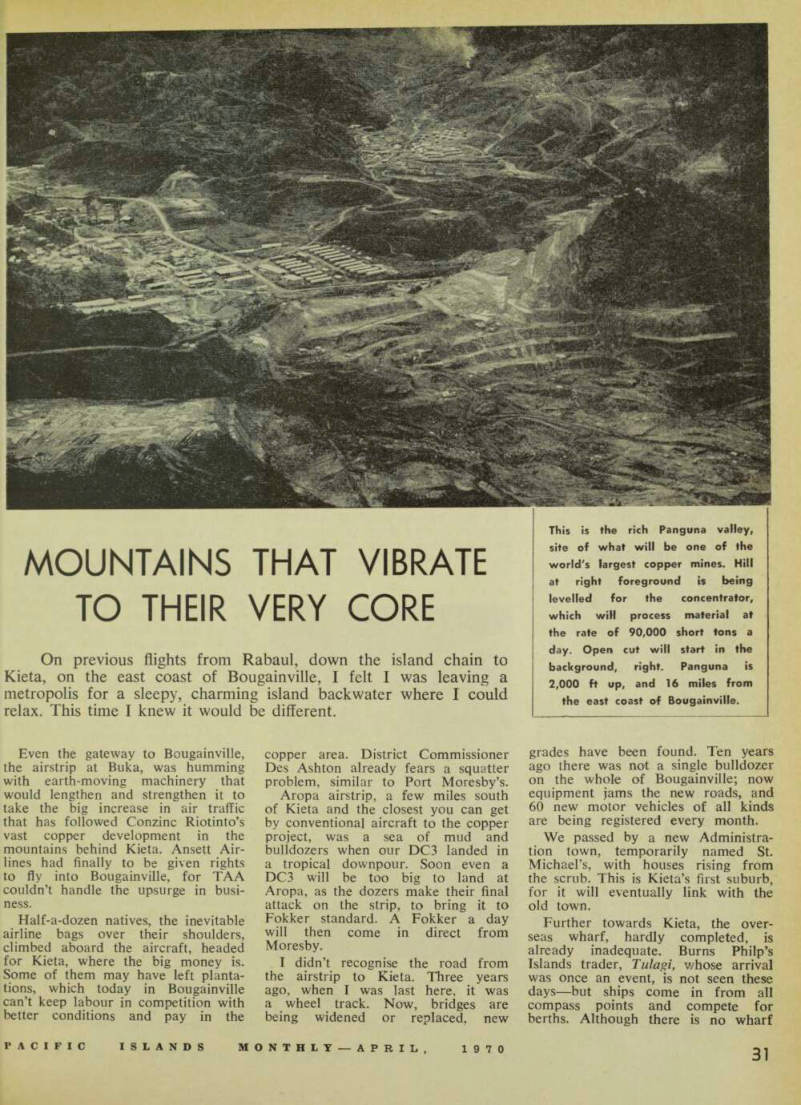
This is the rich Panguna valley, site of what will be one of the world's largest copper mines. Hill at right foreground is being levelled for the concentrator, which will process material at the rate of 90,000 short tons a day. Open cut will start in the background, right. Panguna is 2,000 ft up, and 16 miles from the east coast of Bougainville.
yet at Anewa Bay, site of the new copper port north of Kieta, CRA ships unload supplies on the beach there to avoid the congestion.
Kieta was not merely congested when we drove in—the pretty town was a shambles. Several months of wet weather —the worst stretch in 10 years—had made it a sea of mud, and construction gangs were adding to the morass. A bulldozer driver the previous day had ploughed up the telephone cables three times, adding to the air of harassment that now hangs over Kieta.
"Frontier town"
“We’re suddenly a frontier town,” said Mrs. Greg. Wall, of Island Casuals, planned as Bougainville’s first women’s fashion shop. But on this new frontier her biggest demand is for quality work clothes for men.
Opposite her shop, which she can’t extend until she can coax a carpenter from somewhere, Burns Philp is quickly erecting a store—perhaps a sure sign that the frontier will widen into permanent prosperity.
The big bar at the Hotel Kieta is crowded with men from the mine, and from the big construction and transport contractors whose know how is developing this remote stretch of New Guinea. They can get a drink at their own messes, but they want a change of scene.
The hotel has been over the plimsoll with travellers for months, the humid dining-room is virtually standing-room-only, and manager Si O’Donnell like a cat on hot bricks as he waits for the first stage of $BOO,OOO worth of extensions (final total, three wings, 80 self-contained units) to be finished in a few weeks.
“The day we can put a bulldozer through this building I’ll bung on two 18-gallon kegs to celebrate,” he says. His guests, sharing two to a room, endorse his impatience.
In town, everything you want to buy is either sold out or not yet arrived.
Almost 4,000 men, scattered in workers’ camps in an arc around Kieta, have brought this boom to the backwater township. They have nowhere else to go—and they won’t go anywhere else until they build the mining plant and housing at Panguna, the port at Anewa, the two new towns at Arawa and St. Michael’s, and the roads that link them. And then they will go home, to Australia, America, or the New Guinea main land, and their places will be taken by the permanent staff who will man the mine and the port and
live in the new towns, and by the shopkeepers and public servants who will service them.
There will be 7,000 construction workers at the peak, this year and next —less than half of them New Guineans. The total will drop to 3,500 by 1973—but that figure will already have been matched by the permanent staff and their families living in only one of the new towns —Arawa. Arawa, a few miles out of Kieta, will have 8,500 people within the next five years as the real busi ness of treating 900 million tons of ore over the next 30 years gets into giant stride.
Meanwhile, Kieta is the reluctant, confused midwife to one of the world’s largest copper mines.
The frontier conditions have not so far brought an increase in crime to Kieta. “The men are all working too hard,” says Inspector John Ring, in charge of the Bougainville police district.
Bonanza
Everybody shares in the develop ment bonanza; most of the earlier native opposition to the project has dispersed with growing prosperity.
At nearby Kobuan, coastal depot for the mine, six drivers and four other men for five days each week spend an average of $l,OOO a day in silver pieces, buying fruit and vegetables in the villages. Record day’s silver outlay was $1,400. The famous Buin basketware, made further south, is bought up as soon as it is woven.
Locals say they have seen CRA helicopters leaving Buin with baskets lashed to their undersides.
You need permission from Bougainville Copper Pty., CRA’s operating company for the project, to visit the mine site at Panguna, in the Crown Prince Range. And preferably a four-wheel drive vehicle and a driver-guide.
BCP managing director, Frank Espie, who happened to be “up the hill” on his 36th visit in four years, sent down permission, and lan Williams and Frank Nicholson, at Kobuan, supplied the Toyota. Three years earlier I had set out from Kobuan by helicopter, for the 16 mile road then was still being pushed over the ranges. Cloud at 3,500 ft had forced us back.
Now it was dusk, and raining steadily, as 1 set off more hopefully.
We ploughed our way along the
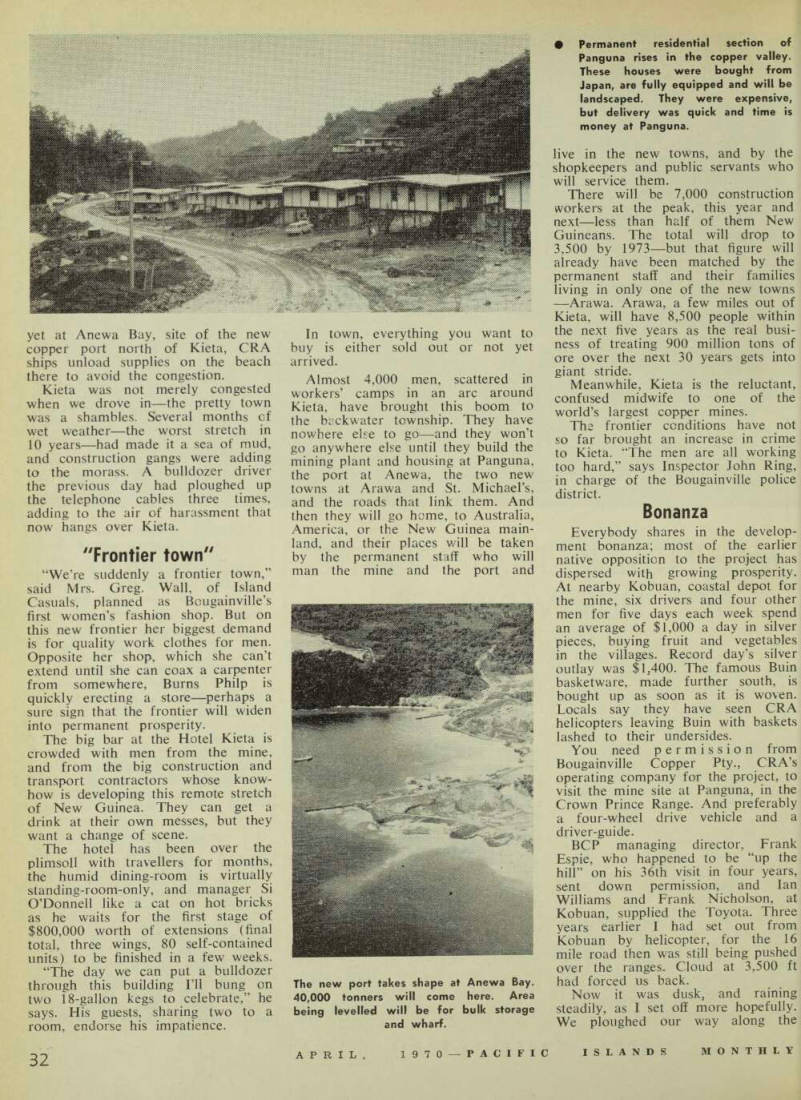
• Permanent residential section of Panguna rises in the copper valley.
These houses were bought from Japan, are fully equipped and will be landscaped. They were expensive, but delivery was quick and time is money at Panguna.
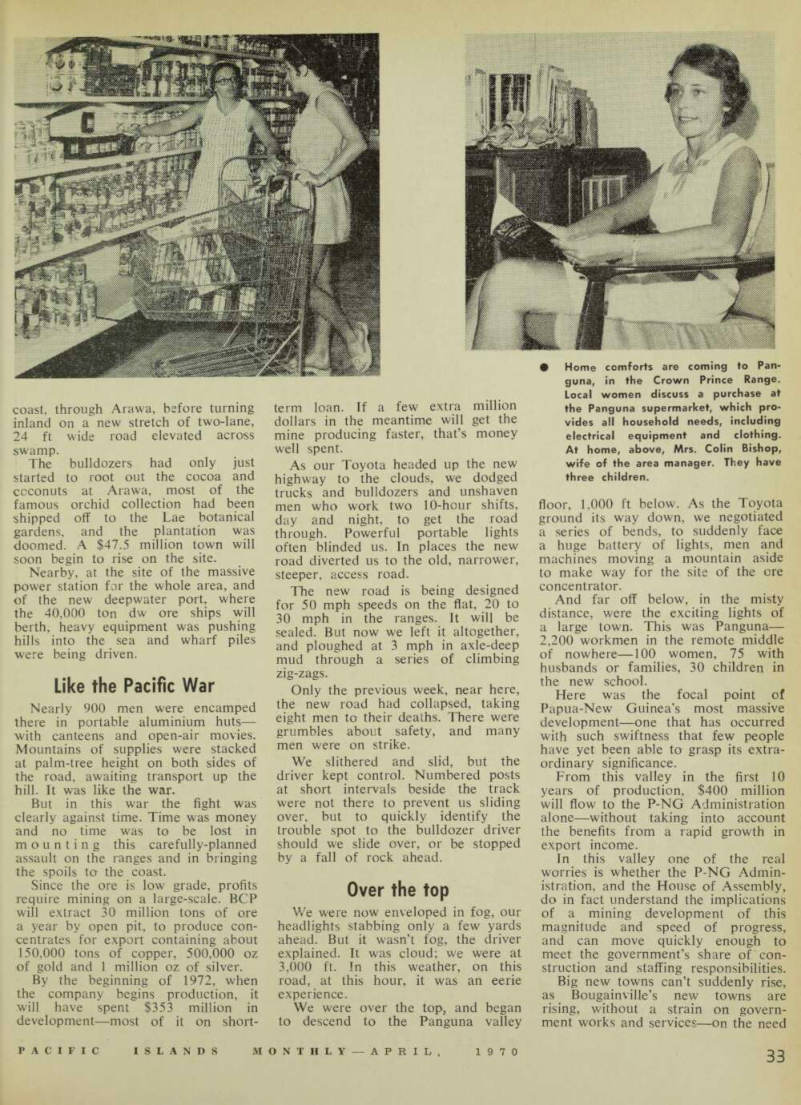
The new port takes shape at Anewa Bay. 40,000 tonners will come here. Area being levelled will be for bulk storage and wharf.
coast, through Arawa, before turning inland on a new stretch of two-lane, 24 ft wide road elevated across swamp.
The bulldozers had only just started to root out the cocoa and ccconuts at Arawa, most of the famous orchid collection had been shipped off to the Lae botanical gardens, and the plantation was doomed. A $47.5 million town will soon begin to rise on the site.
Nearby, at the site of the massive power station for the whole area and «f th ® " e * deep ,T ater por ‘: whe r.® the 40,000 ton dw ore ships will berth, heavy equipment was pushing hills into the sea and wharf piles were being driven.
like the Pacific War
Nearly 900 men were encamped there in portable aluminium huts — with canteens and open-air movies.
Mountains of supplies were stacked at palm-tree height on both sides of the road, awaiting transport up the hill. It was like the war.
But in this war the fight was clearly against time. Time was money and no time was to be lost in mounting this carefully-planned assault on the ranges and in bringing the spoils to the coast.
Since the ore is low grade, profits require mining on a large-scale. BCP will extract 30 million tons of ore a year by open pit, to produce concentrates for export containing about 150,000 tons of copper, 500,000 oz of gold and 1 million oz of silver.
By the beginning of 1972, when the company begins production, it will have spent $353 million in development— most of it on short-
term loan. If a few extra million dollars in the meantime will get the mine producing faster, that’s money well spent.
As our Toyota headed up the new highway to the clouds, we dodged trucks and bulldozers and unshaven men w ho work two 10-hour shifts, day and night, to get the road through. Powerful portable lights o f te n blinded us. In places the new road diverted us to the old, narrower, steeper, access road, The new road is being des i gn ed for 50 mph speeds on the flat, 20 to 30 h F in (he ranges . It wi u be Bu , now we kft it altogether, and ploughed at 3 mph in axle-deep mud though a se ries of climbing Only the previous week, near here, new road had collapsed, taking eight men to their deaths. There were grumbles about safety, and many men were on strike, We slithered and slid, but the driver kept control. Numbered posts at short intervals beside the track were not there to prevent us sliding over, but to quickly identify the trouble spot to the bulldozer driver should we slide over, or be stopped by a fall of rock ahead,
thp ton
UVCI mc We were now enveloped in fog, our headlights stabbing only a few yards ahead. But it wasn’t fog, the driver explained. It was cloud; we were at 3,000 ft. In this weather, on this road, at this hour, it was an eerie experience.
We were over the top, and began to descend to the Panguna valley
floor, 1,000 ft below. As the Toyota ground its way down, we negotiated a series of bends, to suddenly face a huge battery of lights, men and machines moving a mountain aside to make way for the site of the ore concentrator.
And far off below, in the misty distance, were the exciting lights of a large town. This was Panguna— -2,200 workmen in the remote middle of nowhere—loo women, 75 with husbands or families, 30 children in the new school.
Here was the focal point of Papua-New Guinea’s most massive development—one that has occurred with such swiftness that few people have yet been able to grasp its extra ordinary significance.
From this valley in the first 10 years of production, $4OO million will flow to the P-NG Administration alone—without taking into account the benefits from a rapid growth in export income.
In this valley one of the real worries is whether the P-NG Admin istration, and the House of Assembly, do in fact understand the implications of a mining development of this magnitude and speed of progress, and can move quickly enough to meet the government’s share of con struction and staffing responsibilities.
Big new towns can’t suddenly rise, as Bougainville’s new towns are rising, without a strain on govern ment works and services—on the need
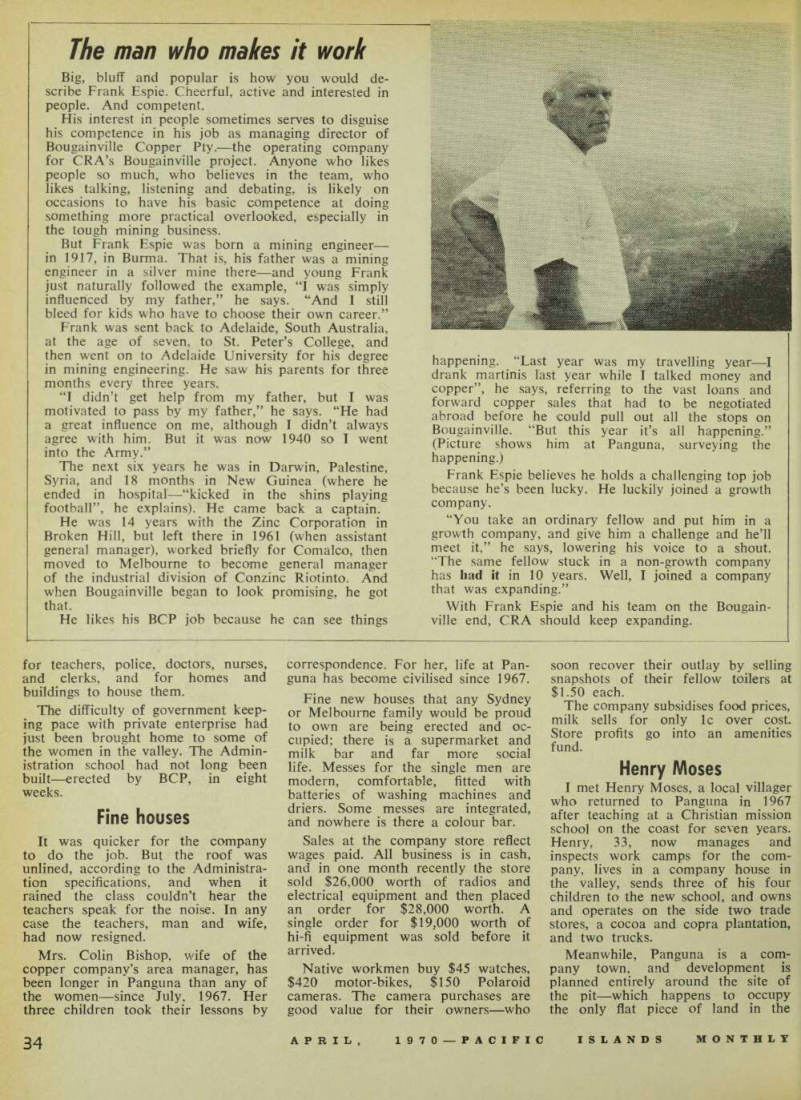
• Home comforts are coming to Pan guna, in the Crown Prince Range.
Local women discuss a purchase at the Panguna supermarket, which pro vides all household needs, including electrical equipment and clothing.
At home, above, Mrs. Colin Bishop, wife of the area manager. They have three children.
for teachers, police, doctors, nurses, and clerks, and for homes and buildings to house them.
The difficulty of government keep ing pace with private enterprise had just been brought home to some of the women in the valley. The Admin istration school had not long been built—erected by BCP, in eight weeks.
Fine houses
It was quicker for the company to do the job. But the roof was unlined, according to the Administra tion specifications, and when it rained the class couldn’t hear the teachers speak for the noise. In any case the teachers, man and wife, had now resigned.
Mrs. Colin Bishop, wife of the copper company’s area manager, has been longer in Panguna than any of the women—since July, 1967. Her three children took their lessons by
correspondence. For her, life at Pan guna has become civilised since 1967.
Fine new houses that any Sydney or Melbourne family would be proud to own are being erected and oc cupied; there is a supermarket and milk bar and far more social life. Messes for the single men are modern, comfortable, fitted with batteries of washing machines and driers. Some messes are integrated, and nowhere is there a colour bar.
Sales at the company store reflect wages paid. All business is in cash, and in one month recently the store sold $26,000 worth of radios and electrical equipment and then placed an order for $28,000 worth. A single order for $19,000 worth of hi-fi equipment was sold before it arrived.
Native workmen buy $45 watches, $420 motor-bikes, $l5O Polaroid cameras. The camera purchases are good value for their owners —who
soon recover their outlay by selling snapshots of their fellow toilers at $1.50 each.
The company subsidises food prices, milk sells for only 1c over cost Store profits go into an amenities fund.
Henry Moses
I met Henry Moses, a local villager who returned to Panguna in 1967 after teaching at a Christian mission school on the coast for seven years.
Henry, 33, now manages and inspects work camps for the com pany, lives in a company house in the valley, sends three of his four children to the new school, and owns and operates on the side two trade stores, a cocoa and copra plantation, and two trucks.
Meanwhile, Panguna is a com pany town, and development is planned entirely around the site of the pit—which happens to occupy the only flat piece of land in the
valley. Houses and amenities spread themselves around the hills.
The current development is in clearing sites and erecting permanent buildings, including the concentrator, and in preparing the way for the giant 17 cu. yd shovels and 100-130 ton trucks that will have the main task of getting at the ore, when up to 120 ft of overburden is removed from the pit site.
The highway from the coast—to be finished by mid-year—is not designed to get the concentrate out, but to get this massive equipment in.
The concentrate will go to the port as a slurry through a pipeline that roughly follows the road, and will be stockpiled there for shipment.
Bougainville today vibrates to its very core with men and equipment dedicated to getting that first ship ment out in 1972.
Henry Moses, a local success story. Like Frank Espie, he joined a growth company.