Rabaul Gloomily Surveys The
p. 32 · Read in the full issue
Prosperity Of Bougainville
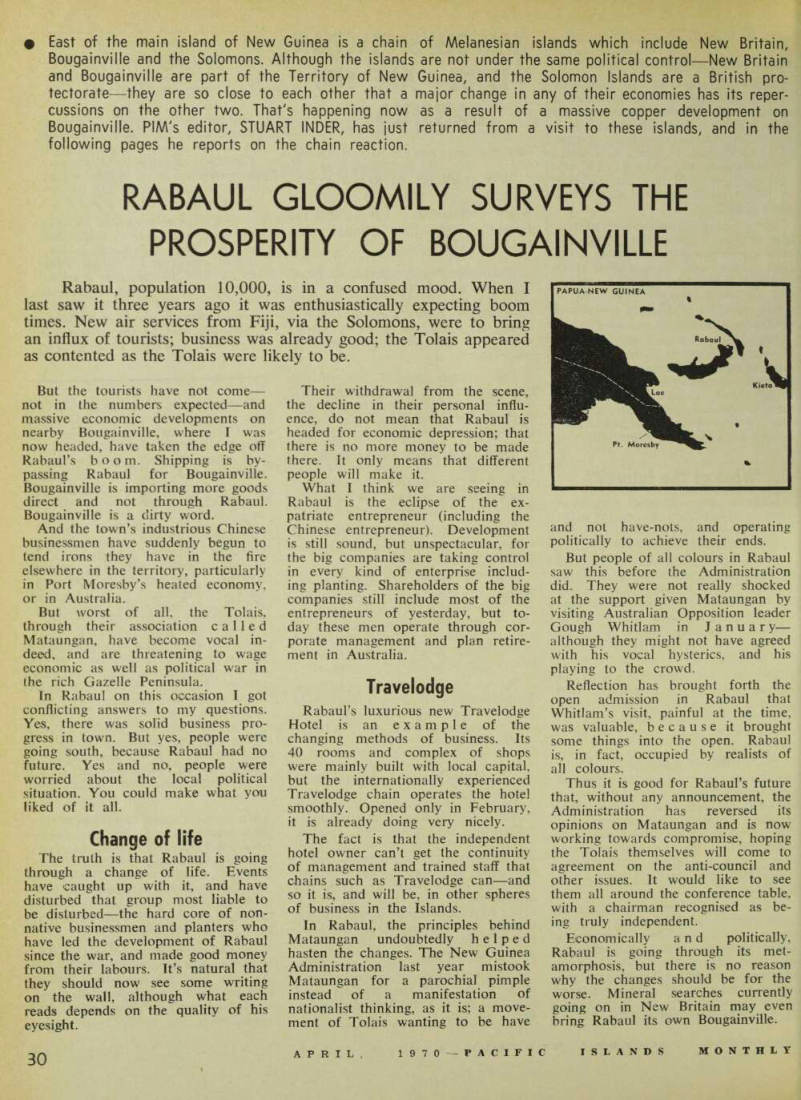
• East of the main island of New Guinea is a chain of Melanesian islands which include New Britain, Bougainville and the Solomons. Although the islands are not under the same political control—New Britain and Bougainville are part of the Territory of New Guinea, and the Solomon Islands are a British pro tectorate —they are so close to each other that a major change in any of their economies has its reper cussions on the other two. That's happening now as a result of a massive copper development on Bougainville. PlM's editor, STUART INDER, has just returned from a visit to these islands, and in the following pages he reports on the chain reaction.
Rabaul, population 10,000, is in a confused mood. When I last saw it three years ago it was enthusiastically expecting boom times. New air services from Fiji, via the Solomons, were to bring an influx of tourists; business was already good; the Tolais appeared as contented as the Tolais were likely to be.
But the tourists have not come— not in the numbers expected—and massive economic developments on nearby Bougainville, where I was now headed, have taken the edge off Rabaul’s boom. Shipping is bypassing Rabaul for Bougainville.
Bougainville is importing more goods direct and not through Rabaul.
Bougainville is a dirty word.
And the town’s industrious Chinese businessmen have suddenly begun to tend irons they have in the fire elsewhere in the territory, particularly in Port Moresby’s heated economy, or in Australia.
But worst of all, the Tolais, through their association called Mataungan, have become vocal indeed, and are threatening to wage economic as well as political war in the rich Gazelle Peninsula.
In Rabaul on this occasion 1 got conflicting answers to my questions.
Yes, there was solid business progress in town. But yes, people were going south, because Rabaul had no future. Yes and no, people were worried about the local political situation. You could make what you liked of it all.
Change of life
The truth is that Rabaul is going through a change of life. Events have caught up with it, and have disturbed that group most liable to be disturbed—the hard core of nonnative businessmen and planters who have led the development of Rabaul since the war, and made good money from their labours. It’s natural that they should now see some writing on the wall, although what each reads depends on the quality of his eyesight,
Their withdrawal from the scene, the decline in their personal influ ence, do not mean that Rabaul is headed for economic depression; that there is no more money to be made there. It only means that different people will make it.
What 1 think we are seeing in Rabaul is the eclipse of the ex patriate entrepreneur (including the Chinese entrepreneur). Development is still sound, but unspectacular, for the big companies are taking control in every kind of enterprise includ ing planting. Shareholders of the big companies still include most of the entrepreneurs of yesterday, but to day these men operate through cor porate management and plan retire ment in Australia, TravplnHrio iidvciuuyc Rabaul’s luxurious new Travelodge Hotel is an example of the changing methods of business. Its 40 rooms and complex of shops were mainly built with local capital, but the internationally experienced Travelodge chain operates the hotel smoothly. Opened only in February, it is already doing very nicely.
The fact is that the independent h ? tel owner c ? n ’* * e ‘ the “T. 1 !! 1 ; °[ management and trained staff that cha .' n ! such , as Travelodge can—and s ° >' '«• and wt 1 be in other spheres business in the Islands, In Rabaul, the principles behind Mataungan undoubtedly helped hasten the changes. The New Guinea Administration last year mistook Mataungan for a parochial pimple instead of a manifestation of nationalist thinking, as it is; a move ment of Tolais wanting to be have
and not have-nots, and operating politically to achieve their ends.
But people of all colours in Rabaul saw this before the Administration did. They were not really shocked at the support given Mataungan by visiting Australian Opposition leader Gough Whitlam in Januar y— although they might not have agreed with his vocal hysterics, and his playing to the crowd.
Reflection has brought forth the open admission in Rabaul that Whitlam’s visit, painful at the time, was valuable, because it brought some things into the open. Rabaul is, in fact, occupied by realists of all colours.
Thus it is good for Rabaul’s future that, without any announcement, the Administration has reversed its opinions on Mataungan and is now working towards compromise, hoping the Totals themselves will come to agreement on the anti-council and other issues. It would like to see them all around the conference table, with a chairman recognised as be ing truly independent.
Economically and politically, Rabaul is going through its met amorphosis, but there is no reason why the changes should be for the worse. Mineral searches currently going on in New Britain may even bring Rabaul its own Bougainville.