About bouts —old
p. 75 · Read in the full issue
and new —on Niue
By J. Edward Brown
I was sitting on the pocket-handkerchief size spread of sand that is Utuko, one of the few small coves on Niue Island with sand and where it is possible to swim in a hole in the coral reef. It was Peniamina Day, a public holiday commemorating the man who brought the gospel to Niue, an event which occurred over a hundred years ago.
Because it was a school holiday there were several small Niuean children playing with two canoes of corrugated iron and pieces of pack ing case wood.
They were unstable vessels, a piece of flattened corrugated iron folded into a half circle, a bow made by joining the sheet of iron into a sharp point and a square stern made of wood.
I remember as a boy in Castle cliff, Wanganui, NZ, the boy next door had one of those same home made craft constructed out of a sheet of flattened corrugated iron, and it was a fascinating boat to a small boy. They are very common on Niue, some children even venturing in them out beyond the reef into the deep blue Pacific.
But Europeans sitting idly on the beach at Niue, and children playing in tin canoes, are not involved in the serious business of fishing for food like the Niuean fishermen in their conventional canoes.
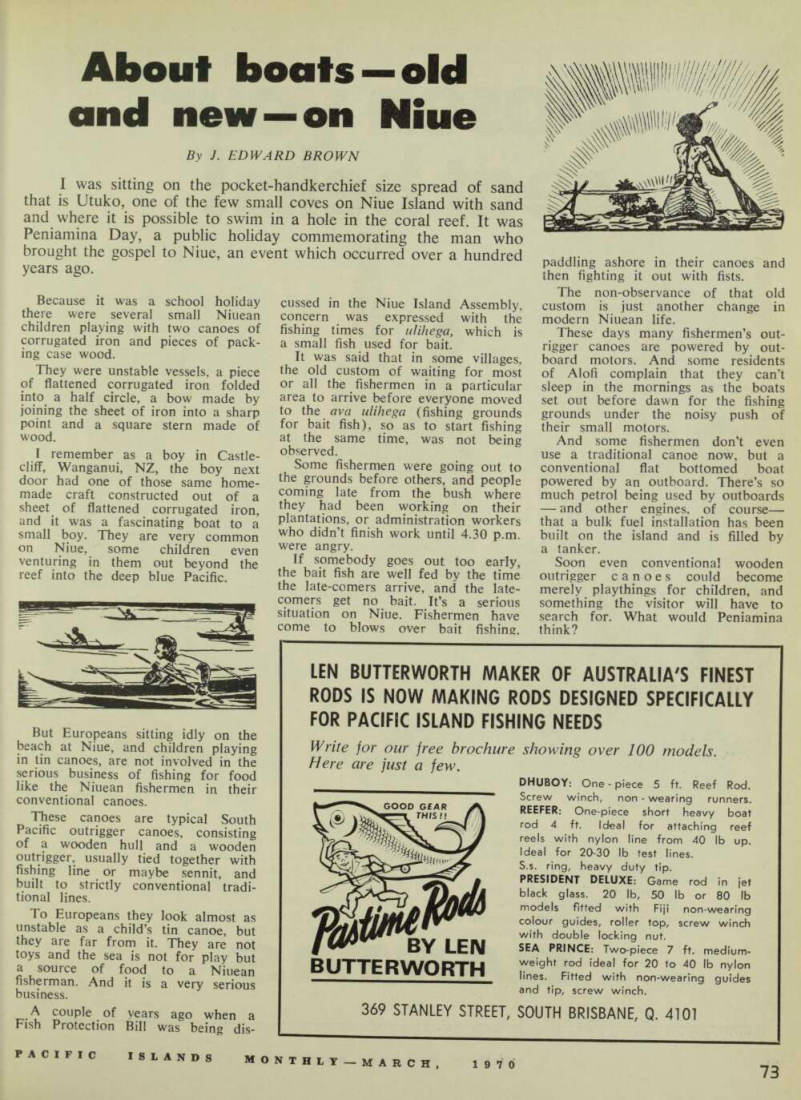
These canoes are typical South Pacific outrigger canoes, consisting of a wooden hull and a wooden outrigger, usually tied together with fishing line or maybe sennit, and built to strictly conventional tradi tional lines.
To Europeans they look almost as unstable as a child’s tin canoe, but they are far from it. They are not toys and the sea is not for play but a source of food to a Niuean fisherman. And it is a very serious business.
A couple of years ago when a Fish Protection Bill was being dis
cussed in the Niue Island Assembly, concern was expressed with the fishing times for ulihega, which is a small fish used for bait.
It was said that in some villages, the old custom of waiting for most or all the fishermen in a particular area to arrive before everyone moved to the ava ulihega (fishing grounds for bait fish), so as to start fishing at the same time, was not being observed.
Some fishermen were going out to the grounds before others, and people coming late from the bush where they had been working on their plantations, or administration workers who didn’t finish work until 4.30 p.m. were angry.
If somebody goes out too early, the bait fish are well fed by the time the late-comers arrive, and the latecomers get no bait. It’s a serious situation on Niue. Fishermen have come to blows over bait fishing,
paddling ashore in their canoes and then fighting it out with fists.
The non-observance of that old custom is just another change in modern Niuean life.
These days many fishermen’s out rigger canoes are powered by out board motors. And some residents of Alofi complain that they can’t sleep in the mornings as the boats set out before dawn for the fishing grounds under the noisy push of their small motors.
And some fishermen don’t even use a traditional canoe now, but a conventional flat bottomed boat powered by an outboard. There’s so much petrol being used by outboards and other engines, of course— that a bulk fuel installation has been built on the island and is filled by a tanker.
Soon even conventional wooden outrigger canoes could become merely playthings for children, and something the visitor will have to search for. What would Peniamina think?