Norfolk tourism
p. 73 · Read in the full issue
It's not the locals who run Norfolk tourism
By Ken Mcgregor
Thanks to Australian visitors ready to see the island despite a formidable five-hour DC4 flight from Sydney, Norfolk Island is making a comeback as an Islands travel destination.
The future looks bright, even allowing for misgivings by conser vationists and some islanders who feel tourism and its side effects are spoiling the place.
Two major projects, upgrading of the airstrip for possible jet services and the advent of a luxury Trave lodge hotel at Kingston, will bring changes in the ’7o’s.
Tourism has taken such a hold in Norfolk and Lord Howe that it dominates business. It is obvious to many that while it is already a major force in Fiji and French Polynesia, in coming years it could well dominate these territories also.
What good, then, and what bad, has tourism done to Norfolk? The answers vary widely according to whether people are for or “agin” its influence.
More prosperity
Bouquets include general pros perity indirectly or directly for everyone from hotel managers to poultry farmers; development, such as electricity and more roads which would have normally come much slower, and a growing degree of sophistication of Islanders by con tact with outsiders.
Brickbats include some ugliness (the duty-free eyesore of Burnt Pine township); ending some of the old Norfolk customs, language and good will in a faster moving society and a general deterioration in the natural environment, including ero sion, killing off of wildlife and too much garbage and filth for the island to cope with.
Tourists totalled 8,422 in 1967, NZ making up just over half and Australia all the rest; in 1968, this figure slumped to 7,901, with New Zealanders dropping drastically to about one-third and Australians comprising about two-thirds.
Last year was a big comeback: Of the 9,545 visitors, 6,826 came from Australia, 2,339 from NZ and 380 from New Caledonia.
January figures this year were up
nearly 20 per cent, indicating an alltime record for 70 of well into the hve figures.
Big numbers of tourists don’t necessarily mean money for all.
Many residents feel islanders see very little of the tourist dollar. Instead, they argue, they have to pay higher prices each year for essentials, such as food and clothing.
With the exception of Aunt Em’s, hotels, flats, guesthouses, hirecar businesses, sightseeing tours, fishmg excursions, duty-free shops and restaurants are mostly controlled by residents who have settled on Norfolk over the last 10 years.
Old families such as the Chris- Adams, Nobbs, McCoys and Buffetts, play little part in tourism, Husband and wife team, Paddy and Dick Cavill, operators of the Garrison Restaurant at Burnt Pine, are typical of the several recent arrivals who have made it”.
After wandering Europe by motor-scooter, the pair sold their Sydney home and moved to Norfolk three years ago. With a small bank loan and the house money they started a high-class restaurant, with none too-cheap prices, featuring seafoods Islands fruits and meats from AU Tr r a a vitnd nd ’ NZ ' -1 XT 11 Travelodge s arrival on Norfolk and it is now almost certain the deal will reach fruition to buy Kingston’s Paradise Hotel for about $250,000 from part-owner Eric Semple, will mean icy winds for other hotels, SU< ? xr- S ?! South Pacific, Norfolk and Kingfisher.
Accommodation standards on Norfolk arent bad, but they aren’t first class. A chain of Travelodge’s repute (remembering its Suva hotel) wUI make the Kingston pub the island s best accommodation. travelodge, of course, will have
its problems. Refurbishing costs will be high, local labour is slow, staff mg w iff a bugbear—people from Sydney will be needed However, the Kingston site, with Emily and Slaughter Bays nearby is magnificent. I understand, inci dentally, Travelodge’s plans will not include adjacent colonial ruins which the island administration pre fers to handle itself, I hope modernising of island ac comodations doesn’t eliminate some of the smaller, and less capitalised, guesthouses. They often give in terested visitors a look at the real Norfolk Aunt'Em’s, at Burnt Pine, is just this. Everything revolves around its attractive manageress, Jeannie Mit chell, of the Christian family, Jeannie, who was born on Tanna in the New Hebrides, while her parents were overseeing plantations during a Norfolk depression, spent 17 years in Melbourne before her mother died on Norfolk. rwL w Da„h»i^
L'cck Ot Doumty
Jeannie delights in taking visitors on visits to old islands homesteads on Norfolk I went to several in cludins a call at a Christian home at which I was shown two extremely old wooden plaques, Four feet high by two feet wide, they were supposed to be from the deck of the Bounty. John Adams the last-surviving Bounty mutineer’ in gold script, had scrawled the’
Lord’s Prayer and the Ten Com mandments on them, I was told by a proud housewife, History apart, and considering its beaches, walks, birdlife (feathered), food, nightlife and beauty of its coastline, Norfolk, I found, has much to offer.
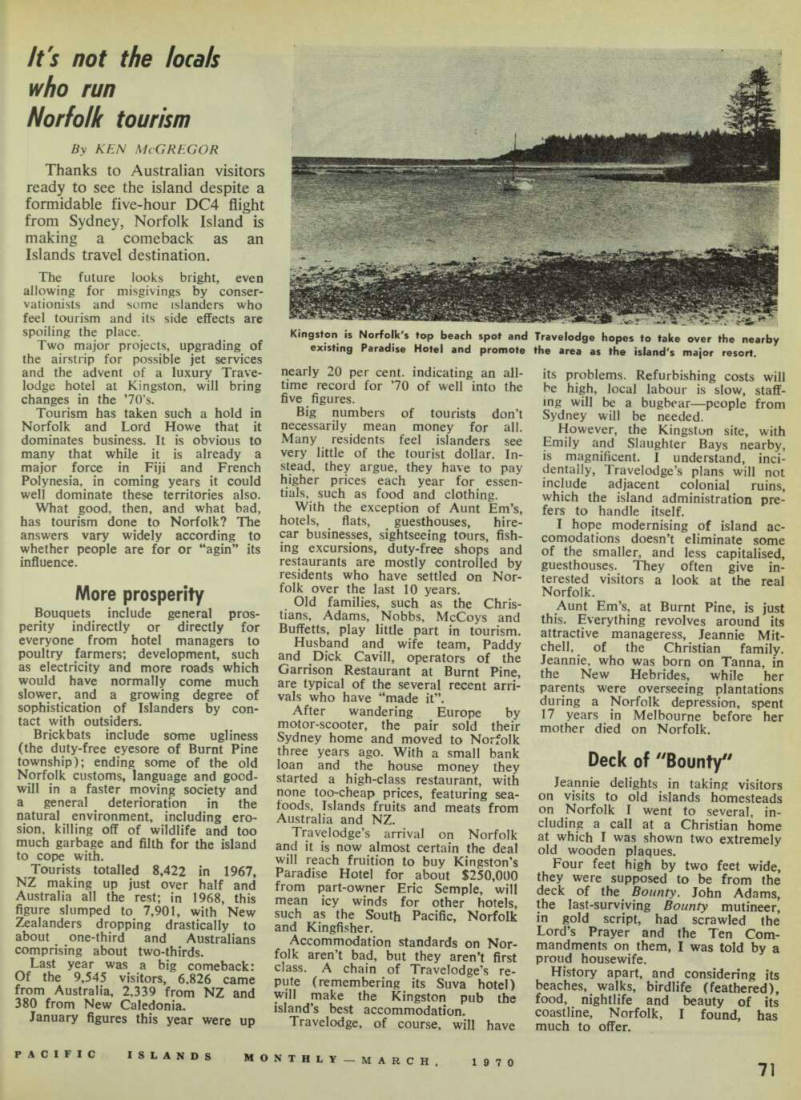
Kingston is Norfolk's top beach spot and Travelodge hopes to take over the nearby existing Paradise Hotel and promote the area as the island's major resort.