Footnotes
pp. 41-42 · Read in the full issue
“Everybody has won and all must have prizes,” said the Dodo to Alice at the conclusion of the great Caucus-race. “Everybody has passed and all must have certificates,” says P-NG’s Department of Education at the conclusion of the Primary School Certificate Examination.
Each November thousands of Niuginian children (in 1969, 17,400) who have completed Standard 6, the primary school top, sit for an examination, on the results of which they receive a certificate.
Their achievements in each of the four subjects in which they are examined are indicated by letters ranging from “A” to “E”. There are no failures in this examination, only letter combinations ranging from four “A”s to four “E”s. And every body gets a certificate.
True, there is some small print on the back, just as there is on the back of a hire purchase agreement. It explains that “A” means the best 5 per cent, of the candidates, “B” the next 25 per cent., “C” the next 40 per cent., “D” the next 25 per cent, and “E” the last 5 per cent.
Of “B” it says, “This is a very good level but is not as good as an ‘A’.” Of “D” it declares, with another pellucid glimpse of the obvious, “A ‘D’-level pass is better than an ‘E’level grade”. While of the last 5 per cent, it comments coyly, “These students have completed a primary school education but have been awarded the lowest level for their examination results”.
How charming!
One may wonder whether “educa tion” is quite the mot juste in this connection, but how charmingly the use of the word “failed” is avoided!
Come January, they swarm into Port Moresby from the villages, these eager young Dick Whittingtons.
They haven’t a cat, but they have a certificate, that eagerly prized, tightly clutched certificate, all too often, alas, a certificate of f , sorry, of E level. They have dreamed, per haps, of a place in a high school classroom, or a chair behind a file laden office desk, on which from time to time some poor devil, a Standard 4 drop-out, will respectfully deposit a cup of coffee.
They soon find out that one “D” and three “E”s are not an open sesame to enter the kind of school or the kind of job they have dreamed of, and if they happen to come from a Motu or Roro village they generally finish up at my front door.
I am told that the significance of the letters on the certificate is ex plained to them by their teachers.
If so, it doesn’t seem to have got through very well, and if the explana tion is couched in the same sort of pussy-footing double-talk that ap pears on the back of the certificate I’m not surprised.
I tell them, as gently as I can, in their own language what the real significance of their treasured certifi cate is, suggest that they might try their luck at a vocational centre, and watch them trudge dejectedly away.
Probably they weren’t “elite” material anyway and deserved their “D”s and “E”s. But I am haunted by the thought that somewhere, in one of the villages I know and love, there may be some bright-eyed youngster who is a sacrifice to computer wor ship. We have all heard of astonished bank customers who have received statements showing a credit balance of $999,999.99. It hasn’t happened to me yet, but apparently it can happen. To a computer which can do that, four “E”s in a row would be mere child’s play.
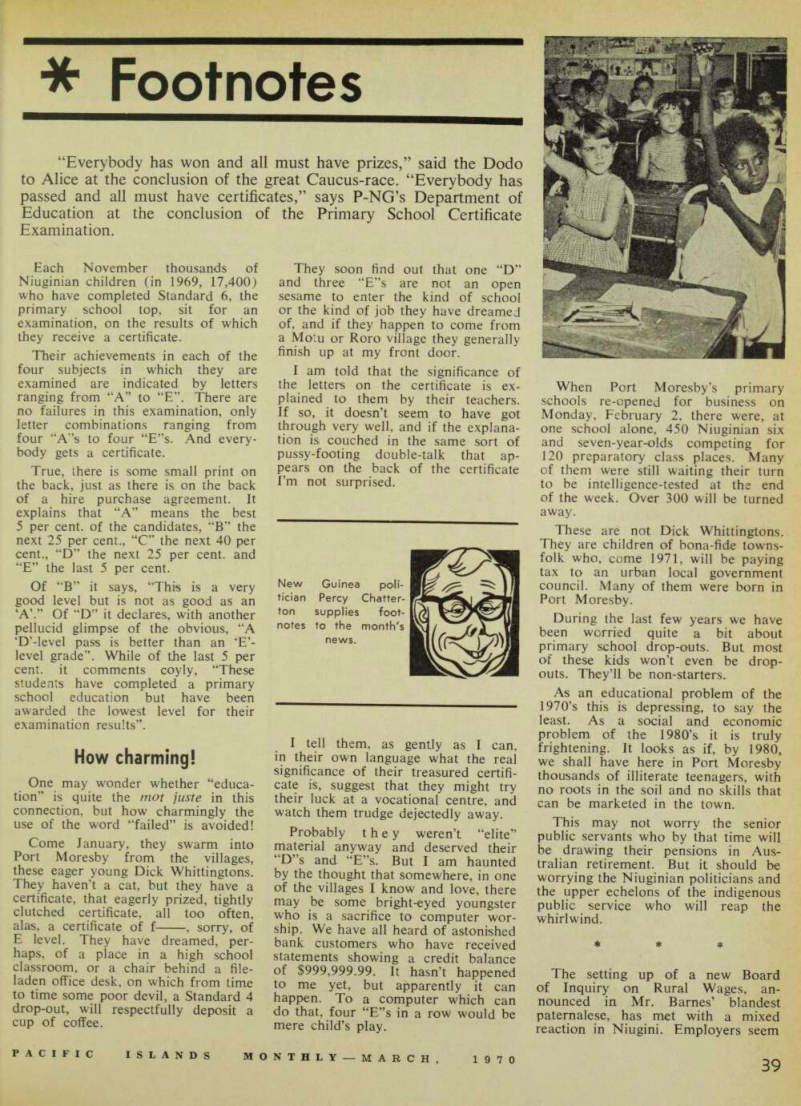
When Port Moresby’s primary schools re-opened for business on Monday, February 2, there were, at one school alone, 450 Niuginian six and seven-year-olds competing for 120 preparatory class places. Many of them were still waiting their turn to be intelligence-tested at the end of the week. Over 300 will be turned away.
These are not Dick Whittingtons.
They are children of bona-fide towns folk who, come 1971, will be paying tax to an urban local government council. Many of them were born in Port Moresby.
During the last few years we have been worried quite a bit about primary school drop-outs. But most of these kids won’t even be drop outs. They’ll be non-starters.
As an educational problem of the 1970’s this is depressing, to say the least. As a social and economic problem of the 1980’s it is truly frightening. It looks as if, by 1980, we shall have here in Port Moresby thousands of illiterate teenagers, with no roots in the soil and no skills that can be marketed in the town.
This may not worry the senior public servants who by that time will be drawing their pensions in Aus tralian retirement. But it should be worrying the Niuginian politicians and the upper echelons of the indigenous public service who will reap the whirlwind. ♦ ♦ ♦ The setting up of a new Board of Inquiry on Rural Wages, an nounced in Mr. Barnes’ blandest paternalese, has met with a mixed reaction in Niugini. Employers seem
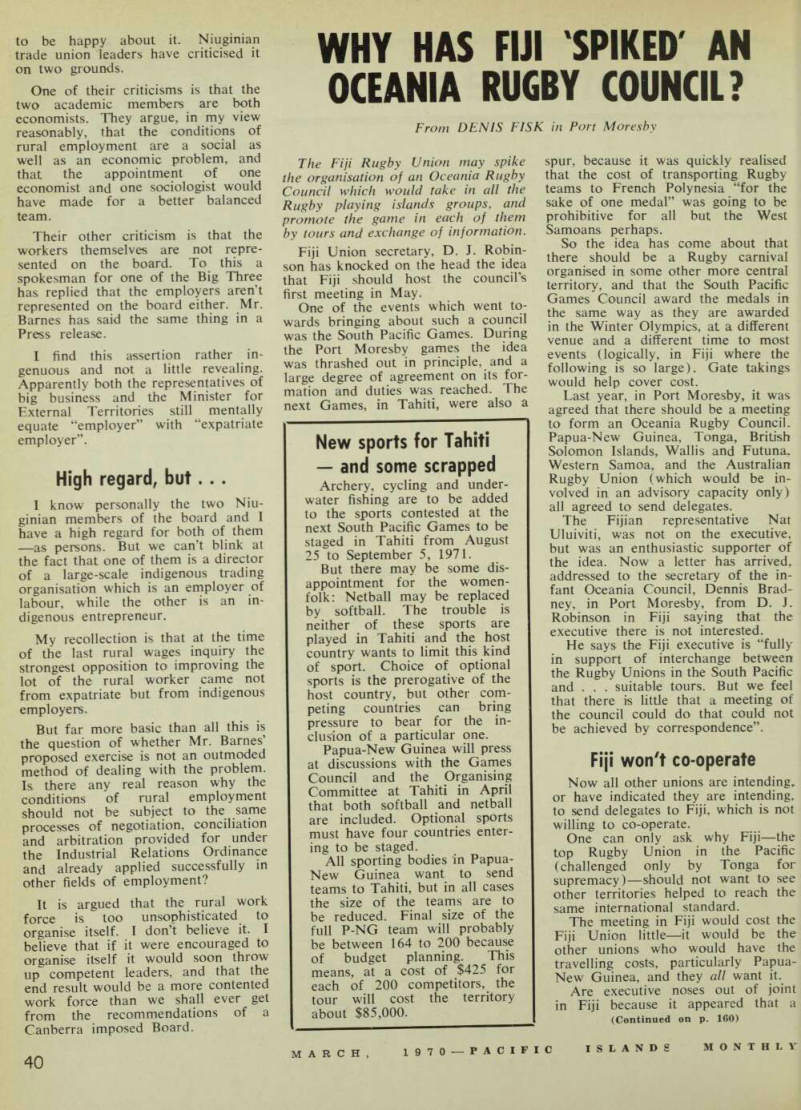
New Guinea poli tician Percy Chatter ton supplies foot notes to the month's news.
to be happy about it. Niuginian trade union leaders have criticised it on two grounds.
One of their criticisms is that the two academic members are both economists. They argue, in my view reasonably, that the conditions of rural employment are a social as well as an economic problem, and that the appointment of one economist and one sociologist would have made for a better balanced team.
Their other criticism is that the workers themselves are not repre sented on the board. To this a spokesman for one of the Big Three has replied that the employers aren’t represented on the board either. Mr.
Barnes has said the same thing in a Press release.
I find this assertion rather in genuous and not a little revealing.
Apparently both the representatives of big business and the Minister for External Territories still mentally equate “employer” with “expatriate employer”.
High regard, but. . .
I know personally the two Niu ginian members of the board and I have a high regard for both of them —as persons. But we can’t blink at the fact that one of them is a director of a large-scale indigenous trading organisation which is an employer of labour, while the other is an in digenous entrepreneur.
My recollection is that at the time of the last rural wages inquiry the strongest opposition to improving the lot of the rural worker came not from expatriate but from indigenous employers.
But far more basic than all this is the question of whether Mr. Barnes’ proposed exercise is not an outmoded method of dealing with the problem.
Is there any real reason why the conditions of rural employment should not be subject to the same processes of negotiation, conciliation and arbitration provided for under the Industrial Relations Ordinance and already applied successfully in other fields of employment?
It is argued that the rural work force is too unsophisticated to organise itself. I don’t believe it. I believe that if it were encouraged to organise itself it would soon throw up competent leaders, and that the end result would be a more contented work force than we shall ever get from the recommendations of a Canberra imposed Board.