Tropicalities
pp. 38-40 · Read in the full issue
Between them the world’s airlines turn out some of the world’s fanciest calendars. The 1970 batch are up to standard—big, glossy, with no expense spared, but the prize, we think, goes to Air India for its woman in 12 parts.
In black and white, on king-sized pages, January begins with eyes, eye brows and decorative caste mark m the middle of the forehead. December ends it with a pair of dainty hands raised prayerfully in the traditional Indian salute.
In between months carry other chunks of girl. April is enlivened by a provocative, part draped middle; May by chain bracelets on bare feet.
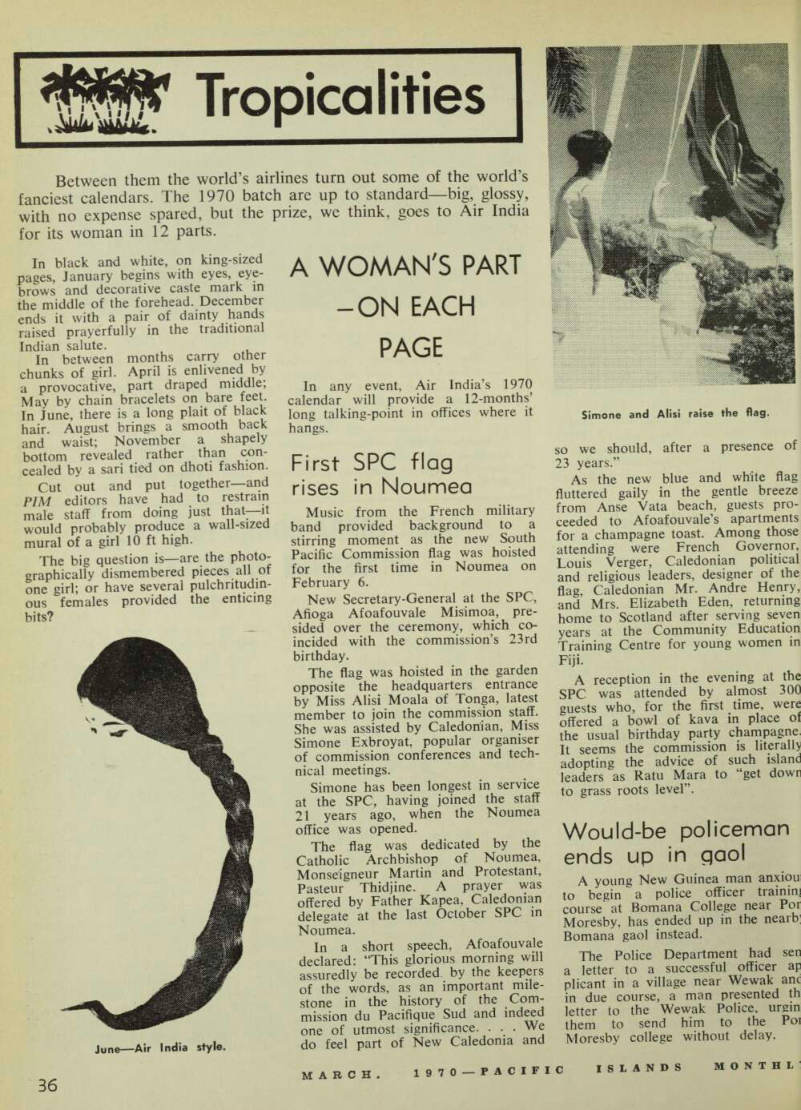
In June, there is a long plait of black hair. August brings a smooth back and waist; November a shapely bottom revealed rather than con cealed by a sari tied on dhoti fashion.
Cut out and put together—and PIM editors have had to restrain male staff from doing just that—it would probably produce a wall-sized mural of a girl 10 ft high.
The big question is—are the photo graphically dismembered pieces all of one girl; or have several pulchritudin ous females provided the enticing bits?
A Woman's Part
-On Each
Page
In any event, Air India’s 1970 calendar will provide a 12-months’ long talking-point in offices where it hangs.
First SPC flag
rises in Noumea
Music from the French military band provided background to a stirring moment as the new South Pacific Commission flag was hoisted for the first time in Noumea on February 6.
New Secretary-General at the SPC, Afioga Afoafouvale Misimoa, pre sided over the ceremony, which co incided with the commission’s 23rd birthday.
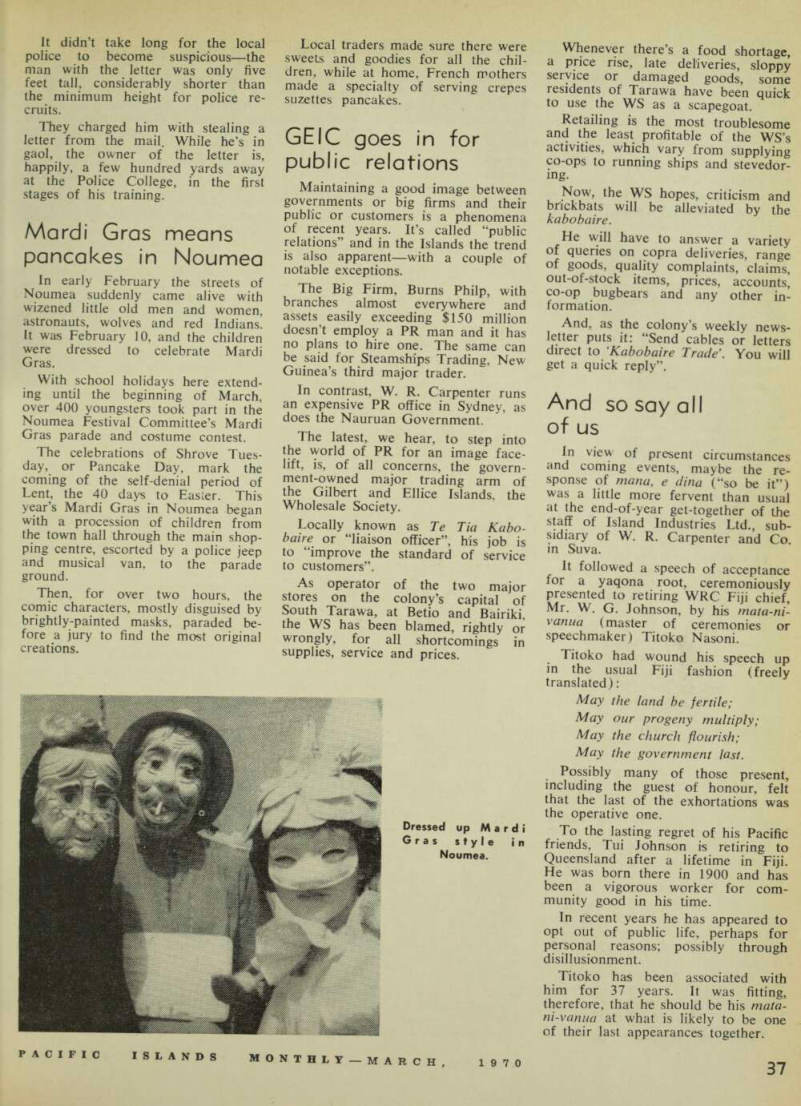
The flag was hoisted in the garden opposite the headquarters entrance by Miss Alisi Moala of Tonga, latest member to join the commission staff.
She was assisted by Caledonian, Miss Simone Exbroyat, popular organiser of commission conferences and tech nical meetings.
Simone has been longest in service at the SPC, having joined the staff 21 years ago, when the Noumea office was opened.
The flag was dedicated by the Catholic Archbishop of Noumea, Monseigneur Martin and Protestant, Pasteur Thidjine. A prayer was offered by Father Kapea, Caledonian delegate at the last October SPC in Noumea.
In a short speech, Afoafouvale declared: “This glorious morning will assuredly be recorded, by the keepers of the words, as an important mile stone in the history of the .Com mission du Pacifique Sud and indeed one of utmost significance. . . . We do feel part of New Caledonia and
so we should, after a presence of 23 years.”
As the new blue and white flag fluttered gaily in the gentle breeze from Anse Vata beach, guests pro ceeded to Afoafouvale’s apartments for a champagne toast. Among those attending were French Governor, Louis Verger, Caledonian political and religious leaders, designer of the flag, Caledonian Mr. Andre Henry, and Mrs. Elizabeth Eden, returning home to Scotland after serving seven years at the Community Education Training Centre for young women in Fiji.
A reception in the evening at the SPC was attended by almost 300 guests who, for the first time, were offered a bowl of kava in place of the usual birthday party champagne.
It seems the commission is literally adopting the advice of such island leaders as Ratu Mara to ‘get down to grass roots level”.
Would-be policeman
ends up in gaol
A young New Guinea man anxioui to begin a police officer traininj course at Bomana College near For Moresby, has ended up in the nearb; Bomana gaol instead.
The Police Department had sen a letter to a successful officer ap plicant in a village near Wewak and in due course, a man presented th letter to the Wewak Police, urgin them to send him to the Poi Moresby college without delay.
June —Air India style.
Simone and Alisi raise the flag.
It didn’t take long for the local police to become suspicious—the man with the letter was only five feet tall, considerably shorter than the minimum height for police re cruits.
They charged him with stealing a letter from the mail. While he's in gaol, the owner of the letter is, happily, a few hundred yards away at the Police College, in the first stages of his training.
Mardi Gras means
pancakes in Noumea
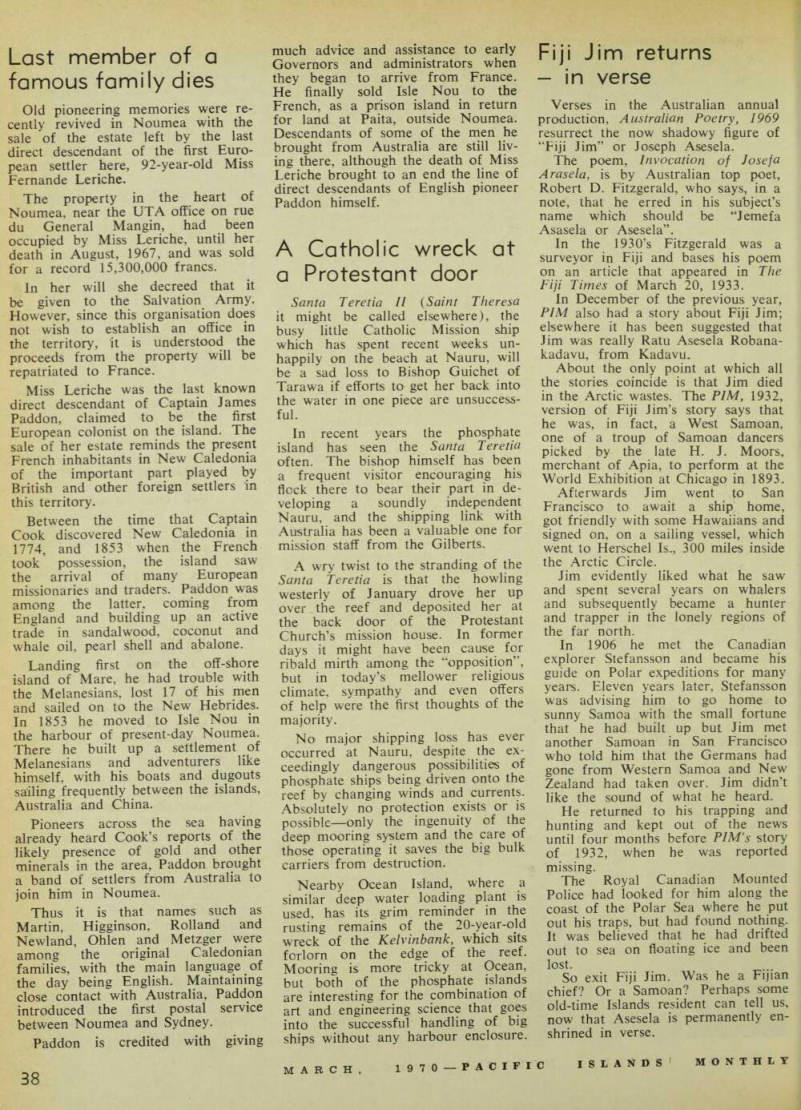
In early February the streets of Noumea suddenly came alive with wizened little old men and women, astronauts, wolves and red Indians.
It was February 10, and the children were dressed to celebrate Mardi Gras.
With school holidays here extend ing until the beginning of March, over 400 youngsters took part in the Noumea Festival Committee’s Mardi Gras parade and costume contest.
The celebrations of Shrove Tues day, or Pancake Day, mark the coming of the self-denial period of Lent, the 40 days to Easter. This year’s Mardi Gras in Noumea began with a procession of children from the town hall through the main shop ping centre, escorted by a police jeep and musical van, to the parade ground.
Then, for over two hours, the comic characters, mostly disguised by brightly-painted masks, paraded be fore a jury to find the most original creations.
Local traders made sure there were sweets and goodies for all the chil dren, while at home, French mothers made a specialty of serving crepes suzettes pancakes.
GEIC goes in for
public relations
Maintaining a good image between governments or big firms and their public or customers is a phenomena of recent years. It’s called “public relations” and in the Islands the trend is also apparent—with a couple of notable exceptions.
The Big Firm, Burns Philp, with branches almost everywhere and assets easily exceeding Siso million doesn’t employ a PR man and it has no plans to hire one. The same can be said for Steamships Trading, New Guinea’s third major trader.
In contrast, W. R. Carpenter runs an expensive PR office in Sydney, as does the Nauruan Government.
The latest, we hear, to step into the world of PR for an image face lift, is, of all concerns, the govern ment-owned major trading arm of the Gilbert and Ellice Islands, the Wholesale Society.
Locally known as Te Tia Kabo baire or “liaison officer”, his job is to “improve the standard of service to customers”.
As operator of the two major stores on the colony’s capital of South Tarawa, at Betio and Bairiki, the WS has been blamed, rightly or wrongly, for all shortcomings in supplies, service and prices.
Whenever there’s a food shortage, a price rise, late deliveries, sloppy service or damaged goods, some residents of Tarawa have been quick to use the WS as a scapegoat.
Retailing is the most troublesome and the least profitable of the WS’s activities, which vary from supplying co-ops to running ships and stevedor ing.
Now, the WS hopes, criticism and brickbats will be alleviated by the kabobaire.
He will have to answer a variety of queries on copra deliveries, range of goods, quality complaints, claims, out-of-stock items, prices, accounts, co-op bugbears and any other in formation.
And, as the colony’s weekly news letter puts it: “Send cables or letters direct to ‘Kabobaire Trade’. You will get a quick reply”.
And so say all
of us
In view of present circumstances and coming events, maybe the re sponse of mana, e dina (“so be it”) was a little more fervent than usual at the end-of-year get-together of the staff of Island Industries Ltd., sub sidiary of W. R. Carpenter and Co. in Suva.
It followed a speech of acceptance for a yaqona root, ceremoniously presented to retiring WRC Fiji chief, Mr. W. G. Johnson, by his mata-ni vanua (master of ceremonies or speechmaker) Titoko Nasoni.
Titoko had wound his speech up in the usual Fiji fashion (freely translated): May the land be fertile; May our progeny multiply; May the church flourish; May the government last.
Possibly many of those present, including the guest of honour, felt that the last of the exhortations was the operative one.
To the lasting regret of his Pacific friends, Tui Johnson is retiring to Queensland after a lifetime in Fiji.
He was born there in 1900 and has been a vigorous worker for com munity good in his time.
In recent years he has appeared to opt out of public life, perhaps for personal reasons; possibly through disillusionment.
Titoko has been associated with him for 37 years. It was fitting, therefore, that he should be his mata ni-vanua at what is likely to be one of their last appearances together.
Dressed up Mardi Gras style in Noumea.
Last member of a
famous family dies
Old pioneering memories were re cently revived in Noumea with the sale of the estate left by the last direct descendant of the first Euro pean settler here, 92-year-old Miss Fernande Leriche.
The property in the heart of Noumea, near the UTA office on rue du General Mangin, had been occupied by Miss Leriche, until her death in August, 1967, and was sold for a record 15,300,000 francs.
In her will she decreed that it be given to the Salvation Army.
However, since this organisation does not wish to establish an office in the territory, it is understood the proceeds from the property will be repatriated to France.
Miss Leriche was the last known direct descendant of Captain James Paddon, claimed to be the first European colonist on the island. The sale of her estate reminds the present French inhabitants in New Caledonia of the important part played by British and other foreign settlers in this territory.
Between the time that Captain Cook discovered New Caledonia in 1774, and 1853 when the French took possession, the island saw the arrival of many European missionaries and traders. Paddon was among the latter, coming from England and building up an active trade in sandalwood, coconut and whale oil, pearl shell and abalone.
Landing first on the off-shore island of Mare, he had trouble with the Melanesians, lost 17 of his men and sailed on to the New Hebrides.
In 1853 he moved to Isle Nou in the harbour of present-day Noumea.
There he built up a settlement of Melanesians and adventurers like himself, with his boats and dugouts sailing frequently between the islands, Australia and China.
Pioneers across the sea having already heard Cook’s reports of the likely presence of gold and other minerals in the area, Paddon brought a band of settlers from Australia to join him in Noumea.
Thus it is that names such as Martin, Higginson, Rolland and Newland, Ohlen and Metzger were among the original Caledonian families, with the main language of the day being English. Maintaining close contact with Australia, Paddon introduced the first postal service between Noumea and Sydney.
Paddon is credited with giving
much advice and assistance to early Governors and administrators when they began to arrive from France.
He finally sold Isle Nou to the French, as a prison island in return for land at Paita, outside Noumea.
Descendants of some of the men he brought from Australia are still liv ing there, although the death of Miss Leriche brought to an end the line of direct descendants of English pioneer Paddon himself.
A Catholic wreck at
a Protestant door
Santa Teretia II (Saint Theresa it might be called elsewhere), the busy little Catholic Mission ship which has spent recent weeks un happily on the beach at Nauru, will be a sad loss to Bishop Guichet of Tarawa if efforts to get her back into the water in one piece are unsuccess ful.
In recent years the phosphate island has seen the Santa Teretia often. The bishop himself has been a frequent visitor encouraging his flock there to bear their part in de veloping a soundly independent Nauru, and the shipping link with Australia has been a valuable one for mission staff from the Gilberts.
A wry twist to the stranding of the Santa Teretia is that the howling westerly of January drove her up over the reef and deposited her at the back door of the Protestant Church’s mission house. In former days it might have been cause for ribald mirth among the “opposition”, but in today’s mellower religious climate, sympathy and even offers of help were the first thoughts of the majority.
No major shipping loss has ever occurred at Nauru, despite the ex ceedingly dangerous possibilities of phosphate ships being driven onto the reef by changing winds and currents.
Absolutely no protection exists or is possible—only the ingenuity of the deep mooring system and the care of those operating it saves the big bulk carriers from destruction.
Nearby Ocean Island, where a similar deep water loading plant is used, has its grim reminder in the rusting remains of the 20-year-old wreck of the Kelvinbank, which sits forlorn on the edge of the reef.
Mooring is more tricky at Ocean, but both of the phosphate islands are interesting for the combination of art and engineering science that goes into the successful handling of big ships without any harbour enclosure.
Fiji Jim returns
- in verse Verses in the Australian annual production, Australian Poetry, 1969 resurrect the now shadowy figure of “Fiji Jim” or Joseph Asesela.
The poem, Invocation of Josefa Arasela, is by Australian top poet, Robert D. Fitzgerald, who says, in a note, that he erred in his subject’s name which should be “Jemefa Asasela or Asesela”.
In the 1930’s Fitzgerald was a surveyor in Fiji and bases his poem on an article that appeared in The Fiji Times of March 20, 1933.
In December of the previous year, PIM also had a story about Fiji Jim; elsewhere it has been suggested that Jim was really Ratu Asesela Robana kadavu, from Kadavu.
About the only point at which all the stories coincide is that Jim died in the Arctic wastes. The PIM, 1932, version of Fiji Jim’s story says that he was, in fact, a West Samoan, one of a troup of Samoan dancers picked by the late H. J. Moors, merchant of Apia, to perform at the World Exhibition at Chicago in 1893.
Afterwards Jim went to San Francisco to await a ship home, got friendly with some Hawaiians and signed on, on a sailing vessel, which went to Herschel Is., 300 miles inside the Arctic Circle.
Jim evidently liked what he saw and spent several years on whalers and subsequently became a hunter and trapper in the lonely regions of the far north.
In 1906 he met the Canadian explorer Stefansson and became his guide on Polar expeditions for many years. Eleven years later, Stefansson was advising him to go home to sunny Samoa with the small fortune that he had built up but Jim met another Samoan in San Francisco who told him that the Germans had gone from Western Samoa and New Zealand had taken over. Jim didn’t like the sound of what he heard.
He returned to his trapping and hunting and kept out of the news until four months before PlM’s story of 1932, when he was reported missing.
The Royal Canadian Mounted Police had looked for him along the coast of the Polar Sea where he put out his traps, but had found nothing.
It was believed that he had drifted out to sea on floating ice and been lost.
So exit Fiji Jim. Was he a Fijian chief? Or a Samoan? Perhaps some old-time Islands resident can tell us, now that Asesela is permanently en shrined in verse.