Fiji's Approach To
pp. 28-139 · Read in the full issue
Dominion Status
There were many public statements made early about the consultations with Lord Shep herd; but they were so mixed up
with a spirit of healthy optimism
about the future of Fiji that it was difficult to separate the grain from the chaff.
However, the following are the main points on which the parties con cerned have reached formal agree ment; and this summary was sup ported by Lord Shepherd in the House of Lords on February 10: • Fiji will move from Crown Colony to be a largely self-govern ing Dominion within the British Com monwealth. There will be a Governor- General appointed by the Queen, with the powers usual in the case of a Dominion.
This could be achieved this year.
October 10, 1970 (96 years after the Deed of Cession was signed) is sug gested as “Dominion Day”. • The Parliament will consist of two Chambers—an elected Legislative Assembly (or Council), and an Upper House. The latter will be partly nominative, and strongly represent the Fijian Council of Chiefs. • There has yet been no agree ment on the electoral system, and
(Continued on page 134)
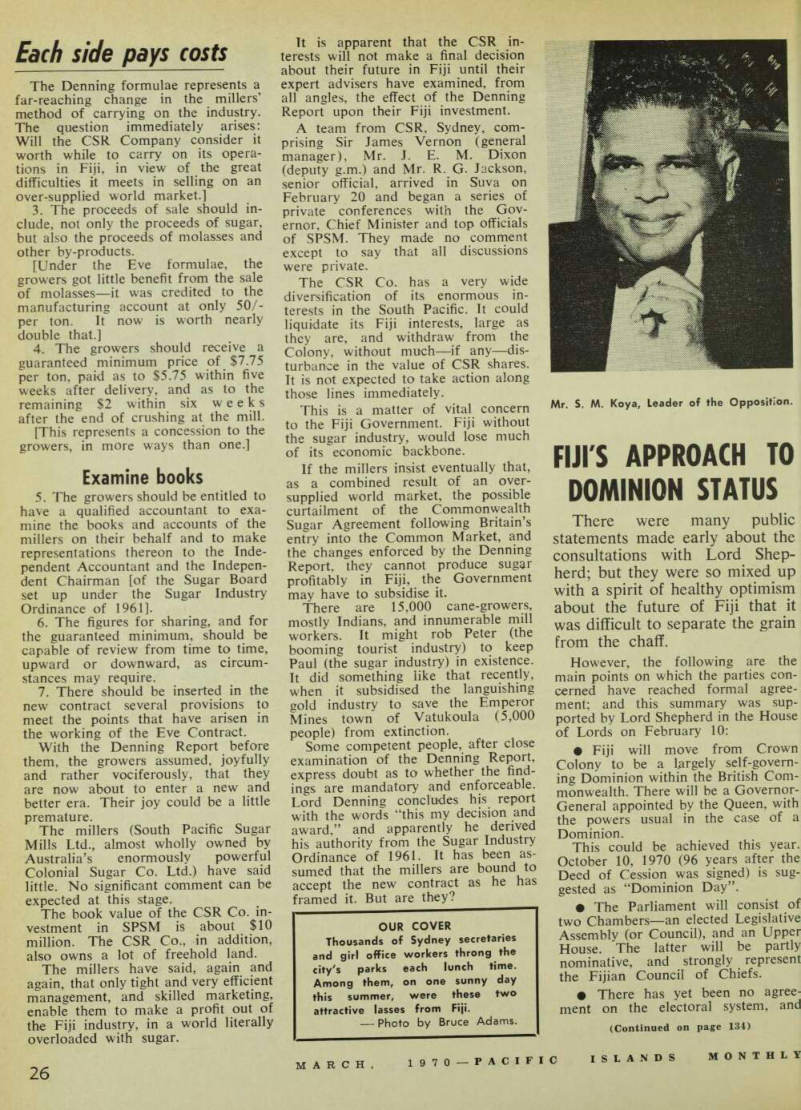
Mr. S. M. Koya, Leader of the Opposition.
the manner of constituting the Upper House. • An ombudsman will be appointed by the Governor-General every four years. He will have a large measure of authority to deal with complaints of the common people against gov ernment officials, public bodies, or even against the government. • Agreement has been reached on such matters as fundamental rights and freedoms, citizenship, the judiciary, the scope and powers of commissions under the Crown, finance.
The following procedure is now being followed: The Fiji Legislative Council met on February 24, and all members, except one, formally endorsed the agreement that now has been reached.
The British Government has been advised, and asked to call a confer ence to either write a new Consti tution, or amend the present one.
Lord Shepherd has stated that, on this request, a Constitutional Confer ence will be called, in London, in April; and if by then or at the con ference, the parties have failed to agree on the composition of the Legis lature and the method of election, his view was that Fiji should proceed to
an election, and that the present system of representation, and of elec tion by communal rolls, should be employed. [LATER: Conference will open in London on April 20.\ Apparently, it is planned that all Legco members who have signed the agreement shall go to the London Conference. The excepton is Dr.
Verrier, who was elected as an Alli ance Party man in 1966, but who broke away to form what he calls the “Liberal Party”, of which he is the only member. He is generally ignored by the two main parties.
Comparison with 1965
Fundamentally, there appears little difference between the Constitutional Conference of 1965, and that planned for April, 1970.
Then, as now, the whole of the Legco members went to London, at Fiji’s expense. Then, as now, no at tempt was made to get the views of the electors on the many complex issues involved—it was (and is now) simply assumed that the Legco members know the answers. Which they do not.
This time, they go off with a much larger measure of agreement on minor issues.
In 1965, there was sharp hostility and distrust between Alliance and Federation people, as they approached London, resulting in an open break there on the constitution of the Legislature, and method of election.
But this time, as before, there is lack of agreement on the vital issues —namely, the composition of the Parliament, and the method of elect ing it.
In 1965, the Patel-led members flatly refused the communal roll, and insisted they would fight it all the way. In 1970, the Federation team, led by Mr. Koya, apparently has agreed that, failing the common roll, it will accept the communal rolls as the basis of the next election.
But there is no real indication that the belligerent section of the Federa tion (of which Mr. Ramrakha apparently is the mouthpiece) is sup porting Mr. Koya all the way in this apparent compromise, or that the Federation campaign for the common roll will be less vigorously pursued in the future.
Fundamental
The fundamental issue in Fiji is the acceptance or non-acceptance of the common roll, by which the anti- European Federation planners hope eventually to get control of Fiji’s ad ministration and economy.
All the rest—Dominion status, British Governor-General, self-govern
ment —while very good, is little more than window-dressing.
The only pledge given, in all this so-called “agreement and progress towards peaceful nationhood” is a sentence used by Lord Shepherd when making his statement on February 10: “The special position enjoyed by the Fijians is to continue as at pre sent.”
Even that is typically vague. The “special position” enjoyed by the Fijians is (a) their lands shall remain irrevocably theirs, as pledged by the Queen at Cession in 1874 and (b) although their numbers are slightly less than those of the Indians this indigenous race must in no circum stances be dominated by an immi grant people.
If something like this can be written into the new Constitution, that will be real progress.
Fiji-lndians' Future
A belief, held fairly widely in Fiji at the moment, that the worth while Indian leaders are trying sincerely to effect integration with the other communities in Fiji, for the establishment of a sound little nation there in the Central South Pacific, is the best thing that has come out of the inter-community talks that have been going on since the irreconcilable A. D. Patel died.
In plain fact, it is vital to the future of Fiji.
This new generation of Fiji-born Indians has a great deal to give Fiji.
They need only leadership and direc tion of a nature to gain the trust of their big, suspicious neighbours in Australia and New Zealand. They must have the help of those neigh bours, in finding jobs for hundreds— maybe thousands—of their unem ployed youths. Australia could give it, either by making investment capital available for new industries in Fiji, or by opening its doors a little to skilled and educated young Indians. Or both.
• Dr. D. J. Lancaster, consultant obstetrician and gynaecologist at the CWM Hospital, Suva, has become Fiji’s only Fellow of the Royal College of Obstetricians and Gynaeco logists.
Dr. Lancaster (43), was elected in recognition of his work in the field in Fiji. One of his main respon sibilities is to teach trainee nurses and students at the Fiji School of Medicine.