Fiji prepares to gulp Denning
pp. 27-28 · Read in the full issue
sugar and Shepherd politics
During February Fiji was busy digesting both the Denning report on the future of its main industry and the idea of Dominion status that had been sprung on the people almost out of the blue in the previous month. "PIM" staff writers deal here with the two vital and related issues.
Round-up by PIM staff writers By late February, Fiji was having a breathing-spell—a thought ful rest after two bouts of wild excitement, one economic and one political.
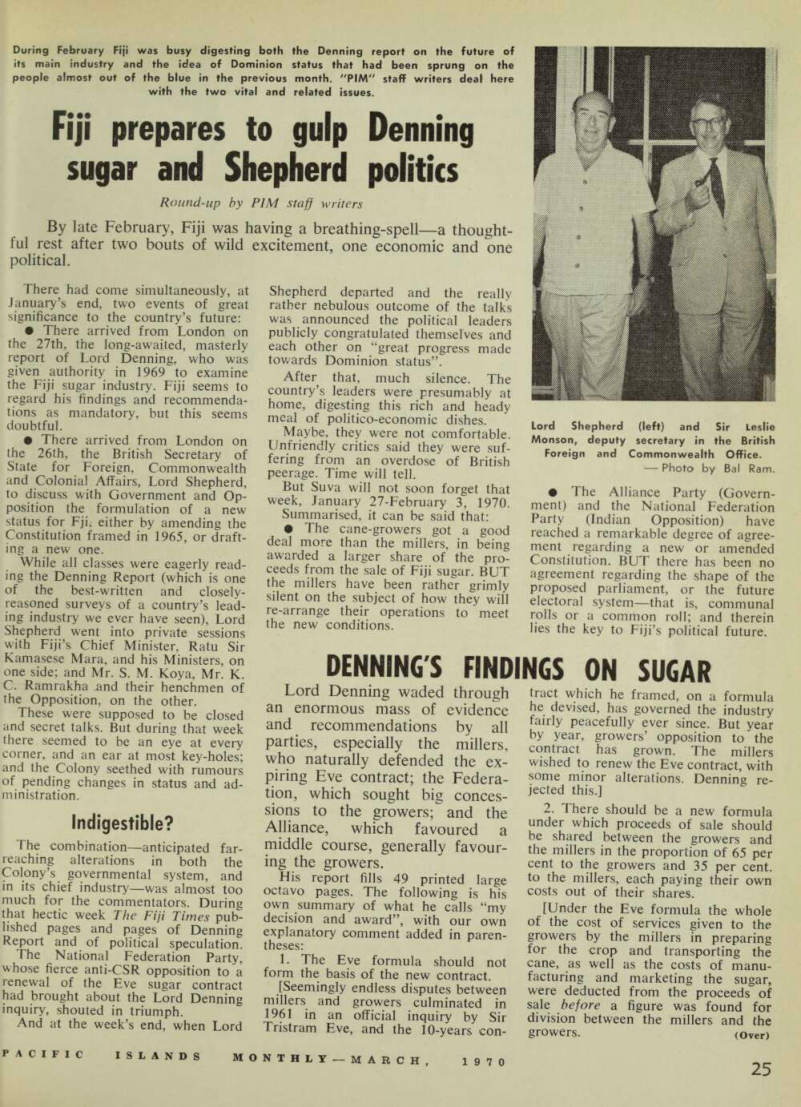
There had come simultaneously, at January’s end, two events of great significance to the country’s future: • There arrived from London on the 27th, the long-awaited, masterly report of Lord Denning, who was given authority in 1969 to examine the Fiji sugar industry. Fiji seems to regard his findings and recommenda tions as mandatory, but this seems doubtful. • There arrived from London on the 26th, the British Secretary of State for Foreign, Commonwealth and Colonial Affairs, Lord Shepherd, to discuss with Government and Op position the formulation of a new status for Fji, either by amending the Constitution framed in 1965, or draft ing a new one.
While all classes were eagerly read ing the Denning Report (which is one of the best-written and closely reasoned surveys of a country’s lead ing industry we ever have seen), Lord Shepherd went into private sessions with Fiji’s Chief Minister, Ratu Sir Kamasese Mara, and his Ministers, on one side; and Mr. S. M. Koya, Mr. K.
C. Ramrakha .and their henchmen of the Opposition, on the other.
These were supposed to be closed and secret talks. But during that week there seemed to be an eye at every corner, and an ear at most key-holes; and the Colony seethed with rumours of pending changes in status and ad ministration.
Indigestible?
The combination—anticipated far reaching alterations in both the Colony’s governmental system, and in its chief industry—was almost too much for the commentators. During that hectic week The Fiji Times pub lished pages and pages of Denning Report and of political speculation.
The National Federation Party, whose fierce anti-CSR opposition to a renewal of the Eve sugar contract had brought about the Lord Denning inquiry, shouted in triumph.
And at the week’s end, when Lord
Shepherd departed and the really rather nebulous outcome of the talks was announced the political leaders publicly congratulated themselves and each other on “great progress made towards Dominion status”.
After that, much silence. The country’s leaders were presumably at home, digesting this rich and heady meal of politico-economic dishes.
Maybe, they were not comfortable.
Unfriendly critics said they were suf fering from an overdose of British peerage. Time will tell.
But Suva will not soon forget that week, January 27-February 3, 1970.
Summarised, it can be said that: • The cane-growers got a good deal more than the millers, in being awarded a larger share of the pro ceeds from the sale of Fiji sugar. BUT the millers have been rather grimly silent on the subject of how they will re-arrange their operations to meet the new conditions.
• The Alliance Party (Govern ment) and the National Federation Party (Indian Opposition) have reached a remarkable degree of agree ment regarding a new or amended Constitution. BUT there has been no agreement regarding the shape of the proposed parliament, or the future electoral system—that is, communal rolls or a common roll; and therein lies the key to Fiji’s political future.
Dennings Findings On Sugar
Lord Denning waded through
an enormous mass of evidence and recommendations by all
parties, especially the millers,
who naturally defended the ex piring Eve contract; the Federa
tion, which sought big conces
sions to the growers; and the Alliance, which favoured a middle course, generally favour ing the growers.
His report fills 49 printed large octavo pages. The following is his own summary of what he calls “my decision and award”, with our own explanatory comment added in paren theses: 1. The Eve formula should not form the basis of the new contract. [Seemingly endless disputes between millers and growers culminated in 1961 in an official inquiry by Sir Tristram Eve, and the 10-years con
tract which he framed, on a formula he devised, has governed the industry fairly peacefully ever since. But year by year, growers’ opposition to the contract has grown. The millers wished to renew the Eve contract, with some minor alterations. Denning re jected this.] 2. There should be a new formula under which proceeds of sale should be shared between the growers and the millers in the proportion of 65 per cent to the growers and 35 per cent, to the millers, each paying their own costs out of their shares. [Under the Eve formula the whole of the cost of services given to the growers by the millers in preparing for the crop and transporting the cane, as well as the costs of manu facturing and marketing the sugar, were deducted from the proceeds of sale before a figure was found for division between the millers and the growers. (o ver)
Lord Shepherd (left) and Sir Leslie Monson, deputy secretary in the British Foreign and Commonwealth Office. -Photo by Bal Ram.
Each side pays costs
The Denning formulae represents a far-reaching change in the millers’ method of carrying on the industry.
The question immediately arises: Will the CSR Company consider it worth while to carry on its opera tions in Fiji, in view of the great difficulties it meets in selling on an over-supplied world market.] 3. The proceeds of sale should in clude, not only the proceeds of sugar, but also the proceeds of molasses and other by-products. [Under the Eve formulae, the growers got little benefit from the sale of molasses —it was credited to the manufacturing account at only 50/per ton. It now is worth nearly double that.] 4. The growers should receive a guaranteed minimum price of $7.75 per ton, paid as to $5.75 within five weeks after delivery, and as to the remaining $2 within six weeks after the end of crushing at the mill. [This represents a concession to the growers, in more ways than one.]
Examine books
5. The growers should be entitled to have a qualified accountant to exa mine the books and accounts of the millers on their behalf and to make representations thereon to the Inde pendent Accountant and the Indepen dent Chairman [of the Sugar Board set up under the Sugar Industry Ordinance of 1961]. 6. The figures for sharing, and for the guaranteed minimum, should be capable of review from time to time, upward or downward, as circum stances may require. 7. There should be inserted in the new contract several provisions to meet the points that have arisen in the working of the Eve Contract.
With the Denning Report before them, the growers assumed, joyfully and rather vociferously, that they are now about to enter a new and better era. Their joy could be a little premature.
The millers (South Pacific Sugar Mills Ltd., almost wholly owned by Australia’s enormously powerful Colonial Sugar Co. Ltd.) have said little. No significant comment can be expected at this stage.
The book value of the CSR Co. in vestment in SPSM is about $lO million. The CSR Co., in addition, also owns a lot of freehold land.
The millers have said, again and again, that only tight and very efficient management, and skilled marketing, enable them to make a profit out of the Fiji industry, in a world literally overloaded with sugar.
It is apparent that the CSR in terests will not make a final decision about their future in Fiji until their expert advisers have examined, from all angles, the effect of the Denning Report upon their Fiji investment.
A team from CSR, Sydney, com prising Sir James Vernon (general manager), Mr. J. E. M. Dixon (deputy g.m.) and Mr. R. G. Jackson, senior official, arrived in Suva on February 20 and began a series of private conferences with the Gov ernor, Chief Minister and top officials of SPSM. They made no comment except to say that all discussions were private.
The CSR Co. has a very wide diversification of its enormous in terests in the South Pacific. It could liquidate its Fiji interests, large as they are, and withdraw from the Colony, without much—if any—dis turbance in the value of CSR shares.
It is not expected to take action along those lines immediately.
This is a matter of vital concern to the Fiji Government. Fiji without the sugar industry, would lose much of its economic backbone.
If the millers insist eventually that, as a combined result of an over supplied world market, the possible curtailment of the Commonwealth Sugar Agreement following Britain’s entry into the Common Market, and the changes enforced by the Denning Report, they cannot produce sugar profitably in Fiji, the Government may have to subsidise it.
There are 15,000 cane-growers, mostly Indians, and innumerable mill workers. It might rob Peter (the booming tourist industry) to keep Paul (the sugar industry) in existence.
It did something like that recently, when it subsidised the languishing gold industry to save the Emperor Mines town of Vatukoula (5,000 people) from extinction.
Some competent people, after close examination of the Denning Report, express doubt as to whether the find ings are mandatory and enforceable.
Lord Denning concludes his report with the words “this my decision and award,” and apparently he derived his authority from the Sugar Industry Ordinance of 1961. It has been as sumed that the millers are bound to accept the new contract as he has framed it. But are they?