Business and Development
pp. 122-127 · Read in the full issue
75 Years 'Young' And
Proud Of It
Even though its original capital of £5O has grown into today’s annual turnover of $l5 million, Islands agent, Nelson and Robert son Pty. Ltd. and its associate companies, feels this is only half the story.
Seventy-five years “young” this month, N. and R. is proudest of the many clients it has maintained for long periods, dating back to New Guinea’s German days, and the de velopment and changes it has en gineered behind the scenes in the Islands.
The company is also proud of the fact that it is one of the leading ex porters of cocoa from the Islands.
N. and R, is today jealous of what it does for its long-term clients. Ser vices go far past selling or buying a ton or two of trochus shell or locat ing false teeth for a Solomons planter or chaperoning Islands children on holidays in Australia.
The company feels that an Islands agent has many roles. The company gets out and meets its clients, worries about their personal problems and takes more than a commercial in terest in the territories in which it operates.
Early cocoa growers
Innovations that N. and R. has spearheaded include early cocoa-grow ing in Western Samoa; assisting the administration of the defunct Expro priation Board in New Guinea; and tracing missing Europeans during the Pacific War.
Great PR perhaps, but most busi nessmen outside N. and R. agree that the company earned its envied reputa tion in the Islands primarily through the original father-and-son team who turned the N. and R. wheel in its first half-century.
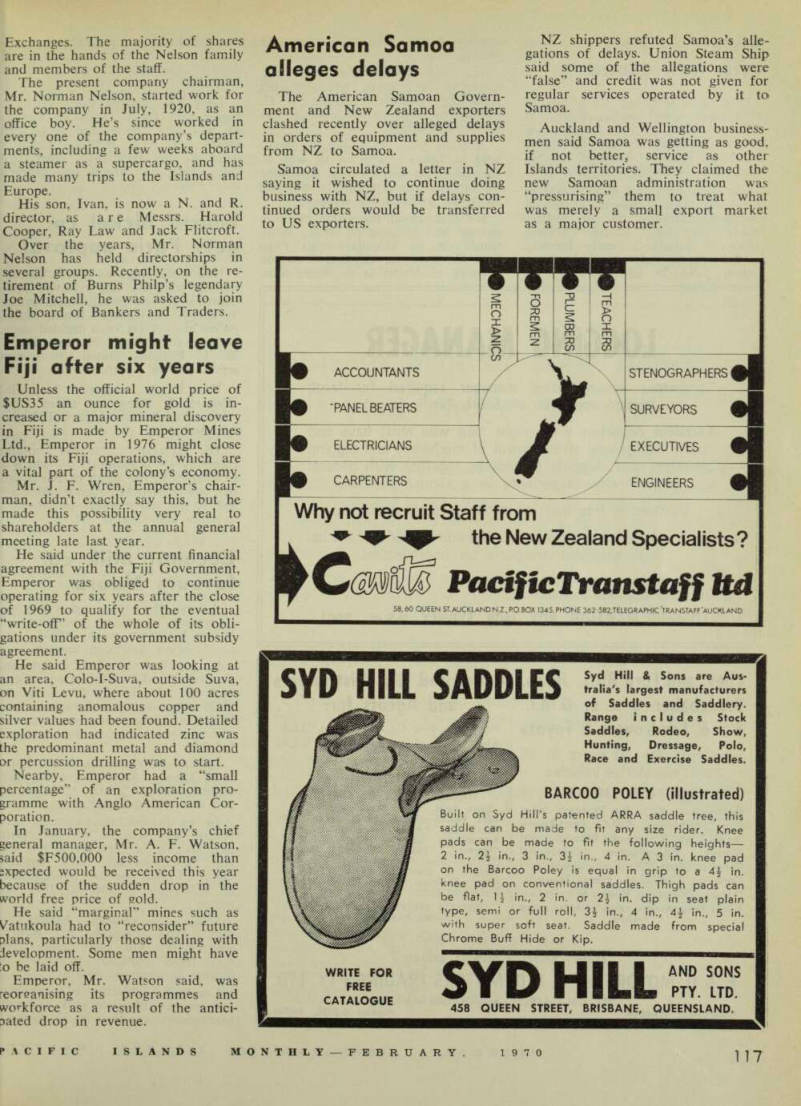
One of its two founders, Ivan Nelson, arrived in Sydney in 1888, a good-looking son of well-off Swedish parents who had given him an agricultural education.
He came on a “health trip”, stayed 53 years and died in Sydney in 1941.
He worked as a surveyor and a teller
in a now defunct bank before he met the shipbroker George Robert son.
Both put up £25 apiece in 1895, and on February 18 of that year formed Nelson and Robertson, ship brokers, in Loftus Street, Initial business was carrying coal to Fiji and returning with raw sugar to Sydney. Their first two ships were the City of Hankow and Mary Moore.
Mr. Robertson, who retired in 1910, handled shipping activities; Mr, Nelson turned his hand to commerce and from the early 1900’s began building up Islands business.
First came Western Samoa, then New Guinea, the Solomons, Fiji,
Norfolk Island and American Samoa.
Until 1946, when N. and R. dis posed of its one steamer, Poonbar, 30 sailing ships were bought, sold or chartered for cargoes from New Guinea to Denmark, Australia to Fiji and New Zealand and Australia to the US.
From an original staff of four, N. and R. now has a staff of over 100.
Subsidiaries include Rabaul Trading Company, with branches in Lae, Madang and Rabaul; a property group, Tusculum Pty. Ltd.; RTC World Travel of Rabaul; and N. and R. Travel Agency Pty. Ltd.
N. and R.’s best known activity is as a buyer and seller of Islands products, including cocoa, greensnail, chillies, crocodile skins, trochus and peanuts.
It recently sold out its equity in the John Burke line, but it acts as agents for this line and the Australian National Line’s new vessel Sydney Trader, on the Queensland run. It also acts, through its New Guinea associates, for overseas shipping in terests.
N. and R. has a half-interest, with an English group, in Teleflex Marine Products Ltd. of Sydney; a Sydney block of flats, and extensive land holdings at Rabaul, Lae and Madang.
Currently the directors have no thoughts of the company going public and being listed on Australian Stock
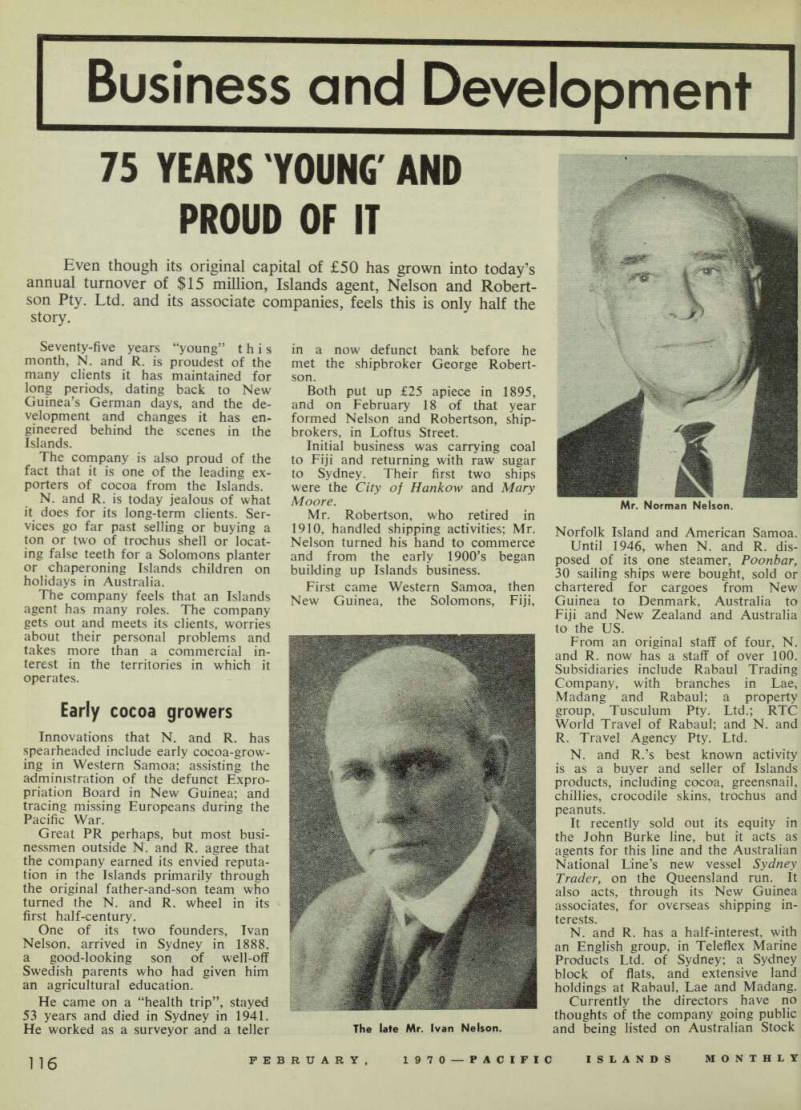
Mr. Norman Nelson.
The late Mr. Ivan Nelson.
Exchanges. The majority of shares are in the hands of the Nelson family and members of the staff.
The present company chairman, Mr. Norman Nelson, started work for the company in July, 1920, as an office boy. He’s since worked in every one of the company’s depart ments, including a few weeks aboard a steamer as a supercargo, and has made many trips to the Islands and Europe.
His son, Ivan, is now a N. and R. director, as are Messrs. Harold Cooper, Ray Law and Jack Flitcroft.
Over the years, Mr. Norman Nelson has held directorships in several groups. Recently, on the re tirement of Burns Philp’s legendary Joe Mitchell, he was asked to join the board of Bankers and Traders.
Emperor might leave
Fiji after six years
Unless the official world price of SUS3S an ounce for gold is in creased or a major mineral discovery in Fiji is made by Emperor Mines Ltd., Emperor in 1976 might close down its Fiji operations, which are a vital part of the colony’s economy.
Mr. J. F. Wren, Emperor’s chair man, didn’t exactly say this, but he made this possibility very real to shareholders at the annual general meeting late last year.
He said under the current financial agreement with the Fiji Government, Emperor was obliged to continue operating for six years after the close of 1969 to qualify for the eventual “write-off” of the whole of its obli gations under its government subsidy agreement.
He said Emperor was looking at an area, Colo-I-Suva, outside Suva, on Viti Levu, where about 100 acres containing anomalous copper and silver values had been found. Detailed exploration had indicated zinc was the predominant metal and diamond or percussion drilling was to start.
Nearby, Emperor had a “small percentage” of an exploration pro gramme with Anglo American Cor poration.
In January, the company’s chief general manager, Mr. A. F. Watson, said $F500,000 less income than expected would be received this year because of the sudden drop in the world free price of sold.
He said “marginal” mines such as Vatukoula had to “reconsider” future plans, particularly those dealing with development. Some men might have .o be laid off.
Emperor, Mr. Watson said, was reorganising its programmes and workforce as a result of the antici pated drop in revenue.
A mprlrnn American aamoa
alleaes delays
7 The American Samoan Government and New Zealand exporters clashed recently over alleged delays in orders of equipment and supplies from NZ to Samoa.
Samoa circulated a letter in NZ saying it wished to continue doing business with NZ, but if delays continued orders would be transferred to US exporters.
NZ shippers refuted Samoa’s alle gations of delays Union Steam Ship said some of the allegations were “false” and credit was not given for regular services operated by it to Samoa.
Auckland and Wellington business men sa j d s amoa was getting as good, if not better, service as other Islands territories. They claimed the new Samoan administration was “pressurising” them to treat what was merely a small export market as a major customer.
IS first
with new plane
Due to a puzzling crash landing on a small American Samoan island.
Ansett Airlines of New Guinea was able to introduce its new 20-passenger Otter aircraft ahead of its NG competitor. TAA, in late January.
The crash was of a $350,000 de Havilland Otter, which made an emergency landing on an isolated beach of Tau Island, Manua, American Samoa, in early January.
It was on a delivery flight from Kansas, USA, by an American ferry
company, to TAA for its NG operations.
The Otter skidded along the sand, careering into rocks which caused superficial damage. Captain J. C.
Averill. the only person aboard, was shaken but unhurt, A team from TAA and de Havil land in January was on its way to Tau to assess damage and determine whether it was worthwhile shipping l h e Otter overseas for repairs, It’s understood the Otter had run out of fuel because of strong head winds on its Honolulu-Pago Pago hop. However, an identical Otter, on delivery to Ansett at the same time.
reached Pago Pago safely, was de livered to Sydney, painted with Ansett colours, and introduced tc NG.
TAA had ordered three of these bigger and faster Otters to replace its NG fleet, at a total cost, with spares, of $1.5 million. Deliver)) dates of the company’s other two were uncertain. Ansett had ordered two Otters for NG.
Fourth nickel co.
gets Paris approval
New Caledonia’s so-called “fourth’ mining company has received Pari; approval for its establishment in th( Territory. The area of future exploi tation has not yet been decided upon however the group’s representative M. L. Poradier Duteil is nov established in Noumea.
The fourth company is callet “Penamax”, being an alliance be tween French Pennaroya and Ameri can Amax.
The Territory’s “second” minin] company “Cofimpac” which i to operate in the south of the island has now named Mr. Jacques Richard son to be its manager in Noumea as from about May.
Coconut milk co.
favours Nauru
Among the spate of companie attempting to set up operations oi Nauru in recent weeks ( PIM , Jan p. 25) is an American concern.
It is Cocomilk Ltd., originatin out of Seattle, Washington, Cocc milk is offering 15,000 shares o SUSI oar value at $lO each to rais< $150,000. Underwriting expenses an commissions will cost the compan $15,000.
Sponsor of Cocomilk is the Unci Sam Agency, Seattle, and its “prc visional director”, Mr. A. Hansvolc c/o Box 6676, Seattle.
In its prospectus, Cocomilk sa) Nauru was selected for incorpor£ tion because of “favourable tax law and the financially stable enviror ment afforded by the concentratio of phosphate wealth in this ne> nation”.
“Nauru is centrally located,” ; says, “and because of Naum' sovereignty, will offer more free dom from politically motivated ir fluence by overseas nations.”
Cocomilk’s objective is to produc and market substitute milk and mil by-products in the Pacific Island
“through the use of indigenous basic food ingredients.”
Cocomilk’s prospectus outlines various modern methods of extract ing milk and milk by-products. It says its main source of income will come from “dairy-type production”, possibly in Tonga.
Fats would come from coconut oil being manufactured in Tahiti (pre sumably from the two-year-old coco nut oil mill on Papeete Harbour).
Sugar would come from Fiji and other carbohydrates from “several Islands sources”.
Cocomilk says the initial $25,000 received from underwriting its stock will be escrowed with the Bank of New South Wales, Nauru. It indi cates it would prefer shareholders to be Islanders, rather than Europeans, and says its “organisational directors” will underwrite its share issue.
No stock exchange listing is men tioned for Cocomilk’s shares.
New Caledonia has
record 1970 budget
New Caledonia’s Territorial Assem bly passed a record budget during its November-January session.
A total expenditure of 5,376.867,- DOO CFP (approx. SAS3 million) is provided for, with administrative expenses being allocated 4,371 mil lion CFP; and 1,006 million CFP being devoted to capital investment.
Final budget figures depended on the recent 24% rise in the price of lickel on the world market. In face }f concern over inflationary effects jpon the French economy, the Paris government has allowed Caledonian lickel sold in France and the Com uon market a provisional price rise if 10%, with a further 10% rise to be granted later. Nickel sold on the foreign market has automatically lumped 24% in price.
Giant nickel growth
in Caledonia
Outside of Canada, New Caledonia is carrying out the greatest expan sion of nickel producing operations n the world.
International Nickel, Canadian lased and American-controlled pro lucer of nickel, recently estimated ? ut-ire production figures for the /arious expansion projects of Cale donia. They are: • Societe le Nickel, sole current iroducer, to increase output from 100 million lbs in 1968 to 130 mil lion lbs by 1971. • Kaiser, whose plant is expected
to be completed in 1971, to produce 30 million lbs per year. • Cofimpac, owned by Inco and French interests, could produce 100 million lbs in 1974. • Penamax GIF, owned by American Metal Climax and Pen arroya of France, could produce 100 million lbs in 1975.
O Patino Mining Corporation, with Societe le Nickel, could pro duce 80 million lbs in 1976.
If these projects all materialise, a Caledonian production of 440 million tons over half the free world’s current production is possible by 1976.
However, as Inco notes, with ex
pansion from other sources, free world production in 1976 is expected to be about 1.7 billion lbs.
Eskell not in
P-NG brewery
The prospectus for New Guinea’s second brewery was released in mid- January, with one surprise. New South Wales State parliamentarian, Mr. S. L. M. Eskell, was missing from the list of the company’s four directors.
As reported in PIM, December last year, three of the directors of Ter
ritory United Brewery Ltd. remain Messrs. N. A. White, chairman, Cliff Jackson, head of the Patair Group, and K. C. James, of Goroka.
Fourth director is Mr. A. J. S.
Cotter, also on the board of an Australian mineral exploration com pany, who replaces Mr. Eskell.
Mr, Eskell told PIM he resigned from TUB although he was “closely in with its moves to float in Aus tralia”. He had resigned for “per sonal reasons” and now had nothing to do with the company.
He said he “wished TUB all the best” and he had the “best relations” with its current directors. Mr. White had been “sorry” to accept his resignation. Mr. Eskell said there had been “no friction” between TUB and him; hotels in NG in which Mr Eskell had an interest would sell TUB beer.
Copper mining to
start in Irian
American miner, Freeport Sulphur, with an iron ore-copper deposit 60 miles inland from the south coast of West Irian, was in January re ported to have signed its first Irian contract—slo7 million—for export of copper to West German and Japanese buyers.
The company was also reported to have decided to buy a 40-seat Fokker Friendship aircraft for operations in the isolated Etsberg area, from base camps on the coast at Merauke and supply depots at Darwin, Australia.
The report said plans had been made to develop mines, at over 11,000 ft., and produce 60,000 tons of processed copper concentrate, enriched to about 20 per cent.
Reserves are estimated at 33 million tons of copper ore averaging 2.5 per cent, copper (five times Bougainville averages), as well as 0.02 ounces of gold ore and 0.3 ounces of silver ore per ton.
The report said all eight of Japan’s copper producing companies, including those associated with the Bougainville development, had signed the contract with Freeport Indonesia Inc. of Djakarta. They, and a German group, had agreed to supply loans of SUS 44 million ($2O million from Japan, $22 million from Germany) to the total cost of $l2O million for the project.
P]M understands Indonesia would prefer Freeport mounted its Irian operations out of Indonesia, rather than Darwin. This is a matter to be hammered out between the company and the Indonesian Government.
Coral can be
precious—if it's old
Charcoal from coconuts, jewellery from coral. It’s all very possible, according to experts, and if current experiments prove fruitful, new Islands industries and exports of these by-products could eventuate.
In New Guinea, cocoa and copra producer, Dylup Industries Pty. Ltd., has begun producing charcoal, of a “very high quality”, from coconuts at a rate of 50 tons a month.
The company says the charcoal is used in the pharmaceutical indus try and plans are to increase output.
In Hawaii, studies are continuing into methods of mining pink and black coral. The University ol Hawaii, Ocean Science and Engineer ing Inc. of Washington and Maui Divers Inc., of Hawaii are co-operat ing in the enterprise.
Pink coral is required to be about 75 years old and black 25 years old.
This year, Maui Divers, expects about SUSI million worth of busi ness from jewellery made from the “precious” corals. Pink coral has been fetching up to 1600 a pound and black, up to $7OO.
Japanese are currently leading the manufacturing field, but American businessmen are now paying interest,
Southland Mining's
future
Mr. Han Akhil, reputed to be Fiji’s richest man, because his 1.6 million shares in the Viti Levu manganese mine, Southland Mining Ltd., are worth S 9 million, is not expected to sell the shares even after February 6, when, under agreement with the company, he is permitted to do so.
With Southland’s other interests in African iron ore, New Caledonian nickel and New Hebrides manganese.
Mr. Akhil sees the company as a good, long-term investment.
The sudden sale of large numbers of shares would, in any event, cause the price to tumble. In January, on Australian stock exchanges, the 25 cent shares were changing hands at $5.50.
Strike ties up
Nickel Co.
A general strike began on January 16 at Doniambo smelting works of Societe le Nickel in Noumea over the company’s refusal to grant workers’ log of pay claims dating back to last August.
Major demand was for one month’s pay as a bonus per year. A bonus equivalent to two-thirds the monthly salary of workers was granted last year to engineers and white collar workers at the SLN. As we went to press talks were continuing on the dispute: so was the strike.
Trade briefs
• The W. R. Carpenter-Thomas Nationwide Transport door-to-door freighting service from Sydney and Brisbane to Lae, New Guinea, has disappointed in its first 12 months.
Volume of goods has been below estimates and the pair encountered strong competition from forwarding agents in both Lae and Sydney. • Prices for copra are going up and prices of cocoa are going down.
New Guinea Copra Board prices rose by $l2 a ton in January to a high of $l3O a ton for hot-air on news of improvements in prices from the world’s biggest producer, the Philippines. Increases in Ghana’s production of cocoa came to light in January, and prices per ton fell below $6OO lowest point since 1968. • Repco, Australian maker of automotive parts, has appointed Mr.
Peter Fisher, owner of Peter Fisher Trading Co., of Sydney, agent for its sales in French Polynesia, Guam, the US Trust Territory, Western Samoa, Tonga, the Gilbert and Ellice Islands and the Cook Islands.
Mr. Fisher, currently on a threemonth trip to Europe, is expected to return to Sydney in early March.
Late March he will begin an extensive sales tour of the US Trust Territory, Nauru, the GEIC and Fiji, where his firm exports a variety of products, from European knives to Australian beer. • After over two years looking for loggers prepared to develop vast
timberlands behind Vanimo, north west New Guinea, the NG Adminis tration has accepted an offer from a Melbourne-based group, Savoy Cor poration Ltd., to survey the area with Japanese paper company, Oji Paper Co. • The 50 cent and $1 shares of two major Island traders. Burns Philp and Steamships, dropped to their lowest level on Australian stock exchanges in over a year, in January, There were no apparent reasons for the falls. BP’s shares sold for $3.90, compared with a ’69 high of $6.50; Steamies, with a $1.03 ’69 high, sold for 67 cents.