both have something going for them
pp. 61-69 · Read in the full issue


Homespun Fiji and brash Honolulu both have something going for them
From SUE WENDT, in Suva “Sent my wife and kids to Hawaii for a month last year and, man, it cost me sixteen hun nerd bucks! But I been down here alone for close on five weeks and I haven’t even gone through
S6OO yet.”
The speaker, festooned with cameras, and hailing—so he informed anyone who was interested and any one who was not—from Alberta, Canada, was a fellow-passenger on a Suva day-cruise recently.
He was volubly enthusiastic about the cruise itself—particularly the price aspect. The trip cost $6 and included reef viewing, a live display of tropical fish and sea creatures gathered by lithe Fijians, several hours of sun and sea, a satisfying chicken lunch and a visit to a gen-u-wine tropical island —value for money if there ever was and better than any thing in Honolulu.
The Canadian observed that Fiji “had it all over the 50th State” and he sure hoped we were aware of it.
Fiji’s tourism moguls, understand ably obsessed with the idea of NOT becoming like Hawaii, purr happily when they hear praise for the simplicity, the authenticity, the friendliness of Fiji and its people, the cheapness of its ground transport and hotels.
A concrete jungle
Quite right, they say, Hawaii is definitely too commercialised . . . it’s a concrete jungle . . . it’s over priced and over-built. Nothing false about Fiji, they declare (though some renegade has begun to manufacture plastic bilos, and, for practical reasons, members of a meke group wear plastic and tinsel instead of voi voi and fresh flowers). Fiji, they insist MUST remain “unspoiled” if it is to continue netting large num bers of visitors, particularly North Americans, each year.
Until recently. I’ve heard only the warnings about not imitating Hawaii, without having seen Hawaii. As a destination holiday, it didn’t attract me much. Other people’s impressions
had evoked an image of a massive, though tawdrier and bawdier, Surfers Paradise; perhaps a little lusher and a lot more lavish, but no more truly paradise than I remember Australia’s Gold Coast to be.
After a week’s holiday at one of the newer Waikiki hotels, looking down from our 12th floor suite upon the burnished bodies of the original Beautiful People, dining at restau rants where the service was im peccable and the food unbeatable, en joying world class entertainment, buy ing at shops where fashions reached the ultimate in uninhibited creation, spending money, certainly, but enjoy ing every minute of it. I’m convinced that Fiji will never be like Hawaii.
Maybe better, maybe worse, but never the same.
For one thing, it’s hard to imagine Fiji (which had 138,175 visitors in 1968) absorbing more than a million
visitors annually, as Hawaii does now. The projected estimate for Hawaii —where tourism has been de scribed as an “instant giant”, whose growth exceeded all expectations—is for 2,200,000 visitors by 1972. They are expected to spend SUS79O million and tax revenue to the State and the counties will be SUSI 26 million.
Even back in 1955, when Hawaii had a mere 110,000 visitors the total revenue gained from tourism was SUSSS million.
Holiday yearning
Obviously, the impact of tourism on Hawaii’s economy is immense, almost beyond measurement—and de spite its critics, the 50th State is satisfying a holiday yearning that commercialisation and concrete jungles do little to despoil.
Boomtown Honolulu its popula-
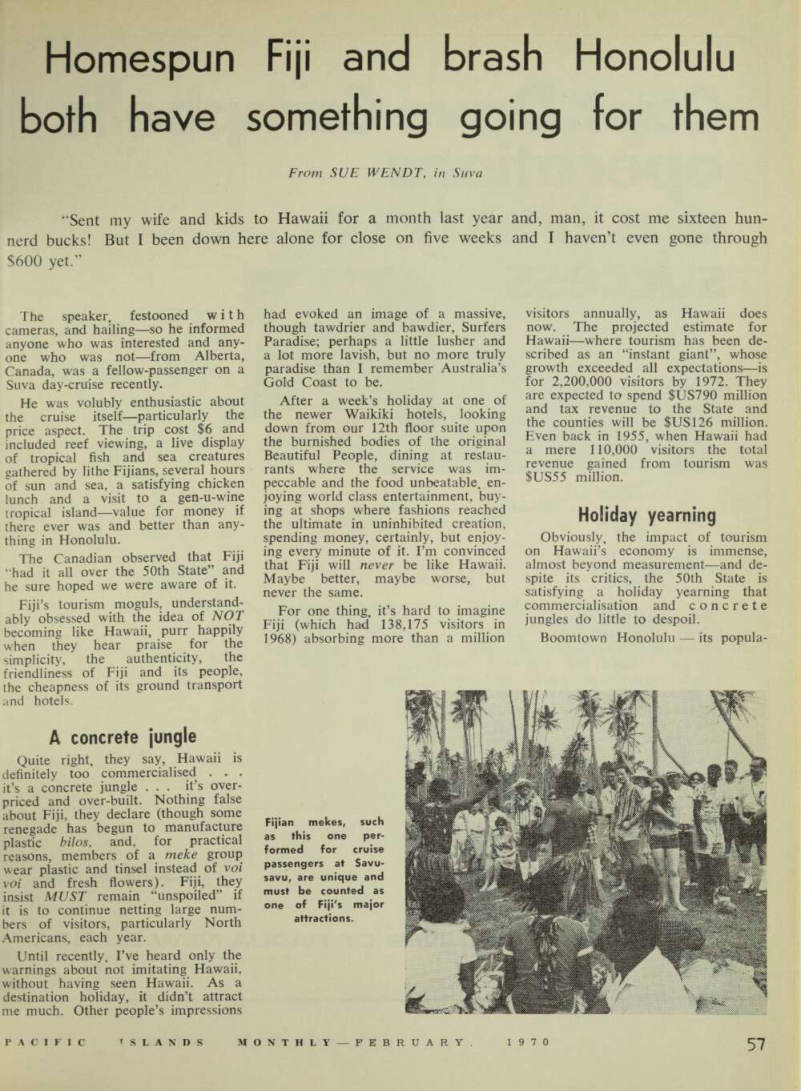
Fijian mekes, such as this one per formed for cruise passengers at Savu savu, are unique and must be counted as one of Fiji's major attractions.
tion increasing by 3 per cent, every year—is not the paradise of every body’s dreams. Certainly not in the sense of peace and tranquility, virgin beach and unchanged customs and people.
The noises of traffic and building projects vie with the twang of the ukeleles and the strong voices of Hawaiian entertainers. Leis, though colourful, are frequently false and the first taste of poi can be awfully disillusioning. Food is expensive and liquor exorbitant. Hippies gather on corners, hold protest marches, and sleep, like bums, on the beach.
But it is a happy town, where every night is Saturday night; where the atmosphere is definitely South Seas carefree; where the poignancy of re union happens 10,000 times a month when jaded soldiers arrive from the battlefields of Vietnam to meet with wives and fiancees for brief “Rest and Recuperation” leave; where buildings tower 20 storeys and the people boast of many racial strains.
Above all—looking at it purely from a tourist’s viewpoint—it is a town that welcomes tourists and turns itself inside out to make them happy.
One doesn’t, of course, have to stay in swinging Honolulu—the Neighbour Islands possess the real assets of paradise and a million visitors were expected to sample them during 1969.
Here, one can still pretend to be Getting Away from It All—and it costs rather less to get there from the US Mainland than it does to go to Fiji.
Hawaii far ahead
In terms of comfort, spectacular accommodation and luxury facilities, Hawaii is unbelievably far ahead of Fiji. You can’t bridge a gap of maybe 15 or 20 years overnight—and by the time Fiji does catch up (with the help of investors, for the locals can’t afford it), Hawaii will be that much further ahead again.
When one realises that there’s not a hot dog rotisserie or a hamburger joint to be found in Fiji, not to men tion the dearth here of blue movie houses and topless waitresses, one realises the width of the gap between the two societies!
For Americans, however, and probably for many Australian and European travellers as well, part of Fiji’s attraction is its homespun air, its impression of being just a little bit behind. But one mustn’t imagine that Fiji is going to stand still for the sake of pandering to tourist tastes —nor, as recent moves indicate, does
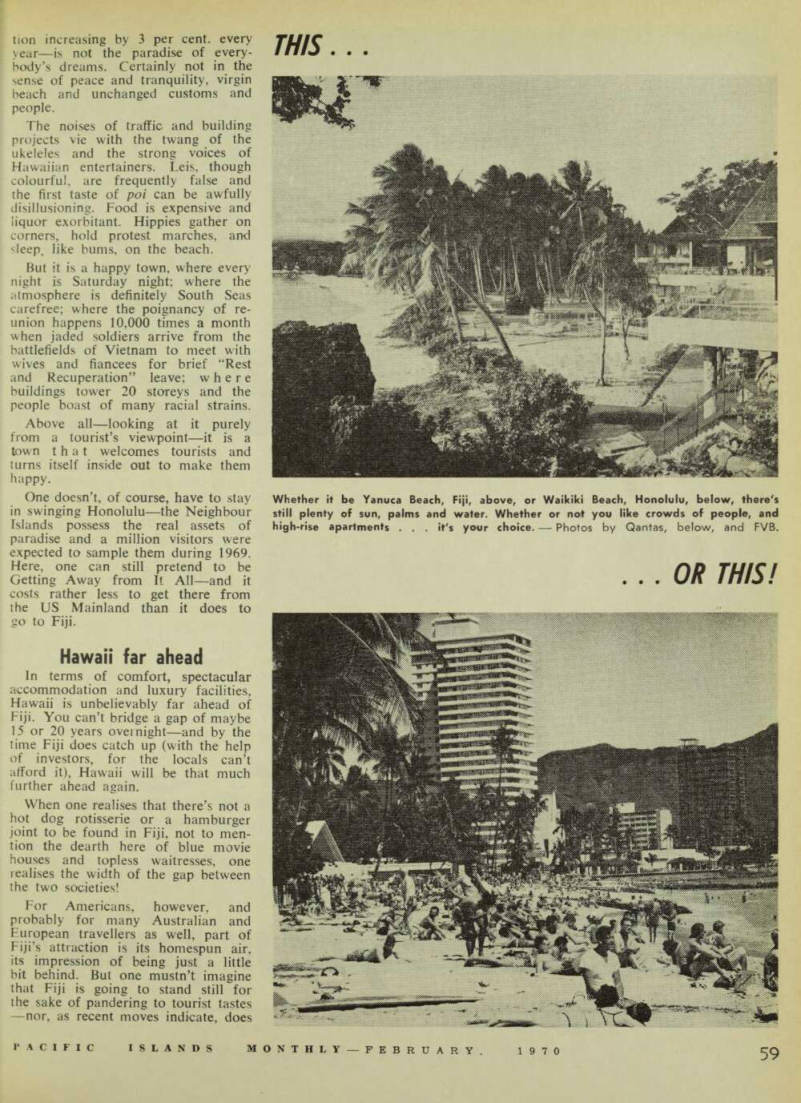
This . . .
... Or This!
Whether it be Yanuca Beach, Fiji, above, or Waikiki Beach, Honolulu, below, there's still plenty of sun, palms and water. Whether or not you like crowds of people, and high-rise apartments . . . it's your choice. Photos by Qantas, below, and FVB.
it seem inclined to make undue con cessions.
The recent abolition of Sunday trading in Suva—although one hopes it is temporary—is an example of Fiji’s reluctance to please the tourist no matter what the sacrifice.
In terms of service, it’s difficult to see the time when Fiji as a whole might be on a par with Hawaii. In Fiji today, hotel service is either hap hazard, but delivered with an enorm ous amount of good humour, or else it is fairly efficient, while lacking the ready smile that tourists talk of as being Fiji’s biggest asset.
Little time to smile
At one particular Suva hotel, one of the newer ones, the dining room is as efficient as any I saw in Hono lulu. Los Angeles or San Francisco— but as a natural outcome of trying desperately hard to do anything pro perly (even to the extent of asking how you’d like your steak done!) the Fijian waiters and waitresses find little time to smile. Their endearing spontaneity has gone, along with their lackadaisical way of doing things.
At another high-standard hotel, the staff members grin broadly most of the time, and jig in rhythm to the music on their way to the kitchen, but their service is not always what one expects!
Hard to forget
A young advertising man had an experience there last month he’ll find hard to forget. Because his boss was away, it fell to him to entertain a visiting Sydney newspaper publishing executive—-a pretty important man to the advertising agency concerned— and his wife, when they were in Suva for a day during a Pacific cruise.
The day started badly when the large air-conditioned car he’d hired broke down before they’d even left the wharf. But the real blow came at the end of the day when the young man and his two charges were dining at the hotel. About half-way through the meal the wife half rose from her chair with the intention of pulling it towards her. The Fijian waiter darted forward, zipped the chair from under her and watched wide-eyed as she crashed to the floor.
Then, overcome by the enormity of his mistake, he burst into pro longed laughter. Fortunately for all concerned, so did the wife. But the young advertising man says his own humiliation was palpable.
There are many stories like this in
Broad Fijian grin
Fiji, but this one I know to be true.
The message seems to be that while you can teach a man to give service, it’s pretty hard to school him to use judgment.
A broad white Fijian grin has made up for many a mistake in the past but as he learns to become more pro ficient at his work, more conscious of the probability of being tipped for service and less casual about be ing sacked from his job, the Fijian worker in tourism might find he has too much to think about to smile at every passing stranger. And if he doesn’t smile—there goes one of Fiji’s number one attractions.
On the other hand, Fiji should guard against the kind of slick super ficiality of the Hawaiian Greeter Girl I saw at Honolulu Airport.
Smile for the camera!
A pert, pretty part-Hawaiian with waist-length tresses, whose job was to go up to a group of new arrivals, slip her arm through that of the nearest male and, without even a word of introduction, smile for the camera. She would then pass the phone number of the photographic agency on to the somewhat bemused tourist and move on to the next group.
The photograph might make a nice souvenir to show the gullible boys back home, but it was an example of the worst kind of tourist “con”.
Its not hard to decide what makes Fiji unique among tourist resorts.
It’s certainly not the sunshine alone, the beach-ringed outer islands or the faintly seedy Colonial air, the duty free shopping nor the multi-racial population. But the combination of them all, held together by Indian and Fijian cultures, makes these islands different from most other holiday destinations.
Tourists want more When he spoke at Fiji’s ninth annual tourism convention last October, Mr. Robert H. Burns, gen eral manager of the sumptuous Kahala Hilton Hotel, Honolulu, pointed out that the visitor who travels several thousand miles is not just interested in sunning on the beach. Most travellers can do that pretty close to home.
He claimed that to most tourists, travel is a status symbol—a fact that is to Fiji’s great advantage. Being able to discuss with his contem-
New culture emerging
poraries the far-away places he’s been able to visit carries far more prestige for today’s American than anew Rolls or a Lincoln Continental.
“Anyone can have one of those but how many people on his block can travel to Fiji and talk knowledgeably about its population and its culture?” he asked.
“Fiji, like Hawaii, has its own unique culture—this should be em phasised. Even if it’s a little ersatz.
In Hawaii, there are very few Poly nesian or Hawaiian shows left on the islands—very few places you can still experience the old Hawaiian culture. There is anew culture emerging now—the blending of many races—and we are trying to emphasise that.
“But the visitor, we find, is so starved for something new and exotic that he flocks to the places that still provide a glimpse of another world.
“So—you have the chance now— be careful to preserve a little bit of what you consider unique that the visitor will be interested in—it’s go ing to pay handsome dividends in the future.”
There seems little doubt that Fiji, with commendable foresight, is de termined to preserve its customs and traditions as zealously as possible.
The Chief Minister has made that clear.
At the same time, the problem is how best to continue pleasing the tourist—the very tourist who has helped provide the people of Hawaii with a healthy economy and varied opportunity. Making cruise passengers feel unwelcome on a Sunday, for in stance, will not please them—but this is only a small matter, affecting a few ships.
It will be the task of the proposed Fiji Tourist Commission (the bill was debated during December’s Legislative Council session) to decide how far “the true culture and customs of the people of Fiji” can be sacrificed—and utilised—in return for Mr. Burns’ “handsome dividends in the future.” • Mr. Tom Huxley, owner of the Plantation Hotel, Madang, New Guinea, has applied to lease a hotel site on nearby volcanic Karkar Island.
The site, near Karkar’s light aircraft airstrip, will be serviced by air from a small strip. Mr. Huxley will build an airstrip near the Plantation hotel, should his application be successful.