Human
pp. 55-58 · Read in the full issue
wreckage of the war
Human u/teckaqe
By Bruce Adams
It's called the dearest piece of real estate in the South Pacific. It's less than two miles long, 500 yards at its widest point and no more than 10 feet high. It's an atoll in the British Gilberts Group, Tarawa.
The cost, not in money, was over 5.000 American and Japanese lives.
It was the worst blood-bath for either side compared for its size in the whole of the Pacific War.
I recently returned to Sydney from this now island paradise, with its palm trees swaying and the blue Pacific washing on its shores. It was hard to believe that on these small atolls 26 years ago men died by the thousands in just three to four days.
I had been taking photographs and collecting information for my new book, "Battleground South Pacific".
The main atoll, Betio, where prac tically all the fighting took place, is still covered with battle relics. Guns, block-houses, pill-boxes, tanks, rusting amtracs, parts of aircraft, hulks of ships—and a few feet under the sand, —hundreds of Japanese and American skeletons.
Indeed, human wreckage from the war can be found in a good many areas of the Pacific only a few feet below the ground, usually in un marked graves. But the worst spots are Tarawa and the island of Bougain ville, where it is believed some 11.000 bodies still lie unclaimed.
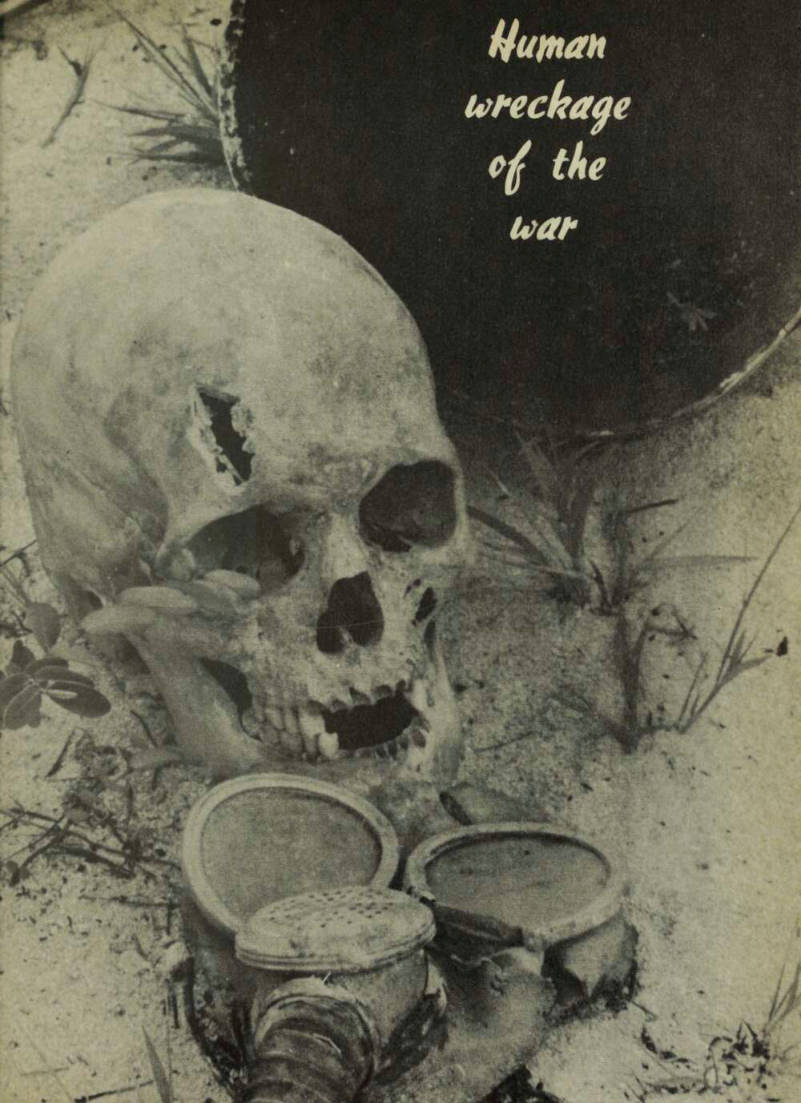
My picture from the previous page gives a comprehensive look at what can be found. A skull with a (bullet?) hole through the forehead ... a Marine Corps helmet and a Japanese gas mask.
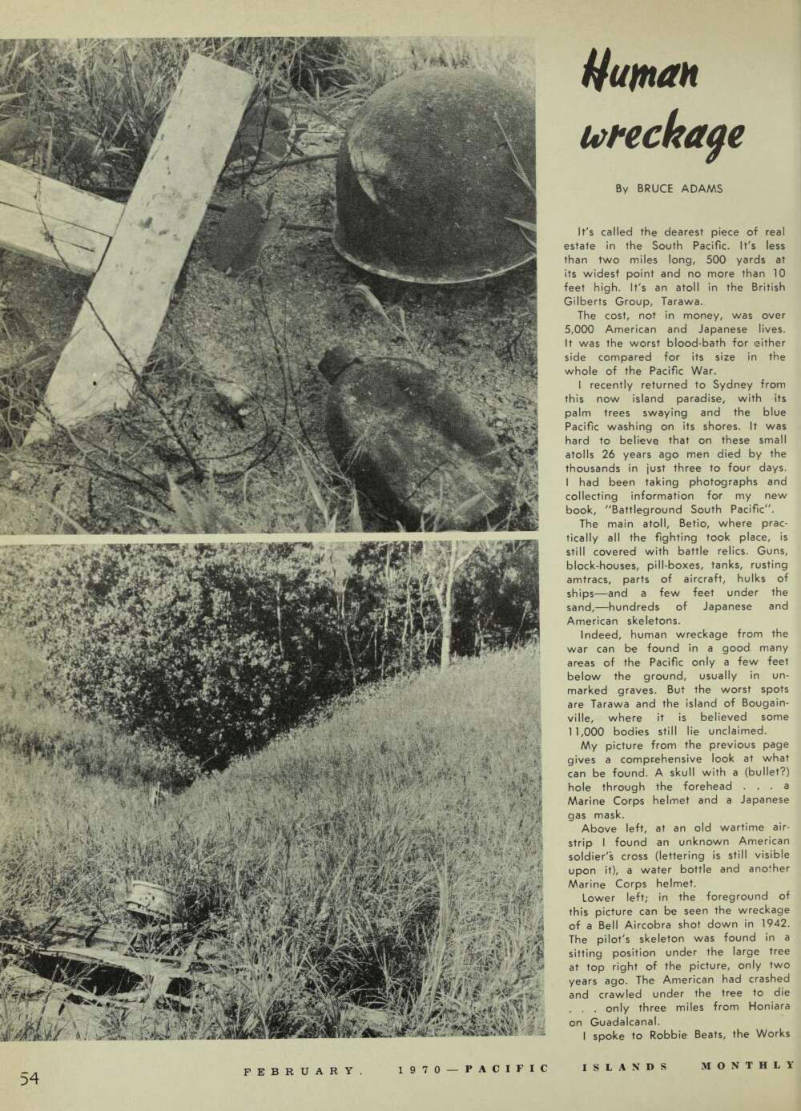
Above left, at an old wartime air strip I found an unknown American soldier's cross (lettering is still visible upon it), a water bottle and another Marine Corps helmet.
Lower left; in the foreground of this picture can be seen the wreckage of a Bell Aircobra shot down in 1942.
The pilot's skeleton was found in a sitting position under the large tree at top right of the picture, only two years ago. The American had crashed and crawled under the tree to die . . . only three miles from Honiara on Guadalcanal.
I spoke to Robbie Beats, the Works
Supervisor for the British Government on Betio. He told me everytime they lay new cables, they invariably dig up bones, skulls, ammunition and unidentified crosses.
The Japanese had an airstrip on Betio, and people in the area say there are dozens of American bodies under the airstrip. When the US War Graves Registration unit arrived they could only find half of the Ameri cans who were killed. And since the war there have never been any Japanese War Graves teams in the area.
I walked along the beaches where the marines were slaughtered. They had waded hundreds of yards to shore, heavily laden with equipment.
Hundreds were killed in the cross fire —some that could not swim had drowned.
On Bougainville, natives are still paid annually four cents a skull for Japanese soldiers whose skulls they find. The Japanese War Graves Com mission even supplies them with plastic bags in which to store the remains.
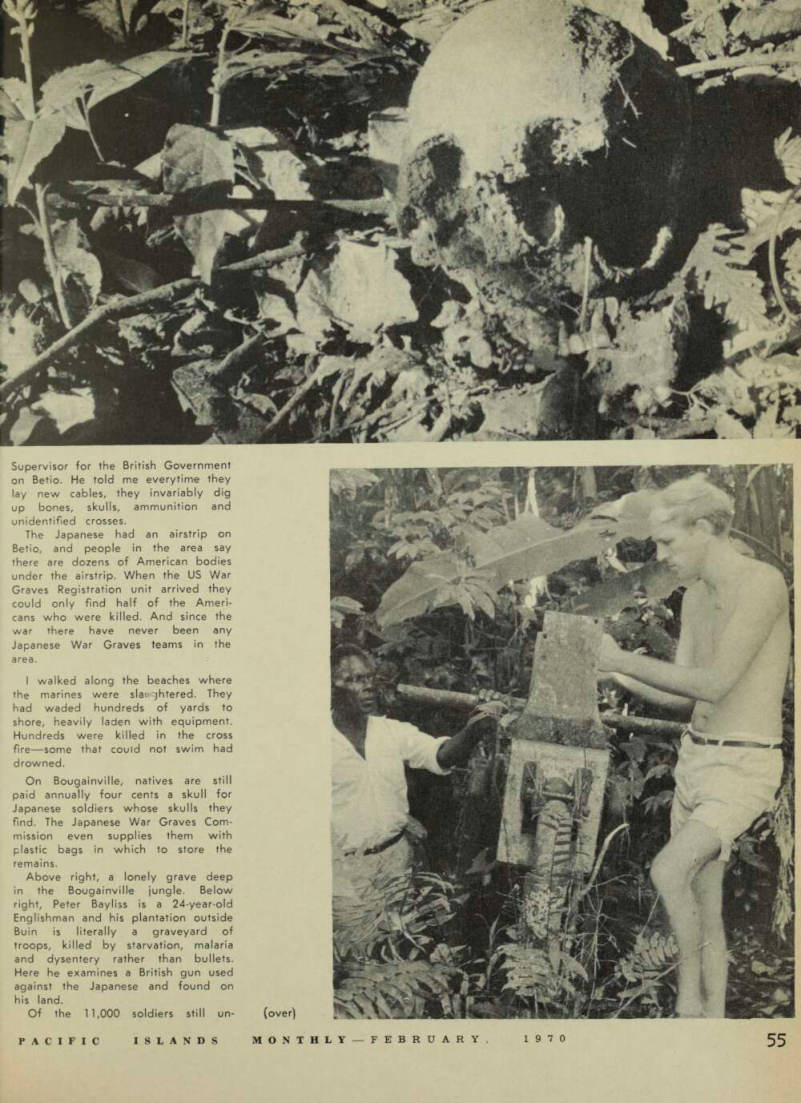
Above right, a lonely grave deep in the Bougainville jungle. Below right, Peter Bayliss is a 24-year-old Englishman and his plantation outside Buin is literally a graveyard of troops, killed by starvation, malaria and dysentery rather than bullets.
Here he examines a British gun used against the Japanese and found on his land.
Of the 11,000 soldiers still un- (over)
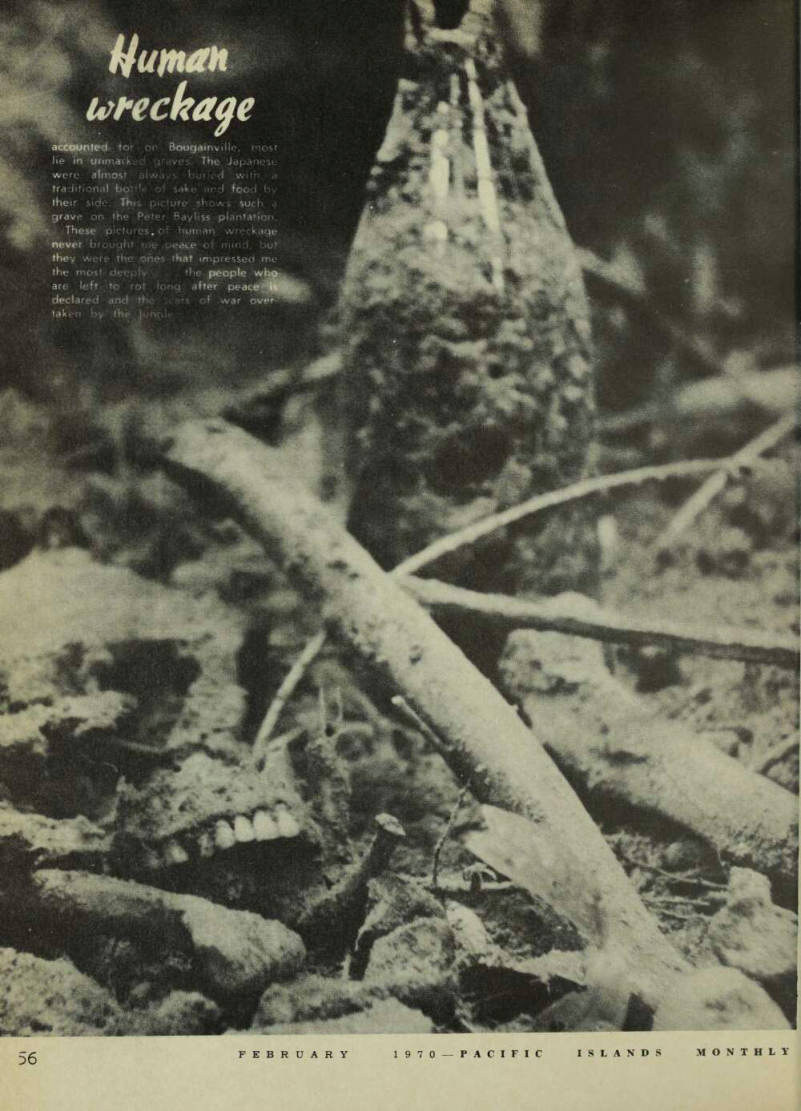
accounted for on Bougainville, most lie in unmarked graves. The Japanese were almost always buried with a traditional bottle of sake and food by their side. This picture shows such a grave on the Peter Bayliss plantation.
These pictures of human wreckage never Brought me peace of mind, but they were the ones that impressed me the most deeply . . . the people who are left to rot long after peace is declared and the [?]cars of war over taken by the Jungle.