the 'fonctionnaire'
pp. 46-47 · Read in the full issue
The man who fought the 'fonctionnaire' is mourned
Old-timers of New Caledonia in December mourned the death of H. E. L. Friday, one of the territory’s best-remembered resi dents. This tribute comes from a friend who knew him there during the war years.
Some time before the war, during the war and for a year or two after the conflict ended, “Preeday”, as he was called, was as well known in Noumea as the “Coconut Square” he often wrote of. New Caledonia is indebted to Friday not only for his writings about it but also be cause, for some time in the difficult days following the change over to de Gaulle and Free France, he served as a professor of English at the local college.
Many a middle aged person in Noumea can recall with a chuckle fun had in his classes and the jokes played on him as he tried to get the message across in his average French.
Immense research
The book by which he is best known is The War from Coconut Square, but it is overshadowed in reality by Cannibal Island (“O Cale donia stern and Wild”), the first of what was to have been a number of books on New Caledonian history.
An immense amount of research went into this book and it could well have been used as a text book on NC history. Unfortunately many obstacles arose which made continu ation of the work impossible without subsidy, which no one, of course, was willing to supply.
Friday was the kindest and most humorous of men. In his early days he was secretary to W.
Somerset Maugham and lived with him on the Cote d‘Azur. He often used to boast of a record swim he once made across the bay of St.
Tropez. He loved New Caledonia and likened the locals to the Aus tralian country people.
He had, however, little time for the French governing class, the fonctionnaire, and two clashes he had with them were both disastrous for him.
The first was with de Gaulle’s
envoy, Admiral d’Argenlieu, and occurred some time after the Battle of the Coral Sea. By his high handed methods the Admiral had incurred the hatred of Noumeans and they finally rose in revolt. Following a huge public demonstration d’Argen lieu fled to the country and was made prisoner there. He was finally released and resumed his position in Noumea.
Friday, as chief correspondent of the most important news agencies, was called in by the Admiral and asked to whitewash the whole affair.
This he refused to do and efforts were made to have him relieved of his position as correspondent, un successfully.
Had his revenge
The Admiral had his revenge when some months later the second contingent of New Caledonian volunteers was to sail for the front.
Friday obtained permission to accompany the men as correspon dent and the night before the sailing date he was issued with a uniform, and entered barracks. During the night, however, messages were ex changed between Noumea and London and Friday next day found himself ejected. The Admiral had had his revenge (he had returned to London some time previously).
His next scrap was much more serious and was with a post-war governor of NC. Friday had turned his attention to the Societe le Nickel, his bete noir, and had been continu ally submitting articles denouncing the conditions under which the SLN housed the coloured labour in its employ.
Censorship was still in force and each time the censor ruled out Friday’s references to SLN. Finally he received a letter from the governor asking him “if he really desired to stay in NC and if so to cease his attacks on SLN”. Friday asked for an interview and in com pany with the Australian Consul of the time, called on the governor.
From Friday’s account the call was a stormy one. He gave his point of view and not only shook the governor but shocked the consul.
He left New Caledonia soon after, a step ahead of being expelled, it was said. He came back on a short visit to Noumea some years ago and had every intention of coming back for a long stay after his European trip.
Few who knew him in 1942 will forget his stocky figure in a US Army uniform with the armband with a big “C” on it. When first issued with this outfit he was delighted (he
said) with the attitude of everyone., People were so genteel, everyone smiled when they saw him in the new uniform. No one had the heart (until much later) to tell him that the reason for the smiles was the letter “C”, which in France is used to denote a portion of female anatomy not advertised in polite society.
He lived in a house near the morgue of the US Forces and when anybody wanted Friday they rang the morgue. He was very proud of this. It was never wise to visit him (at least not often) at meal times, as he had contacts with the NZ Army from which he obtained a seemingly never-ending supply of canned lamb’s tongue. It was the only item ever served at his table.
Grotesque situations
He had a genius for blundering into grotesque situations. A few: • Shortly before the Free French revolution in NC, two men were pried apart in the bar of the Old Central Hotel. They were both Englishmen. One was Friday and he had come to blows with his fellow countryman over, of all things, the respective merits of Petain and de Gaulle. • Once on a visit to the town of Bourail and walking along its main street (the main is the land road)' he noticed big nails driven into the road’s surface and started pulling them up, mumbling something about cars running over them and getting punctures.
It was only after about five: minutes that he saw in the distance a man dancing with rage, and real
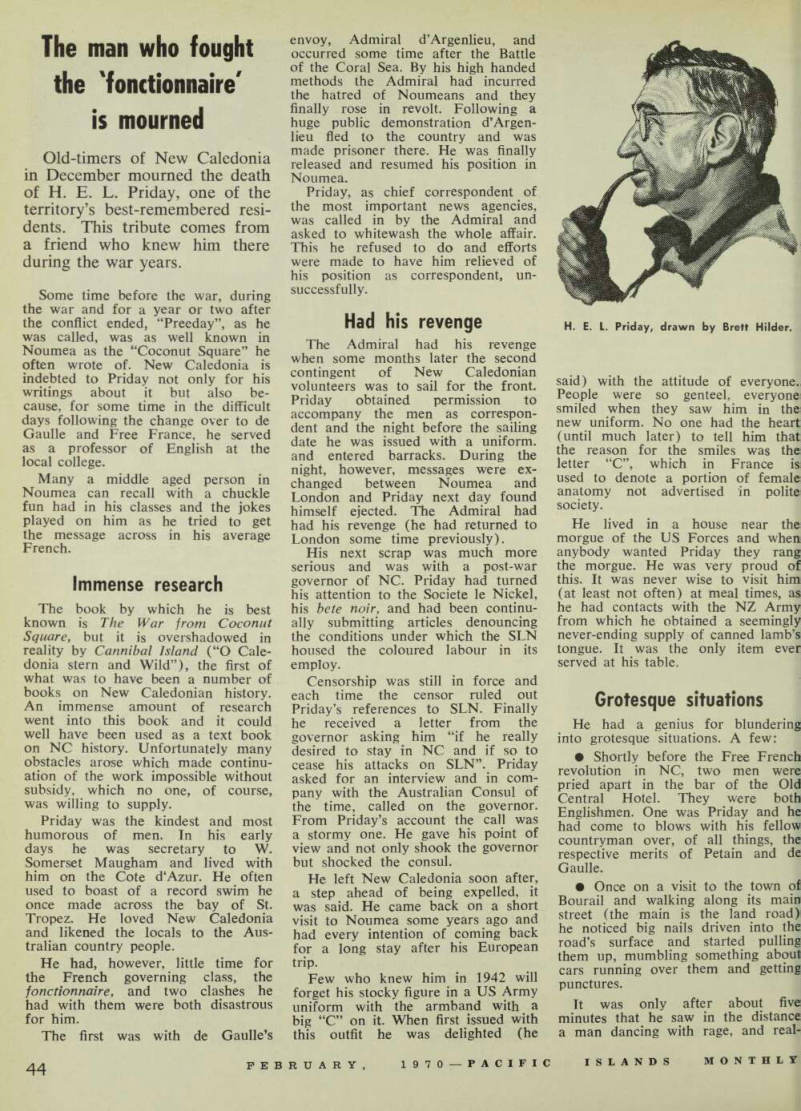
H. E. L. Priday, drawn by Brett Hilder.
ised that he had been pulling up the chain marks of a surveyor. • On a visit to the tiny village of Ponerihuoen, while standing on the ferry landing in the middle of the village, Friday decided it was hot and he wanted to bathe. He stripped off everything and slipped into the river and enjoyed a swim.
Of course it was the siesta hour but if the village streets had been crowded it still might not have hin dered Friday. • On a trip to Isle of Pines on a native outrigger he was held up by a half cyclone and spent a wild and windy night reciting to the crew of the outrigger verses from Shakes peare’s Tempest. They could not understand a word, he related later, but they sensed what the words meant. • He loved to tell the story of a night he spent in a ruined native hut with the late Mick Griffiths, ex Australian boxer and New Caledonia nickel prospector. They slept well, he said, on two old broken down beds. He later learned that it was the home of two lepers who had died there.
Hooked a body
However, he never surpassed him self in the grotesque, as when he went fishing on the islands ships wharf at Noumea. He hooked some thing and after a good deal of difficulty brought it to the surface only to find himself staring into the face of a very dead US soldier. The line broke and it was only after two days that the body was finally found on the other side of the harbour.
Several marks of sympathy have been shown locally following the report of Friday’s death. The local Bulletin du Commerce had a very sympathetic reference to him, stating that “he was very well known in Noumea during the war”, probably one of the year’s greatest under statements.
One old-timer was heard to say, "Freeday, c’etait un hon gars”, an epitaph which would greatly have pleased him. • Up to 100,000 copies of the 1970 Papua-New Guinea telephone directory will be printed. About 40,000 of these will be distributed to telephone subscribers or sold over the counter in P-NG but the rest will circulate overseas, mainly in Aus tralia, where they are in demand by business houses and mail order organ isations.