Bougainville 4,000
pp. 43-45 · Read in the full issue
Another Husband
For The
Princess?
it was a legal marriage. So far as Tonga is concerned it was a legal annulment. And there the matter rests for the time being.
Bougainville 4,000
years ago
The pre-history of Bougainville is completely unknown—but American archaeologist, Mr. John Terrell, is out to change all that. He has just completed 10 months excavating and surveying on the island and is due back soon to lead a three-month expedition to Buin, which has never been excavated before.
He says only four archaeologists have ever worked in Bougainville and, to date, material found has dated back to only 500 BC. As material dated far earlier than that has been found in surrounding islands, he be lieves that settlement took place in Bougainville at least 2,000 years earlier.
During his stay last year he planned the expedition and looked for ex planations for the cultural diversity of the island. He worked for three months in Teop, off the north west, coast, and was made a member of the Namai clan there. His native name was Kamahira, a name belong ing to an important man of the past who had led the clan down from the hills.
This year’s expedition will attempt to find out, by surveying and ex cavating, a general idea of the sequence of development of South Bougainville.
What's in a name?
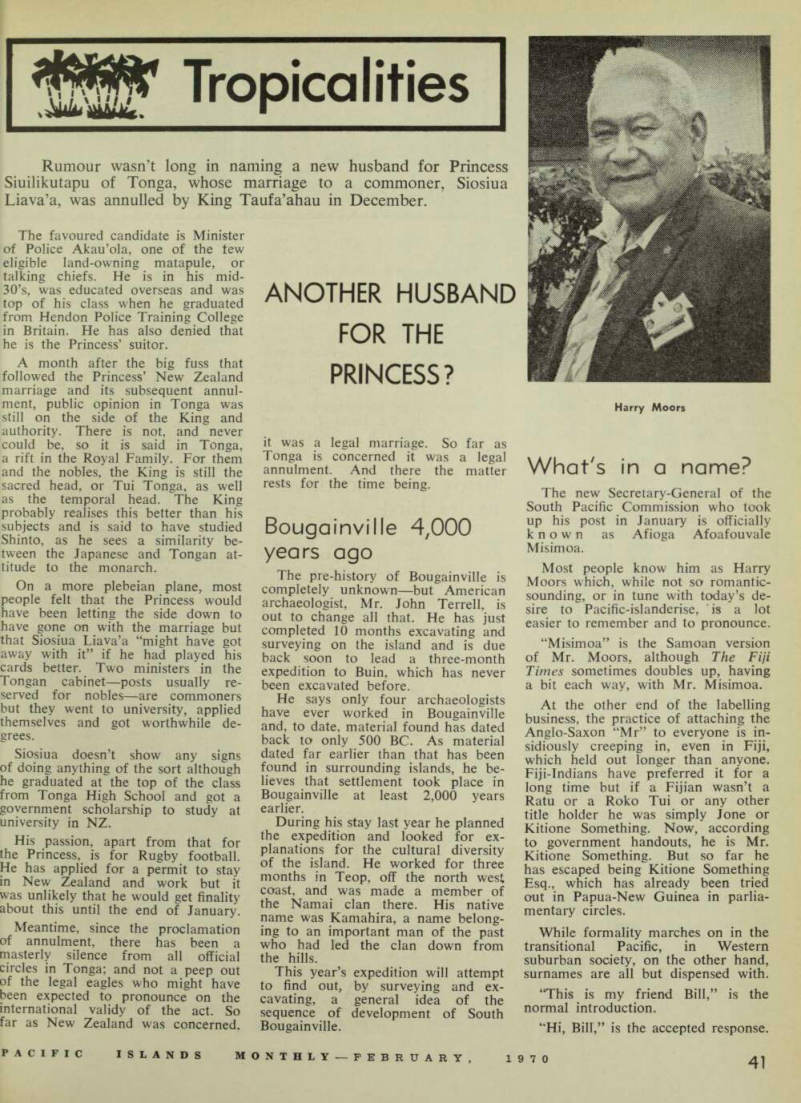
The new Secretary-General of the South Pacific Commission who took up his post in January is officially known as Afioga Afoafouvale Misimoa.
Most people know him as Harry Moors which, while not so romantic sounding, or in tune with today’s de sire to Pacific-islanderise, is a lot easier to remember and to pronounce.
“Misimoa” is the Samoan version of Mr. Moors, although The Fiji Times sometimes doubles up, having a bit each way, with Mr. Misimoa.
At the other end of the labelling business, the practice of attaching the Anglo-Saxon “Mr” to everyone is in sidiously creeping in, even in Fiji, which held out longer than anyone.
Fiji-Indians have preferred it for a long time but if a Fijian wasn’t a Ratu or a Roko Tui or any other title holder he was simply Tone or Kitione Something. Now, according to government handouts, he is Mr.
Kitione Something. But so far he has escaped being Kitione Something Esq., which has already been tried out in Papua-New Guinea in parlia mentary circles.
While formality marches on in the transitional Pacific, in Western suburban society, on the other hand, surnames are all but dispensed with.
“This is my friend Bill,” is the normal introduction.
“Hi, Bill,” is the accepted response.
Harry Moors
When "magic"
located wrecked
Hebrideans
Older residents of the New Hebrides will remember Sir George Joy, who was Resident Commissioner there for many years. He later was Governor of St. Helena, spent two years in Arabia and was then Civil Secretary at Aden. When last heard from he was honorary secretary to the Society for Psychical Research in London, a scientific body that makes investigations into telepathy, pre cognition and so forth.
In the matter of telepathy Sir George relates this story from his New Hebridean experiences: “In 1932 there was a fairly severe hurricane and one of the small copra ships, with 15 people on board, did not return to Vila. After a wait of several weeks it was presumed that it had been lost with all hands. It was a French vessel and as all had relations in Vila or in the outer islands, there was a great emotional upset.
“My French colleague (M. Sautot of other fame) decided, in consulta tion with the Monseigneur, that there should be a Mass for the Dead at the Catholic church. The whole com munity went with myself and col league in full regalia, trappings and all (the French love uniforms and ceremony), and shed many tears.
“But there was an old woman in Vila who dealt in what is known as ‘radesthesia’, though she called it by another name. She had a map of the Group and a pendulum. This she held over the map, while she recited incantations: the pendulum swung backwards and forwards across the map but always pointed to a small coral atoll far away to the south west of the Group.
“There, said she with conviction, were the 15 occupants of the sup posedly lost vessel. She persisted with such vigour that eventually the master of one of the Burns Philp vessels decided to go to look, although it took him well out of the usual course.
“There on the atoll, were the 15 survivors, whom we had decently buried, all alive and kicking and not much the worse for their ex perience, although stranded and isolated and their vessel wrecked.
“The master took them aboard and wirelessed Port Vila. You can imagine the scene and commotion which the news caused. On the appointed hour, my colleague and I with the whole of the Vila community, went down to the wharf to welcome the
survivors, together with the local brass band.
“Tricolours and Union Jacks were everywhere and much champagne at six shillings or so a bottle. As the men came ashore, the band played the two national anthems, Sautot and I stood at the salute, everyone kissed everyone, the lost-ones were reunited with their families and a col lection was made there and then for the old woman.
“Whether the Monseigneur undid the Mass for the Dead I do not know! This story is as factual as I can recollect.”
Army says goodbye
to its bird
They’re trained to kill, but the troops of the Second Battalion Pacific Islands Regiment had a tear in the eyes recently when a mascot died.
The mascot was a cassowary the battalion received last year on a long-range patrol in the Gulf District of Papua.
At Wewak in November it died unexpectedly and was given a burial in the PIR cemetery with full military honours. A photograph in colour has been hung in the Officers’ Mess.
Officer Commanding, Lieutenant- Colonel McKenzie said: “We’ll miss that bird ... it was just at the stage where it was beginning to obey com mands on ceremonials”.
Sunset dinners
at Bora Bora
One of PlM’s keenest readers in the outer reaches of French Poly nesia is Alec Bourgerie, affable man ager of the Hotel Bora Bora for several years. Recently, a PIM staff writer who put in a night at Alec’s luxury pub found Alec was addicted to “sunset dinners” on the hotel’s beach, facing the huge Bora Bora lagoon.
With help from locals who turn up en masse to down beer and pork, Alec roasts two large pigs on spits
above the sand. Guests are servec this with red wines and French brea« at long benches, while Bora Bon dancers and singers entertain for ai hour and a half.
The hotel has 32 standard bun galows with rates from SUS4O to s7< a night and nine de luxe overwate bungalows, with rates from S5O t( $BO a night. Five new overwate bungalows will be built in 1970.
While the rates are high, the: do include all meals and many extra —and Bora Bora, says the PIM man is one of the most beautiful place in the world!
Soli succeeds
in Samoa
Latest Islander to give the lie tc the myth that no Islander can rui his own business successfully is aj American Samoan, Soli Aolaolagi the 46-year-old owner of “Soli’s Res taurant”, second of the territory’ first-class restaurants.
Using a loan of $25,000 from th< Bank of American Samoa am $lO,OOO of his own and his family’ money, Soli built and opened hi restaurant on the shores of Pag< Pago harbour early in 1969.
With seating for 54 people, meal varying from Indian chicken curr to barbecued beef or lobster tails floor show three nights a week am a total staff of 24 Samoans, “Soli’
Restaurant” has been clocking up ; turnover of over SUS 1,000 a week.
Soli’s wife, Simeamativa, and at: tractive daughter, Christina, 19, havi been giving valuable help with th< cooking, serving and ushering O'
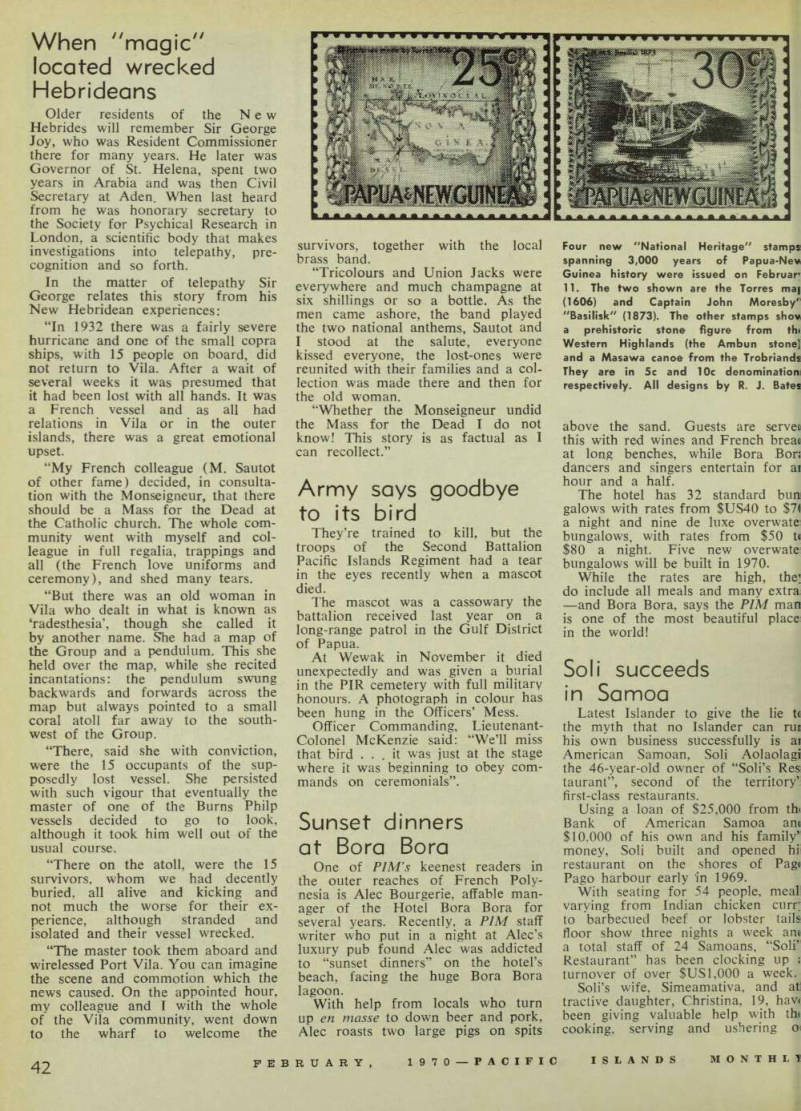
Four new "National Heritage" stamps spanning 3,000 years of Papua-New Guinea history were issued on Februar 11. The two shown are the Torres ma| (1606) and Captain John Moresby' 1 "Basilisk" (1873). The other stamps show a prehistoric stone figure from th* Western Highlands (the Ambun stone) and a Masawa canoe from the Trobriands They are in 5c and 10c denomination! respectively. All designs by R. J. Bates
guests. Service is so prompt com pared with other Islands’ restaurants that it’s almost frightening!
Born at Olosega Village, in the neglected Manua Islands Group of the territory, Soli joined the US Navy in 1942 as an officers’ cook. For the following 21 years he remained with the navy, gaining valuable ex perience cooking and catering for large numbers in Guam and Hawaii, ordering supplies and learning to be a barber.
His “retirement” in 1962 with a navy pension of $125 a month merely meant to Soli it was time to ‘have a go” on his own and soon after he opened his own barber’s >hop in downtown Fagatogo. The shop was a success, and he later successfully tendered for a barber’s shop at the Pago Pago Inter continental Hotel.
With an annual turnover from aaircuts at $14,000, Soli took on the aperation of a beauty salon at the lotel, and another daughter, Emily, 12, operates this shop for him.
His biggest step, however, is the estaurant, now not quite a year )ld. Few expenses have been spared o make it presentable and Soli is ifter a big share of the business rom the growing numbers of Ameri can visitors to Pago Pago. He is competing, ironically, with the Inter ontinental’s luxury restaurant but t’s a battle locals welcome—the ;eneral view is competition between wo restaurants is long overdue down ’ago way.
The Garricks to keep
their Fiji land
The grandchildren of pioneer Fiji settler, Joseph Hector Garrick, who built up one of the richest private estates in Fiji, have decided to pre serve and develop what is left— some 10,000 acres of choice land.
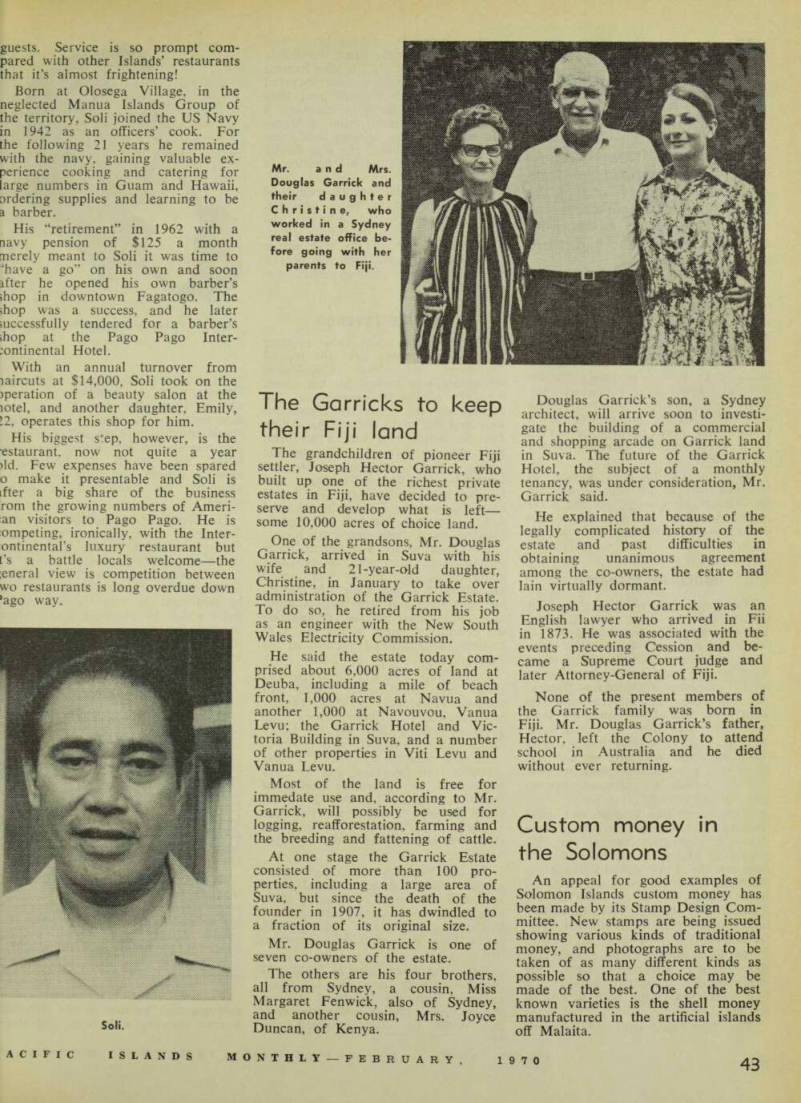
One of the grandsons, Mr. Douglas Garrick, arrived in Suva with his wife and 21-year-old daughter, Christine, in January to take over administration of the Garrick Estate.
To do so, he retired from his job as an engineer with the New South Wales Electricity Commission.
He said the estate today com prised about 6,000 acres of land at Deuba, including a mile of beach front, 1,000 acres at Navua and another 1,000 at Navouvou, Vanua Leyu; the Garrick Hotel and Vic toria Building in Suva, and a number of other properties in Viti Levu and Vanua Levu.
Most of the land is free for immedate use and, according to Mr.
Garrick, will possibly be used for logging, reafforestation, farming and the breeding and fattening of cattle.
At one stage the Garrick Estate consisted of more than 100 pro perties, including a large area of Suva, but since the death of the founder in 1907, it has dwindled to a fraction of its original size.
Mr. Douglas Garrick is one of seven co-owners of the estate.
The others are his four brothers, all from Sydney, a cousin, Miss Margaret Fenwick, also of Sydney, and another cousin, Mrs. Joyce Duncan, of Kenya.
Douglas Garrick’s son, a Sydney architect, will arrive soon to investi gate the building of a commercial and shopping arcade on Garrick land in Suva. The future of the Garrick Hotel, the subject of a monthly tenancy, was under consideration, Mr.
Garrick said.
He explained that because of the legally complicated history of the estate and past difficulties in obtaining unanimous agreement among the co-owners, the estate had lain virtually dormant.
Joseph Hector Garrick was an English lawyer who arrived in Fii in 1873. He was associated with the events preceding Cession and be came a Supreme Court judge and later Attorney-General of Fiji.
None of the present members of the Garrick family was born in Fiji. Mr. Douglas Garrick’s father, Hector, left the Colony to attend school in Australia and he died without ever returning.
Custom money in
the Solomons
An appeal for good examples of Solomon Islands custom money has been made by its Stamp Design Com mittee. New stamps are being issued showing various kinds of traditional money, and photographs are to be taken of as many different kinds as possible so that a choice may be made of the best. One of the best known varieties is the shell money manufactured in the artificial islands off Malaita.
Soli.
Mr. and Mrs.
Douglas Garrick and their daughter Christine, who worked in a Sydney real estate office be fore going with her parents to Fiji.