Cork Helmet And Pacific
pp. 83-87 · Read in the full issue

Travel Guide For 1895
In these days of pampered travel, where money, even in the Pacific, buys every tourist contentment from air-conditioning to the latest aircraft, it s a chastening and intriguing experience to read through the first travel guides to the Pacific, which armed you for every kind of contingency.
The days when travelling really meant adventure are sadly over— give or take a few choice spots but publications such as the Union Steam Ship Company’s 1895, A Cruise in the Islands, and Dineen’s Commercial Directory and Tourists Guide of 1903, and Burns Philp’s Picturesque Travel of a few years later, bring it all back.
At the turn of the century the intrepid tourist stepped ashore in the “cannibal islands” armed with a giant medicine box and an assortment of “regulation clothing”, including white drill, cummerbund and cork helmet He reallv needed
those Guides
tnose guides.
The Union Steam Ship guide was among the first of them, published in 1895 in New Zealand. It covered Tonga, Samoa and Fiji and was written anonymously, but the author was probably Beatrice Grimshaw. It
contained less than 50 pages, but the advice was useful, Dineen’s came at the turn of the century, published by T. B. Dineen of Clarence Street, Sydney, and also of Suva. It was a solid little book of more than 200 pages and was “the first complete work of the kind hitherto published”—a year book of New Caledonia, Fiji, the Samoas, Tahiti, and the Cook Islands,
Bladder troubles
, .. . . , . 11 c f rned advertising, including w ?P? eal , to the reader to Buy Wolfe s Schnapps for curing urinary complaints”, and “Wolfe’s Schnapps for bladder troubles”.
Picturesque Travel, the Burns Philp publication, came out in 1911, a handsome publication detailing itineraries and costs of BP services from Australia to Java, Singapore, Papua, the Solomons, Lord Howe
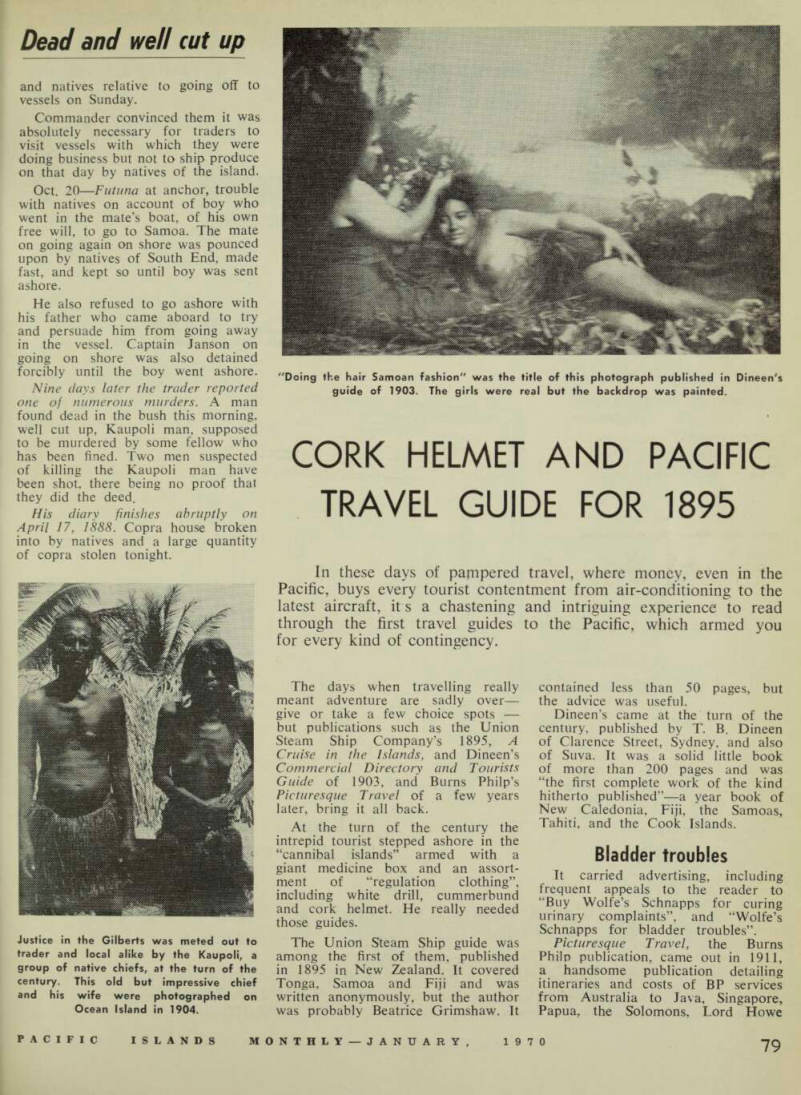
"Doing the hair Samoan fashion" was the title of this photograph published in Dineen's guide of 1903. The girls were real but the backdrop was painted.
A good salary indeed
and Norfolk, the New Hebrides, the Gilbert and Ellice and the Marshalls.
The German territory of New Guinea was not included.
A study of Dineen’s shows that the High Commissioner of the West ern Pacific and Governor and Com mander-in-Chief of Fiji at that time was Sir Henry Moore-Jackson and the Civil List published in the 1903 edition reveals he was being paid £2,700 a year—a good salary indeed, considering his private secretary, Archie Montgomerie Esq, was having to make do on £2OO. Even the Colonial Secretary and receiver general, the Hon. W. L. Allardyce CMG, was drawing only £750.
Those were the days when a spade was a spade and Suva’s mental institution was simply the “Lunatic Asylum” (“Chief warder Norman Smith, assisted by three male and one female warder”). The main dif ference between it and the gaol seems to have been that in 1901 the gaol had six executions.
A farthing an hour
Dineen’s table of wages, printed as a ready reckoner for Islands employers, started off at one farthing an hour, for eight, nine, and 10-hour days. One farthing an hour for a 10-hour day was £3/5/- a year, which is what some Polynesian plantation workers were getting, plus rations and quarters.
Dineen’s tourist accounts of the Islands owed a lot at times to the Union Steam Ship Company’s book let, but with some extra advice thrown in, such as, “A horse and trap can be easily hired for a drive along the Waimanu Road to the Rewa Valley of Fiji, during which many lovely glimpses of land and seascape can be obtained. The sugar mill will probably come in for a visit but we do not advise it, for since the writer paid a visit to a certain sugar mill, he has no respect for sugar”.
The same section on Fiji gives some parting advice “Bring a small supply of suitable opening medicines, some insect powder, a bottle or two of pavloids, antipyrin, antifebrine, and some for diarrhoea. The latter may be found especially useful as such an attack in this climate may be dangerous and should be taken in time.
“Leather goods go speedily to the dogs, mildew grows on everything except steel or iron (therefore steel cabin trunks are to be recommended
instead of leather); wear light serge or flannel clothing; shoes or boots must have good thick soles, and although leather leggings may be found to create heat yet they will be a necessary protection, and if worn with knickerbocker suits will be found a real comfort as well.
“A photographer, by expending a pound or two with Mr. J. Waters, photographer, of Victoria Parade, Suva, who knows as much of the islands as anyone at present living there, will get such information as will save much future annoyance and many dry plates.”
Dineen’s seemed to have a soft spot for Fiji, and said it was puzzled as to why there was such a small number of tourists there, “for there is not a more interesting or enjoy able trip on the globe”.
It took rather a different view of New Caledonia, by back-handedly pointing out under its Tourist Note on Tahiti that Tahiti was of more than usual interest to tourists, as it “exhibits the system and the results of colonisation by our French neigh-
hours in a much more amiable phase than that to be seen at Noumea, New Caledonia—a magnificent and a valuable colony defiled by the vilest of human dregs and a constant menace to the peace and friendship of two nations.”
Dineen continued: “Had there never been a penal establishment set up at N.C., much closer relations would now exist with Australia, and more money would be invested to its lasting benefit.
“On arrival at Tahiti the traveller soon notices that he is on French territory, by the frequent sprinkling of police and military unforms; the names of the streets, and on the
shops at once arresting his attention.
Apart from this, Papeete will be found to be quite a gay little city; in fact a miniature Paris.
“The style of living is also model led after the Parisian; the hotels are mostly used for sleeping places, all meals being had at the restaurants, of which there are several. Should you be able to speak French you will find matters much more pleasant, many of the French residents being right good and jovial fellows indeed; of the British and Americans they are sterling representatives of their race and well maintain their hos pitable traditions.”
In its notes on Tonga. Dineen gave some advice still useful today for any tourist to the South Seas: “Our advice to tourists is to restrain their propensity to purchase many curios on first landing. If you collect too eagerly at first, you will over crowd yourself, and will probably throw away much of your earlier collections. There is no stint here, and by waiting for a little experience, which soon comes, a better and more
choice collection will be made and labour will not be wasted”.
But the voice is raised another octave when Dineen’s discusses Swallow’s Cave at Vavau, Tonga, which is still a tourist attraction, “Visitors are requested to refrain from disfiguring its walls, as some asinine vandals have done by paint ing their names and dates in letters a foot long,” it says. “It is cheap immortality, but it only exposes the wretched perpetrators to the curses of some and the hearty detestation of all genuine lovers of the pic turesque.”
In Papeete, Dineen suggests that early risers should visit the markets
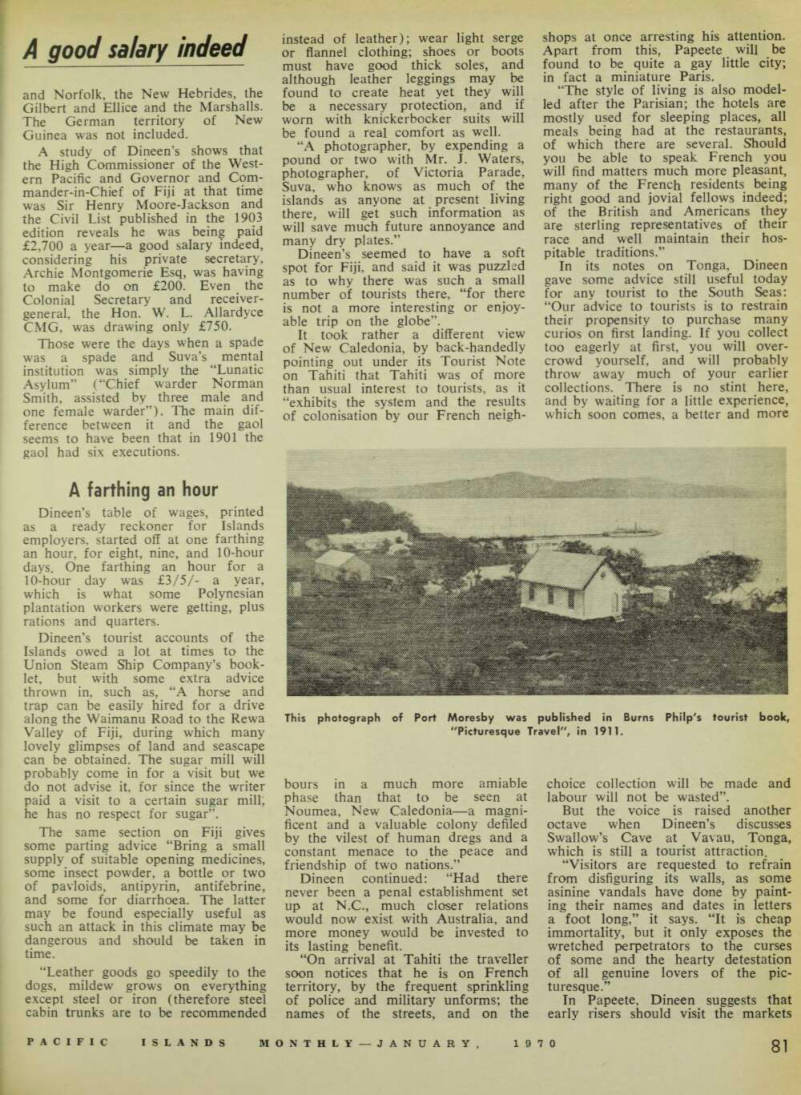
This photograph of Port Moresby was published in Burns Philp's tourist book, "Picturesque Travel", in 1911.
Safer not to sit down
about 5 a.m. and then hear the Garrison Band in the afternoon.
Pomare’s tomb is well worth a visit but “as natives regard the place around the tomb as leprous, it would be safer not to sit or lie on the ground; nor should ladies wear long skirts, at any rate it would be better not to allow them to brush the sward”.
Over in Apia, Western Samoa, says Dineen’s, “wild boars are frequently seen, and there is a plenti ful supply of wild ducks and pigeons; to shoot the latter a gun licence must be obtained, but no licence is required to ply the spear in the case of the wild pig or boar, which is without doubt the most exciting, as it is certainly the most dangerous, sport of the islands”.
The introduction to the Union Steam Ship Company’s booklet on Samoa, Tonga and Fiji gives some more advice about clothing, ob viously regarded as one of the most vital questions for any intending visitor to the Islands: “The regula tion wear for men is white drill. A cummerbund of silk or woollen material is substituted for the waist
coat and is thought to be a necessary protection to the loins against changes of temperature.
“Those, however, who move about much from place to place, and who have to get through much walking or riding, will find the flannel shirt or the flannel suit the most com fortable and convenient form of dress. The best form of hat is perhaps the light unlined cork helmet.”
Picturesque Travel was a different kind of work—a selling brochure rather than a guide. To its compilers all trips were “replete with novel sights, beautiful scenery and curious people”, and there was no suggestion that there were any real problems to be overcome once the traveller paid his fare of from £25 to £4O for his two to four months circular tour from Sydney to the Gilberts and the Marshalls, or his £25 for his 52 days in the New Hebrides, “With so many delightful trips to choose from,” said Burns Philp’s book, “it is difficult to draw com parisons, but for those who have the time to spare a seven weeks tour through the New Hebrides via Lord Howe and Norfolk Islands has much to recommend it.
“The New Hebrides have loomed large in international affairs by the
efforts put forth by both France and Great Britain to obtain possession of these fertile islands, and the recent appointment of a Condominium Government with a neutral President marks an earnest effort to arrive at a peaceful settlement of a vexed question.
100 calls each trip
“With the exception of Vila there are no settlements, but the few hundred white residents are scattered throughout the island in ones or twos so that the steamers often make over 100 calls each trip at trading and mission stations, planta tions, etc., everyone of which the visitor finds something unique and attractive to see.
“Necessarily with so much to see in a limited time, energy and enthusiasm is a condition precedent to thorough enjoyment, and in many places a landing through the surf is necessary. But the trouble is well worth it and many a peek at heathen temples or relics of cannibal customs not yet entirely abolished may be obtained as the reward of a hurried trip ashore at some out-of-the-way island which the more indolent would pass by rather than miss the dinner bell on the steamer.”