Magazine Section
pp. 79-83 · Read in the full issue


Rough justice in the Gilberts
During the 1880’s Europeans in the Gilbert and Ellice Islands were pretty evenly divided between missionaries, traders and scoundrels . . . and sometimes the three types became rather blurred as missionaries were accused of sleeping with native women, and traders of brutality. Years before the British Empire embraced the Gilbert and Ellice Islands to bring rather shaky control, Europeans got along as best they could; sometimes dispensing their own arbitrary sort of justice.
These extracts are from a diary belonging to a trader on Beru (now held by the E. W. Gurr collection of New Zealand’s Alexander Turnbull Library). The author could be a Frank Volleiro who was trading on the 11 mile long south Gilbert atoll during this period—certainly he was always getting into trouble. These extracts start from 1882.
Sept. 9— Arrived from South End Station, found that during .’. . , ® my absence the natives had stolen a great number of my shark fins that I had bought from them on my previous visit to this station.
Nov. 6—Arrived from South End Station, found that all my fowls and the rooster had been stolen, making a total loss of 10 hens and four chickens. Natives becoming thieves more than formerlv Purchased from North End missionary 30,000 nuts on account of LMS, 8,000 on own account.
Tmmh iiictirp XT 9 1 Nov. 9 Kaupoh and police of the whole island busy punishing a man and woman for co-habitating, neither being married. The man refusing to pay the fine, they concluded to make both the man and woman fast to a tree and keep them in the sun until they either paid their fine or expired from exposure.
Un his resisting, a policeman fired at /T but .then others attacked turn with their weapons. The man has been badly wounded with a whale spade m the head and is otherwise injured from ill usage.
Ihe natives say these punishments are ordered by the Samoan teachers ar A e x fas J becoming rulers of the island. Natives greatly f*K r ® d for * he worse towards white traders on the island. Two fines im-
posed today. One of a 1,000 nuts for ‘ h n e ™ an and for the woman, the other 800 for each, Dec. 25—Schooner George Noble arrived, sailed again same day.
S ‘ eal ' Feb. 18—Schooner Julia from Honolulu.
Feb. 19—Schooner Julia left having on « from this island ? ‘ • t , I‘ s * a y , n h °* „ b f t fn me ' T S T ? 1 a gh ! and 1 fisted him and ordered him to go
tnfd* t**® althougl
Sk f 8 • whe ff u P° n . l tOO H , a s ' c . k , of a size suitable to punish a thief. I struck him over the head with it and drew blood, no serious wound, slightly broke the skin.
The man when brought before the Kaupoli denied the theft. Kaupoli believing him and not crediting my assertions, fined me 1,000 nuts or 100 heads of tobacco. This I refused to pay unless they fined the native for stealing Today they came to my house in full force Police and members of the house of government demanding the fine and on my again refusing to pay it unless the thief was also fined, I was pounced upon by a great number of them and received most brutal treat ment, was tied and dragged to the Kaupoli house and kept tied until my friends brought 1 000 nuts Natives infinitely worse under the new order of things than when they governed themselves as thev did about 13 or 14 years ago. Bad influence at work somewhere.
Apr. 27—Arrived schooner Midge from Fiji , . . returned labour . . . recruited 37 . . . squalls.
June S—HMS Espigele on a cruise called to impose fine on natives for thieving from the wrecked schooner Orwell. Fine, 600 bags of copra to be paid within three years. Left same day.
June 21—Copra house fell. . . .
July 2—Left Scott’s old station that I rented for 15 months and came to
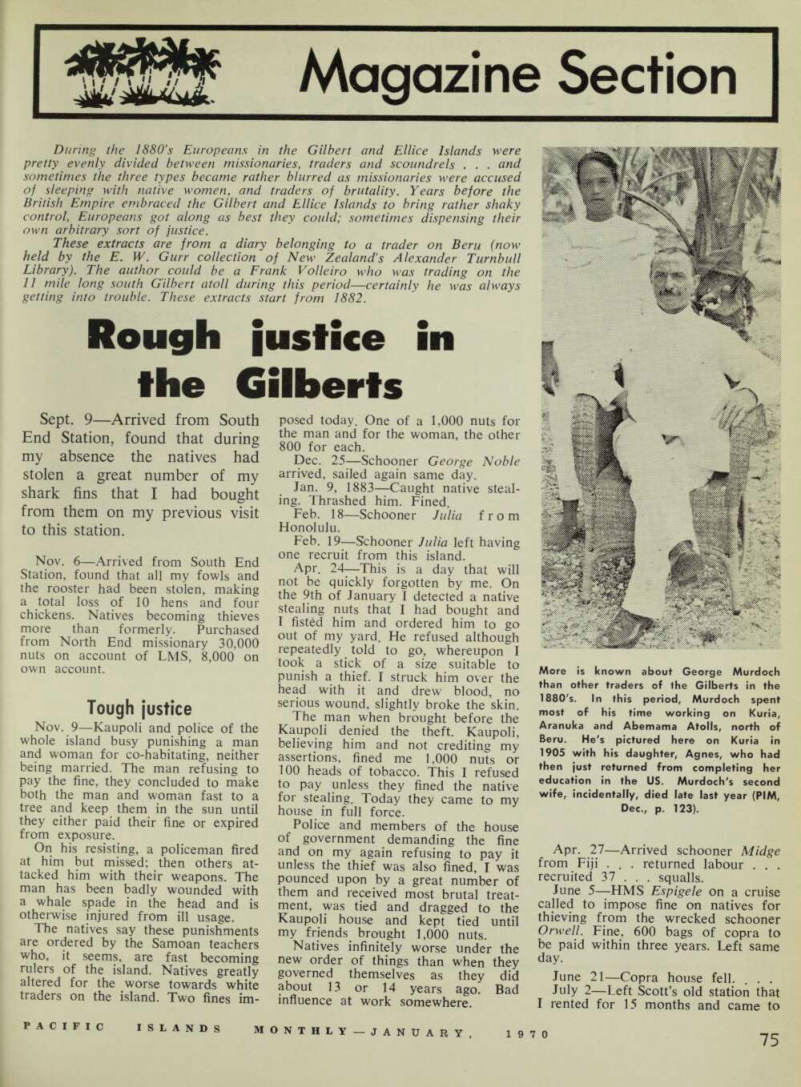
Mor`e is known about George Murdoch than other traders of the Gilberts in the 1880's. In this period, Murdoch spent most of his time working on Kuria, Aranuka and Abemama Atolls, north of Beru. He's pictured here on Kuria in 1905 with his daughter, Agnes, who had then just returned from completing her education in the US. Murdoch's second wife, incidentally, died late last year (PIM, Dec., p. 123).
Disputed land
new house on wife’s land at Tabana naikarana.
July 3—Frank for South End Station. Kaupoli from S and M to decide disputed piece of land . . . decision not known . . . against Frank given in the evening.
Aug. 6—Finished and paid for copra house . . . commenced making copra . . . rain squalls Aug. 11—Chinaman’s woman came and received from me balance of account of $2.50, also two meat and four yards ribbon. Paid natives for work for week commencing 6th.
Aug. 16 —Patience from Fiji with returned labour and for recruits.
Frank from South End . . . squally.
Sept. 26—Schooner George Noble from Fiji arrived, also German three master schooner Estrella trading through the group.
In October, three ships—a Tahiti barque, the Minnie Hare from Fiji and Kalona from Honolulu arrived and departed, recruiting. From New Zealand came the Henderson McFarlane schooner Three Cheers.
Improper connection!
Numerous other vessels called and departed for labour and copra. They included the ketch “Patience”, an unidentified whaler, “Estelle”, “Ran som”, “Kaluna”, “Annie F. Briggs”, “George Noble”, HMS “Dart”, “Midge”, “Ariel”, “Taviun i”, “Futuna”, “Eria” and “Terauiti”.
On one visit of the “Estelle” in February, 1884, Sunday church services were postponed because, the trader said, the missionaries traded with the ship instead. An October 28 reference was a long one: Missionary at Middle Station in difficulty with natives on account of having improper connection with a native woman whose husband is absent, having gone to Fiji.
On investigating the matter it was shown that this is the second time the same young woman has conceived by the same missionary. The first she was persuaded by him to get rid of, as many of these people do. This second they were not fortunate enough to conceal. Hence the dif ficulty.
During the investigation the mis sionary had to acknowledge having co-habitated with the woman.
An entry about a month later also abounded with local scandal: The native who has been trained by the Samoan teacher has for some
time been holding the office of school master and assistant preacher or curate, but it has transpired today that he had been in the habit of cohabitating with his female scholars though the daughter of a native, Teketa, by name, has for some time resisted his efforts to seduce her.
But on the night of the 22nd he managed to carry out his designs upon her by entering the place in which she was sleeping in company with other girls who are under the “special training” of the missionary.
In the morning she made known to her mother what had occurred.
The father has threatened to kill the girl. The Kaupoli has met and im posed a fine of a piece of land upon the young Christian. During the in vestigation it transpired that he has been performing the same offence on many of his lady scholars.
No need of wife
On May 4, 1885, the trader claimed another missionary— at middle station was sleeping with schoolgirls.
Nothing less than two girls satisfy him. It seems strange that he does not sleep with his own wife, but I suppose he has the use of so many schoolgirls so much younger than his own wife that he can dis pense with her company at night.
May 6—Noticed a difference with the natives in trading. Before today they were satisfied with my pay for copra. Somebody underselling.
June 12—A meeting of the three big houses to decide what should be done to a man who had murdered a woman, missionaries present. It was decided to execute the native at the expiration of three days, giving him time to make his peace with God.
September 24 —Saw partial eclipse of the moon at 7 p.m.
Nine months later, the trader had more trouble with local authorities.
Last night, captain of the schooner Ebon invited me to visit the vessel for trading. He was anxious to get all goods sent ashore by boat in the morning, so as to be able to proceed on his voyage as soon as possible.
Tobacco troubles
The police were sent by Kaupoli to impose a fine of 200 sticks of tobacco (NZ), 100 to be paid by me, and 100 by the other trader from the station on South End. The reason being given is that it being Sunday we had no right to go off to a vessel.
The fact is the Kaupoli is out of tobacco and wishes to get some cheap smoking if possible.
Troubles over Sunday trading were resolved by the visit of a warship two weeks later: Ship Miranda arrived.
Commander Eustace Rooke . . . com mander landed, visited Samoan teacher and Kaupoli, left same evening. While on shore the com mander rectified a little misunder standing between European traders
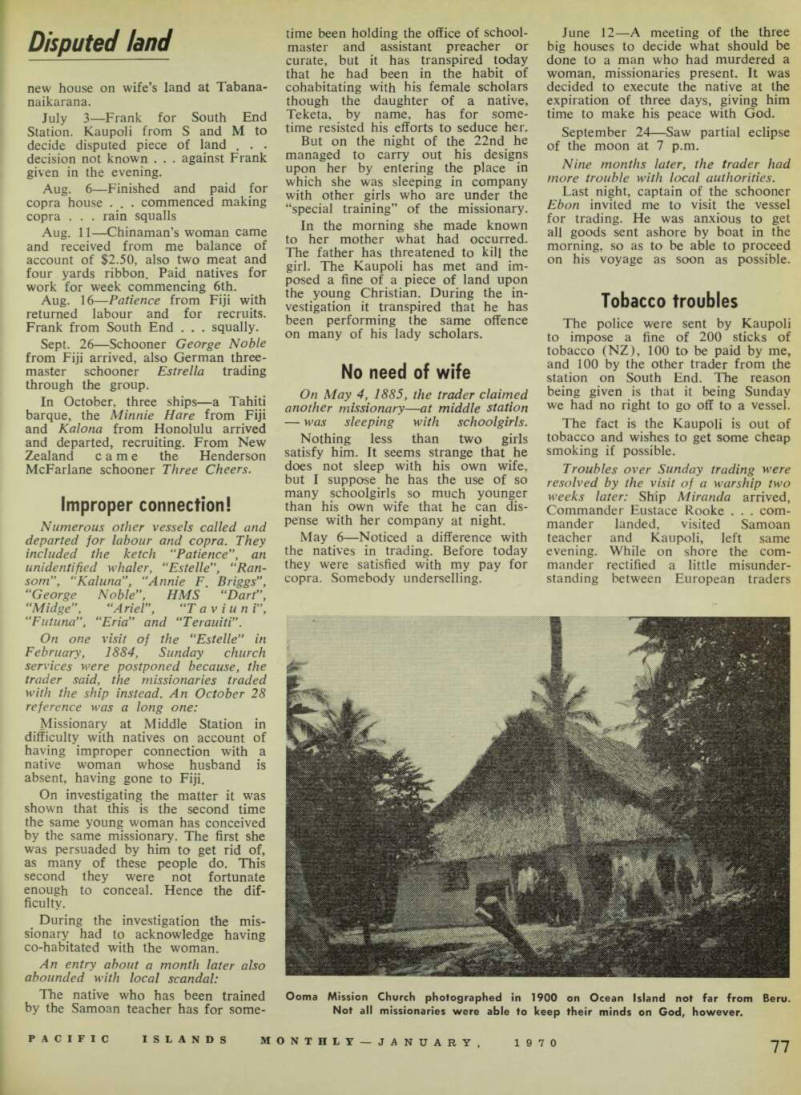
Ooma Mission Church photographed in 1900 on Ocean Island not far from Beru.
Not all missionaries were able to keep their minds on God, however.
Dead and well cut up
and natives relative to going off to vessels on Sunday.
Commander convinced them it was absolutely necessary for traders to visit vessels with which they were doing business but not to ship produce on that day by natives of the island.
Oct. 20 — Futuna at anchor, trouble with natives on account of boy who went in the mate’s boat, of his own free will, to go to Samoa. The mate on going again on shore was pounced upon by natives of South End, made fast, and kept so until boy was sent ashore.
He also refused to go ashore with his father who came aboard to try and persuade him from going away in the vessel. Captain Janson on going on shore was also detained forcibly until the boy went ashore.
Nine days later the trader reported one of numerous murders. A man found dead in the bush this morning, well cut up, Kaupoli man, supposed to be murdered by some fellow who has been fined. Two men suspected of killing the Kaupoli man have been shot, there being no proof that they did the deed.
His diary finishes abruptly on April 17, 1888. Copra house broken into by natives and a large quantity of copra stolen tonight.
Justice in the Gilberts was meted out to trader and local alike by the Kaupoli, a group of native chiefs, at the turn of the century. This old but impressive chief and his wife were photographed on Ocean Island in 1904.