It looks like the power of
pp. 34-35 · Read in the full issue
Tongans support annulment . . .
It looks like the power of love is nil in Tonga
From a Nukualofa correspondent Treasured memories of my true love, My one and only sweetheart, Where my heart and love will live forever . . .
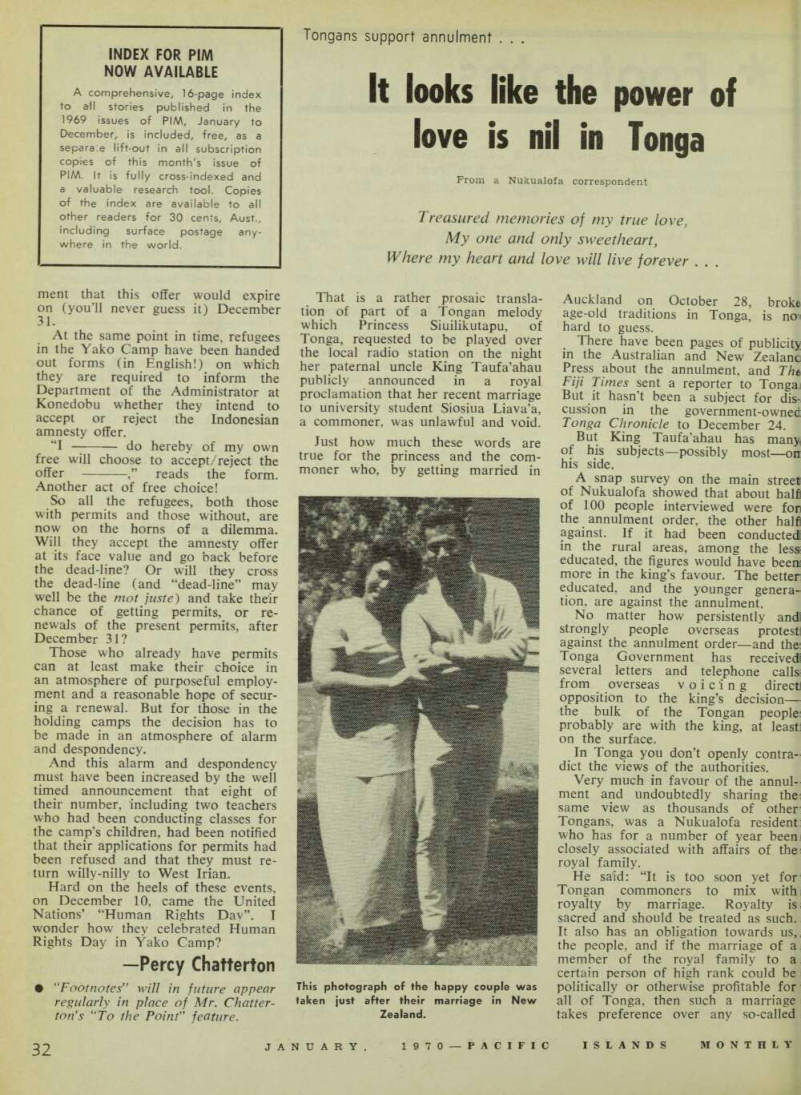
That is a rather prosaic transla tion of part of a Tongan melody which Princess Siuilikutapu, of Tonga, requested to be played over the local radio station on the night her paternal uncle King Taufa’ahau publicly announced in a royal proclamation that her recent marriage to university student Siosiua Liava’a, a commoner, was unlawful and void.
Just how much these words are true for the princess and the com moner who, by getting married in
Auckland on October 28, broke age-old traditions in Tonga, is no*' hard to guess.
There have been pages of publicity in the Australian and New Zealanc Press about the annulment, and The Fiji Times sent a reporter to Tongaj But it hasn’t been a subject for dis cussion in the government-owned Tonga Chronicle to December 24.
But King Taufa’ahau has many of his subjects—possibly most—on his side.
A snap survey on the main street of Nukualofa showed that about halfl of 100 people interviewed were fori the annulment order, the other halfl against. If it had been conducted! in the rural areas, among the less? educated, the figures would have been more in the king’s favour. The better educated, and the younger genera tion, are against the annulment.
No matter how persistently and! strongly people overseas protest! against the annulment order—and the: Tonga Government has received! several letters and telephone calls; from overseas voicing direct opposition to the king’s decision— the bulk of the Tongan people: probably are with the king, at least; on the surface.
In Tonga you don’t openly contra dict the views of the authorities.
Very much in favour of the annul ment and undoubtedly sharing the same view as thousands of other Tongans, was a Nukualofa resident who has for a number of year been closely associated with affairs of the royal family.
He said: “It is too soon yet for Tongan commoners to mix with royalty by marriage. Royalty is sacred and should be treated as such.
It also has an obligation towards us, the people, and if the marriage of a member of the royal family to a certain person of high rank could be politically or otherwise profitable for all of Tonga, then such a marriage takes preference over any so-called
This photograph of the happy couple was taken just after their marriage in New Zealand.
marriage arising out of true love.
Royalty cannot choose freely. It has an obligation”.
The interesting thing is that the overseas Press reports seem to have more facts to go on than the locals.
The princess is not giving interviews —she’s in the country—and neither is her father, the Premier, Prince Tu’ipelehake, or King Taufa’ahau.
Royalty has closed its ranks.
According to overseas newspaper reports, Princess Siuilikutapu had been willing to give up all her royal privileges if that would have allowed her to remain the wife of the good looking, clean-living (neither smokes nor drinks) 21-year-old Rugby-play ing Liava’a. But it seems the king was set on dissolving the marriage regardless of the princess’ wishes.
The Cakobaus?
Sources associated with Tongan royalty say that Princess Siuilikutapu was to have married either one of the highest chiefs in Tonga or a member of the influential Cakobau family of the neighbouring British colony of Fiji.
Now the marriage has been annulled, one hopes that Princess Siuilikutapu’s fate won’t be the same as that of the late Queen Salote’s half-sister, Princess Fusipala, who had reportedly been in love with a low-ranked Tongan noble, but was betrothed to a higher chief.
She refused to enter into an arranged marriage and died single at the age of 20, apparently a heart broken princess. ’Ofa, Tongan for love, compassion
and mercy, is the most beautiful word in the whole Tongan language. ’Ofa is instilled in the minds of Tongans and in their hearts at a very early age. ’Ofa to your neigh bours, ’ofa to the animals, *ofa to foreigners, ’ofa to your husbands and wives, ’Ofa in its highest form is reciprocal and sees no barrier to its being fulfilled.
Liava’a knew he would meet stiff opposition by marrying his royal sweetheart. But his ’ofa was so great he decided to marry her anyway. The princess, in all her glamour and royal glory, was so steeped in ’ofa with the pauper that although she must have at least suspected tough royal opposition, she went ahead and married the Rugby-playing com moner.
Here in Tonga, as in New Zealand, questions are still being asked and haven’t been answered about the annulment order.
The New Zealand courts ap parently will recognise an annulment if at least one of the parties was in an overseas country at the time of the proclamation.
If the annulment should not be recognised by New Zealand could Liava’a claim the princess if she visits New Zealand? Can any action be taken against her if she should visit New Zealand with another husband?
And is Tonga doing right by exposing its young people to western culture in New Zealand (Liava’a is studying in NZ under a Tongan grant), and then expecting them not to absorb western ideas?
No social upheaval
There can be no doubt that legally Tonga has had the right to make the annulment order. And there is also no doubt there is not likely to be any social upheaval in Tonga because of the king’s decision.
Nevertheless had King Taufa’ahau consented to the marriage, instead of preventing it, he would have won the admiration of every Tongan, The truth seems to be that Tonga generally supports what the king has done because the king has done it, but the opposite decision would probably have been accepted as readily.
Whatever the decision, there would be a split in Tongan opinion, as apparently there ’is, behind the scenes, in the royal family now.
In NZ it looks as though Siosiua will have to apply for a work permit if he wishes to say in the country.
At present he is officially a student, but having missed all his examina tions for the past two years and already pessimistic about his chances of success in coming exams, he is worried the Tongan Government will revoke his scholarship.
If it does, Siosiua wants to pay the government for having given him the scholarship and then stay in NZ, with or without his wife. At present it is understood that the NZ Uni versity Students’ Association is back ing his application to settle per manently in the country.
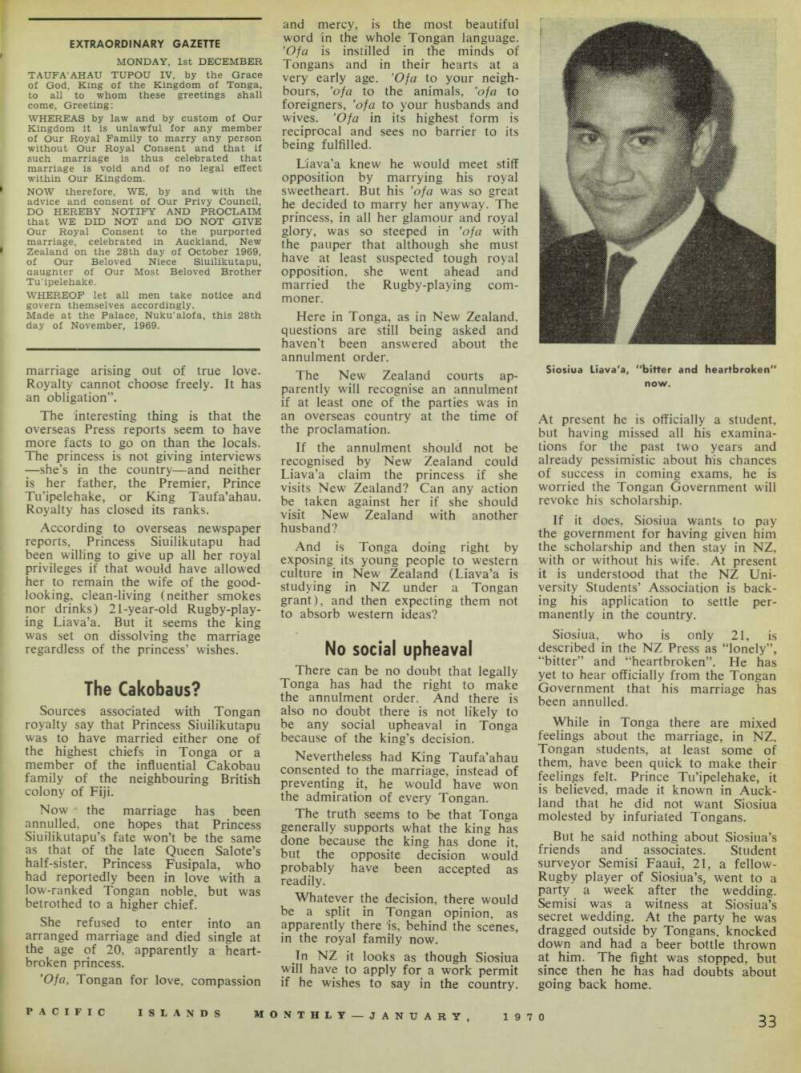
Siosiua, who is only 21, is described in the NZ Press as “lonely”, “bitter” and “heartbroken”. He has yet to hear officially from the Tongan Government that his marriage has been annulled.
While in Tonga there are mixed feelings about the marriage, in NZ, Tongan students, at least some of them, have been quick to make their feelings felt. Prince Tu’ipelehake, it is believed, made it known in Auck land that he did not want Siosiua molested by infuriated Tongans.
But he said nothing about Siosiua’s friends and associates. Student surveyor Semisi Faaui, 21, a fellow- Rugby player of Siosiua’s, went to a party a week after the wedding.
Semisi was a witness at Siosiua’s secret wedding. At the party he was dragged outside by Tongans, knocked down and had a beer bottle thrown at him. The fight was stopped, but since then he has had doubts about going back home.
Siosiua Liava'a, "bitter and heartbroken" now.