*Footnotes
pp. 33-34 · Read in the full issue
“Children, we have made you a delicious curry from a well tried Australian recipe, and now, to give it a local flavour, we are going to allow you to sprinkle some grated coconut over it.”
The idea of urban local govern ment for Port Moresby has been tossed around since 1953. It gained impetus, if that is not too strong a word to use, when the South Pacific Commission organised a seminar on the subject here some years ago.
Now it is coming on us with a rush, and not for Port Moresby alone but for Lae, Rabaul and Madang as well. The Administration has decided to set up urban local government councils in these four centres, if possible in July, 1970, and certainly not later than January, 1971.
It has set up “citizens’ consulta tive committees” in each of the four towns to advise it, but, to some at any rate, it seems that these com mittees have been set up to sprinkle on the grated coconut rather than to cook the curry, or even to choose the recipe.
The problems facing Port Moresby are much more difficult than those facing the other three major towns.
For one thing Port Moresby is much bigger. It comprises administrative, commercial and industrial areas, high and low covenant housing areas, numerous shanty settlements, and traditional tribal villages of some size. Its citizens range from the highly sophisticated to the very un sophisticated, from the affluent on upward of $2OO a week to the indigent on $7 a week.
Moresby problems
And within its boundaries there are substantial areas of unalienated land, that is, land still held communally under traditional tribal ownership.
Levying rates on such land involves both physical and psychological problems. Because of this it has been suggested that the traditional Aus tralian system of levying rates is un suitable, and that an alternative should be sought.
The present Local Government Council Ordinance was framed with rural local government in mind. Do we need a brand new Municipal Councils Ordinance to cope with the
urban situation, or can we get past with amendments to the present ordinance, and, if so, what sort of amendments should they be?
Two schools of thought have emerged on this issue.
The first, held by the Administra tion itself and by the present Town Advisory Council (which will of course go out of business when a municipal council comes into being) is that we should get away to an early start under the present ordinance minimally amended, and work out what further changes are needed as we go along.
The second, held with tenacity (some would say obstinacy) by those
concerned with community develop ment and the problems of squatter settlements and the drift to the towns, says: “No, let’s first thoroughly discuss what the shape and scope of urban local government should be and provide for it by legislation, so that we can start as we mean to go on”.
As the Citizens’ Consultative Com mittee is very much an ad hoc body it is anyone’s guess what support these opposing schools of thought have among the townsfolk, brown and white. A public meeting called to discuss the problem didn’t help much. Those who attended it were vociferous enough, but a roll-up of 60 out of a population of 45,000 can hardly be called representative.
It looks as if a substantial proportion of Port Moresby’s citizens couldn’t care less.
What does emerge fairly clearly
is that the affluent sector will con tribute most to the municipal kitty in actual dollars, the non-affluent sector will contribute most in proportion of income, and both sectors suspect that they won’t get value for their money.
THOSE of us who are concerned for the welfare of West Irianese refugees can hardly be blamed for viewing recent events with some mis giving.
Nearly 300 of these people have been granted what are officially known as “temporary entry permits”, which enable them to live here. Some have been here since the interregnum of UN control between the Dutch departure and the Indonesian arrival.
It has recently been revealed that many, if not all, of these permits expire on December 31. Renewals will have to be applied for, and may presumably be either granted or re fused at the bureaucratic will. If they are refused, their former holders become illegal immigrants liable to deportation.
About 500 others are awaiting a decision on their applications for permits. Most of these crossed the border before or during the so-called “act of free choice”, and have since been living a pretty aimless existence in holding camps. Physically they have been well treated, but psycho logically there can hardly fail to have been an increasing sense of disillusion and frustration as the weeks and months have dragged by.
And now, in December, things are happening with a rush. An Indo nesian deputation has visited the holding camps at Yako and Manus Island to explain to their inmates the amnesty offer recently made by the Indonesian Government. While there they made a surprise announce
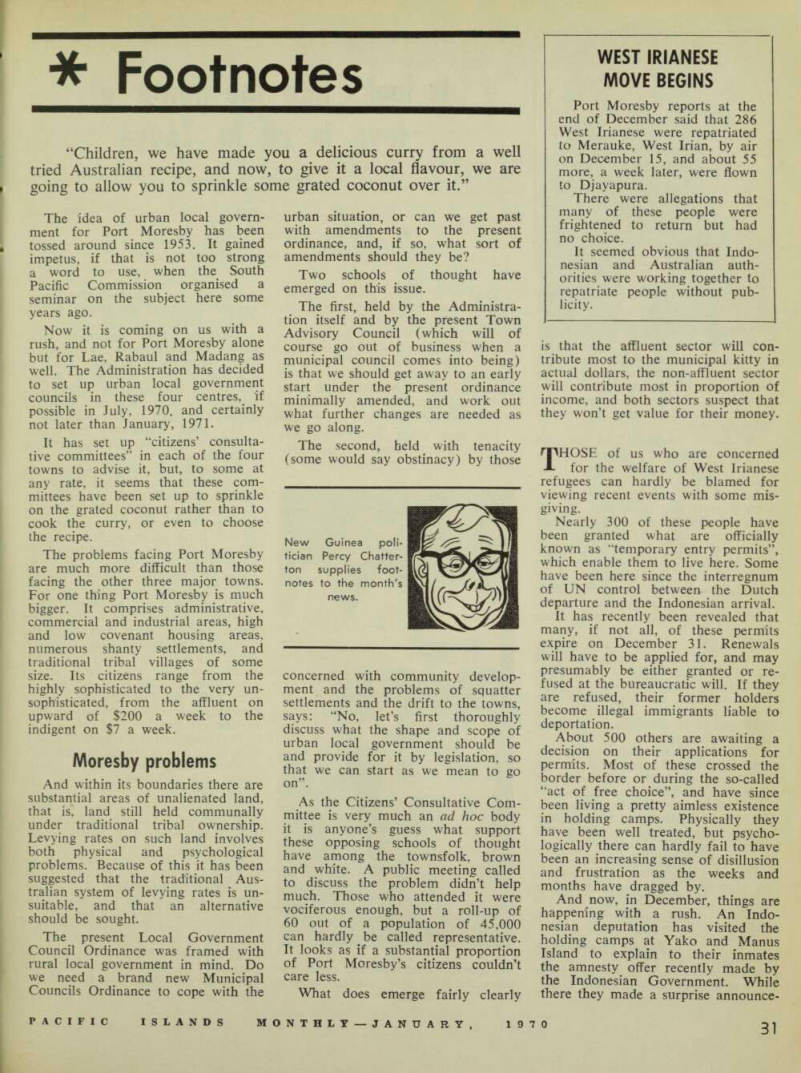
New Guinea poli tician Percy Chatter ton supplies foot notes to the month's news.
ment that this offer would expire on (you’ll never guess it) December At the same point in time, refugees in the Yako Camp have been handed out forms (in English!) on which they are required to inform the Department of the Administrator at Konedobu whether they intend to accept or reject the Indonesian amnesty offer.
“I do hereby of my own free will choose to accept/reject the offer ,” reads the form.
Another act of free choice!
So all the refugees, both those with permits and those without, are now on the horns of a dilemma.
Will they accept the amnesty offer at its face value and go back before the dead-line? Or will they cross the dead-line (and “dead-line” may well be the mot juste ) and take their chance of getting permits, or re newals of the present permits, after December 31?
Those who already have permits can at least make their choice in an atmosphere of purposeful employ ment and a reasonable hope of secur ing a renewal. But for those in the holding camps the decision has to be made in an atmosphere of alarm and despondency.
And this alarm and despondency must have been increased by the well timed announcement that eight of their number, including two teachers who had been conducting classes for the camp’s children, had been notified that their applications for permits had been refused and that they must re turn willy-nilly to West Irian.
Hard on the heels of these events, on December 10, came the United Nations’ “Human Rights Day”. I wonder how they celebrated Human Rights Day in Yako Camp?
Percy Chatterton
“ Footnotes” will in future appear regularly in place of Mr. Chatter ton’s “To the Point” feature.