A spark, at last,
pp. 28-31 · Read in the full issue
in the New Hebrides council
Prom a Vila correspondent
The docility and apathy which have characterised all previous meetings of the New Hebrides Advisory Council disappeared at the December budgetary session. The meeting was to be held from December 8-12 but it was extended, because of pressure of bus iness, to December 16, and even so many questions could not be discussed and an extraordinary session is to be held in March.
It was the second meeting of the council elected in the first part of 1969 by a new electoral system which provides for indirect election of New Hebridean members through elected local councils and informal meetings; for European members through an electoral college.
Both forms of election have been much criticised; the former by the local councils since the privilege of voting is extended to those who have chosen not to support the Admini stration by refusing to form local councils (local councils represent a population of 27,000 out of a total 80,000); the latter because the choice of electors is bound to be arbitrary.
Both systems disenfranchise women, but the members of Advisory Council, all but one of whom are men, do not appear to have noticed this anomaly in the embryonic New Hebridean democracy.
"Prosperous 7 country
The New Hebrides is a prosperous country and the picture given by the statistics quoted in the opening speech of the British and French resident commissioners, was rosy.
The favourable economic results of 1969 are: copra production high, record exports of fish, very favour able long-term marketing prospects for the beef industry, the mine at Forari re-opened by a consortium of New Caledonian and Australian
interests, export of timber just started, etc.
Revenue in 1969 was $350,000 more than had originally been forecast, although increased expendi ture on some items meant that the end of year surplus would be only about $145,000.
Special applause was reserved for the fact that the New Hebrides 25 gold centime stamp issued at the time of the first tests of another Anglo-French project, the Concorde, had won first prize at a Paris philatelic show.
The speech forecast that the rate of change in the New Hebrides (already bewildering to many New Hebrideans) would increase in the 70’s. Very considerable extensions in medical and educational services, with a campaign for the eradication of malaria, are planned and expendi ture on economic development is likely to increase substantially in the 70’s.
Main item of the agenda was the Condominium budget for 1970. For almost the first time in the history of the Advisory Council—now 15 years old—the council was in an ex pansive mood and found little to criticise in the budget. Although the New Hebrides is very little taxed —it is estimated that taxes amount to less than $4O per head per year —usually Advisory Council is deter mined to oppose all and any govern ment expenditure.
This council in contrast voted in creases in the budget—for more tourist promotion, to employ a fully qualified statistician for the first time, to increase the broadcasting time of Vila Radio, for new veterinary and forestry officers. Members also suggested that the Condominium should purchase a third vessel so that government officers might be able to tour the islands more regularly.
Lack of communication
As the budget was studied each senior Condominium civil servant was questioned on the operation of his department in 1969 and his plans for 1970. It soon became obvious that what is most badly needed in the New Hebrides is a better flow of information between government and public—perhaps this difficulty is inevitable in a community where so few are literate.
Department heads were often criticised for not doing exactly what they were trying to the best of their abilities to do. As usual the Public Works Department and the Agri cultural Department were criticised for not doing enough and for not being everywhere at the same time.
The chief surveyor seems to feel he has been a particular victim of the difficulties of conveying informa tion to the New Hebrideans. He pleaded, with tears in his eyes, to members to try and explain to the New Hebridean public that survey
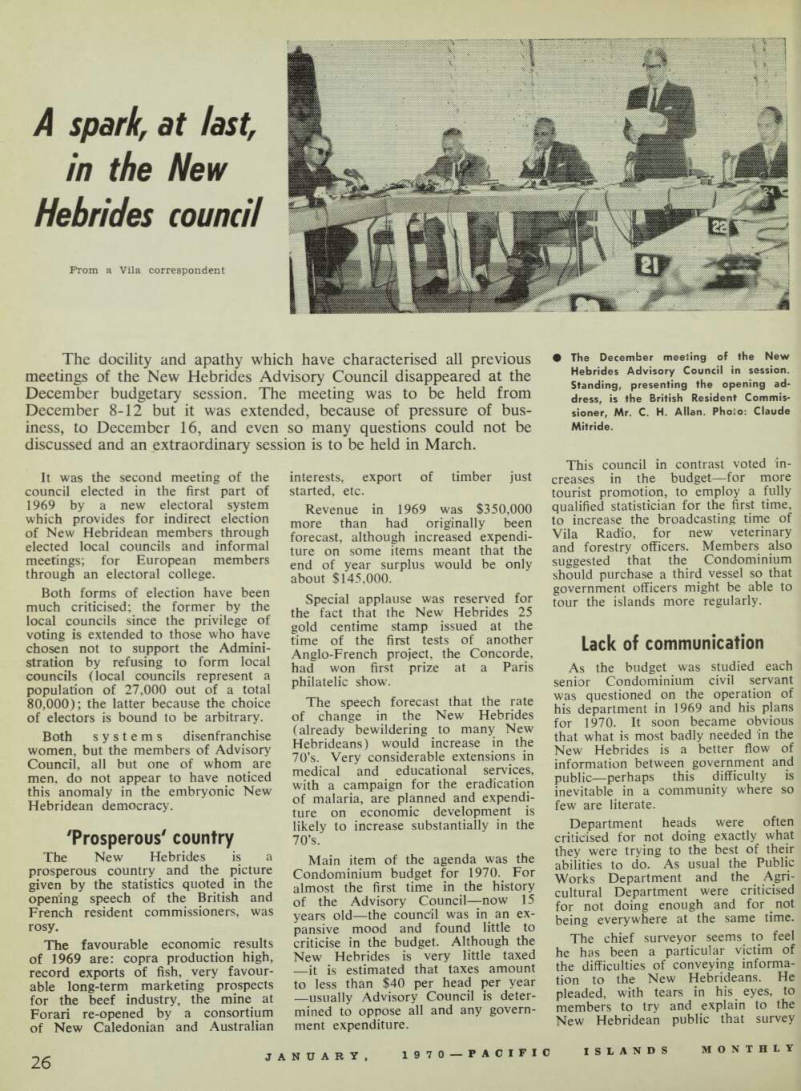
The December meeting of the New Hebrides Advisory Council in session.
Standing, presenting the opening ad dress, is the British Resident Commis sioner, Mr. C. H. Allan. Photo; Claude Mitride.
Not depriving them of land
work was not necessarily intended to deprive them of land, but that much of it was for the good of the com munity. The majority of basic survey marks in the islands are destroyed, another factor which has tended to perpetuate the interminable New Hebridean land disputes.
Two problems were raised in the context of the Condominium subsidy to education, which is paid to the budgets of the National Administra tions who build and run schools with funds which derive mainly from tax payers in Britain and France. Tech nical education is still very in adequate in the New Hebrides and the French and British were criticised for having done very little to teach simple, practical skills which would be used to improve standards of living in the villages.
Their policy appears to be chang ing, but in the past it has been to delay any practical teaching until there were sufficient candidates with at least primary education to attend these schools. Members disagreed with this policy.
The job problem
The other problem discussed was the problem of school-leavers. Most children seem to feel that the world owes them an office job if they com plete primary school. Major British and French investments in educa tion—which are sometimes com petitive—in the last five years mean that soon the number of people finishing primary school who will be able to get office jobs—and they will soon be in competition with those having completed secondary school— will be a minute proportion of the total number leaving school.
Much criticism of school leavers’ attitudes was expressed by the New Hebrideans. The Administration re plied by extolling the benefits of village and agricultural life. This reply, and the nebulous recommenda tion made at the end of the debate that the young should be encouraged to feel that village life was best, did not really answer the misgivings of New Hebridean members. They ap peared to be saying that the content of education was devised mainly for the benefit of those who were going on to secondary education (a tiny minority in the New Hebrides).
Technical and agricultural education were neglected, with the result that the great majority who leave school at primary level are misfits in the village environment. School curricula
should be rethought with this in mind.
At the beginning of the debate on Civil Aviation members discovered with dismay that, although $40,000 had been voted for the improvement of internal airfields in 1969, the money had not been spent because of shortages of men and equipment and difficulties of transport of heavy earthmoving equipment from island to island.
The Resident Commissioners plan to establish a Department of Civil Aviation by March 1, 1970. Although Bob Paul and the late Paul Burton founded New Hebrides Airways nearly 10 years ago, basic legislation on civil aviation had to be agreed on in London and Paris.
The discussion on internal avia tion at the Advisory Council, which was probably mundane for the aviation experts, revealed that many of the internal airfields are considered by the government to be dangerous.
Bob Paul, managing director of New Hebrides Airways, who is a member of the Advisory Council, spoke forcefully in an effort to persuade the government that these airfields should be improved immediately.
After the debate on the budget, a draft regulation to establish a housing authority in Vila was sub mitted to the council. Studies of the
deplorable conditions in which New Hebrideans are housed in Vila were first undertaken in 1966; land on which to build houses to be rented to the poorly housed was purchased in 1968. Now, at the end of 1969, the Administration had drafted a regulation so that an authority can be established to manage this estate —on which not one house has yet been built. Generally one admires the slow pace of life in the New Hebrides. Only occasionally do these delays seem unforgiveable.
Yes to investigation
Much of the fire and enthusiasm of the meeting was reserved for the debates on Members’ motions. Some highlights: A motion was approved asking the Condominium to investigate the Societe Portuaire, operating Santo wharf. It was alleged by Mr. Seagoe r a British landowner living near Vila who proposed the motion, that share holders had been able to make eight times their original investment in the last 10 years, as well as 8 per cent, interest each year. Such a high level of profits would appear to be at the expense of the general public and wharf users.
A lively discussion ensued in which members rushed to tell an apprecia tive audience about the rudeness and inefficiency of the staff at Santo wharf. Although one shareholder was present and able to defnd the Societe
Portuaire, the motion was carried with a large majority.
Two members’ motions were critical of the Santo Coconut Re search Station, which was established by the Institut des Recherches des Huiles et Oleagineux and is partly financed by France with a subsidy from the Condominium budget.
The director was asked to appear to defend the station’s usefulness to the New Hebrides’ economy. He came with a suitcase full of learned volumes, with charts and with samples of different species of coco nuts.
What science could do
For half the morning members clustered around him, and since many of them probably had no scientific education they listened amazed and open-mouthed while he explained what science could do for their plantations.
The final conjuring trick was to show two halves of husked coconut which appeared identical until one looked inside and saw that there was twice or three times as much coconut meat inside one of them.
The essence of his remarks was that with fertiliser and different species of coconut palms, plantations in the New Hebrides, which at present pro duce 400 to 800 lb of copra per acre, may in future produce 2,400 lb on the same area.
The general feeling seemed to be one of regret that members had dared
to criticise the magician who was to make their plantations produce as much as six times the present quantity. The prospects for the long term price of copra also mentioned in the motion were practically for gotten and somewhat cursorily dis cussed.
This rather absurd discussion was one result of the failure in the flow of information. The director of the station had apparently not considered it part of his responsibility to give periodic talks on Radio Vila, or write periodically for the government newsletters so that his research station should not have been an ex pensive mystery bound to attract criticism.
The final debate touched on Na- Griamel. In the opening speech the Resident Commissioners expressed in rather vague terms their intention of not allowing the local nationalists, grouped under the name Na-Griamel, to interfere with good administration.
They said, “Whether or not their actions were approved by their leaders was not clear but certain members of this movement have adopted attitudes or have acted in ways which are prejudicial to the public good and to the proper work ing of the government. We should like it to be understood both by them and the leaders of the movement that they cannot be allowed to take the place of government or to obstruct the action of those who, whether they are government officers or members of voluntary agencies.
are working for the good and progress of all.
“We recognise the right of free association but we must prevent intimidation and systematic obstruc tion and if necessary we shall have to consider what legal measures should be taken to prevent these abuses.”
All the New Hebridean members of council and Archdeacon Raw cliffe, Anglican missionary from Aoba, proposed a motion welcoming the Resident Commissioners’ state ment on Na-Griamel.
In the past two years Na-Griamel had often been referred to obliquely, now for the first time it was men tioned by name, giving its importance some recognition. Jimmy Stevens, leader of Na-Griamel makes many promises: to return to New Hebrideans land which is European owned but not under cultivation, to find a market for the banana crop (economically unlikely), to provide farm machinery for all, to set up his own schools. ( PIM, July, 1969, p. 23).
Jimmy Stevens, a half-caste with a luxuriant grey beard, visits his estimated 10,000 followers in the islands in a little launch, flags wav ing. conch shells blowing—with much more stagecraft than the average District Agent. Where Jimmy’s views are followed, villagers generally re fuse to co-operate with government officers, take their children out of school, remain sullen and speechless when faced with government people, although they often remain as hospitable and helpful as ever to non-government Europeans.
Taking 50 wives
Debate on this subject was curtailed by lack of time but enough was said to gather that New Hebridean members, mostly educated in mission schools, were shocked by Jimmy’s reported intention to take 50 wives (polygamy is not a crime in the New Hebrides).
What most shocked Europeans was the allegation that much of the money collected for the future of the New Hebrides in donations from
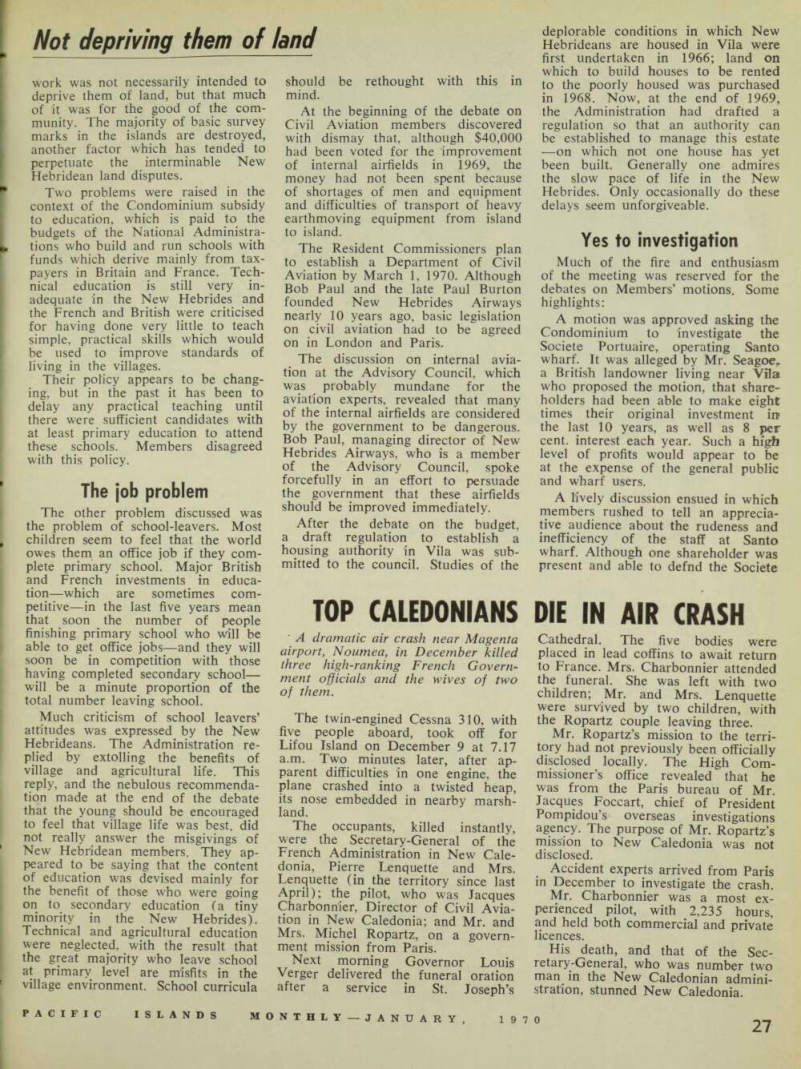
The New Hebrides in December saw the arrival of a new French Resident Commissioner, Mr. Robert Langlois, seen here (centre) being greeted on arrival at Vila by the British Resident Commissioner, Mr. C. H. Allan, and the acting French Resident Commis sioner, Mr. Delabrousse. Mr. Langlois is a former secretary-general for French Polynesia and was also in the New Hebrides from 1961 to 1965. Photo: Claude Mitride.
Jimmy to raise the flag
Jimmy’s followers is spent to main tain his rather high standard of liv ing. This probably does not detract at all from his qualities in the eyes of his followers, who pay taxes which are used to give salaries to maintain the high standard of living of Con dominium personnel!
Next August Jimmy plans to raise the flag. This act is supposed to have magical power. Fortunately at the extraordinary session in March, Advisory Council will continue the unfinished debate on Na-Griamel.
Perhaps radio reports on this dis cussion and the one to come in March will raise some doubts in the minds of Jimmy’s followers.
This Advisory Council meeting dis played a comparatively high level of debate. European members seem less conservative than their predecessors —willing to admit that progress is not necessarily alien to the New Hebrides.
New Hebridean members are young, better educated; it is no longer necessary to have a Pidgin interpreter. The most important criterion in the election of members seems to have been the ability to speak English or French.
Few can understand
Although there are many people in the New Hebrides to whom the Administration might usefully listen for advice on policy, there are com paratively few who speak the metro politan languages. As a result of this over emphasis of language, some members are also civil servants, a curious anomaly if Advisory Council is an imitation of Western parlia ments where civil servants are all presumed to be neutral.
These young members are more articulate, better able to go to the heart of an issue, they no longer assume that all government is con cerned with crime and its punish ment.
New Hebridean members of the former council were older men; their speeches gave the government and colleagues an opportunity to learn something about the New Hebridean way of thought. There was an immense communications gap as each group interpreted the speeches of the other group in the light of their own preconceptions.
Now the communications gap is probably between the representatives and their constituents. One wonders if they bother to try and bridge it.