companies
p. 27 · Read in the full issue
Australian companies discover Nauru
By staff writer KEN McGREGOR
Nauru, independent republic of the Central Pacific since January, 1968, looks like being all set to rival the Australian island territory of Norfolk Island as a tax-free haven for Australian com panies. Without any publicity, over the last 24 months 30 new companies have been incorporated or registered in Nauru.
The tally looks like growing pretty quickly, especially as there is some apprehension in Australian business circles that the Australian Govern ment may soon legislate to nullify Norfolk Island’s tax free status for companies. There are at present more than 1,800 company registrations on little Norfolk.
There is no chance of the Aus tralian Government being able to control the financial workings of Nauru, as they can their own nearer Australian territory.
Nevertheless the republic has not gone out of its way to publicise its tax-free status, and the extent of its present company registrations was re vealed to me only recently when I followed up a small item published in the official fortnightly roneoed news sheet of the republic, The Bulletin.
Sale of shares
I then learned how a partner in a Sydney firm of solicitors, acting on behalf of a group of large Australian companies with an annual turnover in excess of $5O million, had flown to Nauru in November, in connec tion with the sale of shares in a South African subsidiary company and the provision of loan facilities for that company.
The solicitor registered a company we will call ABC as a wholly-owned subsidiary of an Australian public company we will call CDE.
It won’t have an office on Nauru nor a representative. The main interest of CDE, which is Sydney based, is in making and selling special
equipment for the governments of Australia and South Africa, I have been told that CDE plans to operate an international lending and remitting house on Nauru, and that first trans action will be a large CDE loan to FGH of South Africa, a big con tractor of heavy equipment to the South African Government and in which CDE had a reduced 40.95 per cent, equity interest.
CDE recently reduced its hold ing in FGH because its initial hold ing (50.41 per cent.) restrict FGH’s loan raising capabilities, under South African law.
I understand that CDE made a large capital profit from the sale of its 10 per cent, in FGH.
There could be many advantages in operating from Nauru for any company, but just what plans CDE has are not clear.
The republic stands to gain a registration fee from dealings like this, up to an agreed percentage of the volume of funds moving through Nauru.
I understand Nauru could also earn a management payment from companies which have nobody to manage them on Nauru.
There is, of course, nothing illegitimate about this kind of arrangement, but the Commonwealth Reserve Bank can be expected to take a close interest in such deals with the republic.
Although there can be no restraints on Nauru there can be restraints, and I believe there will be restraints, on Australians taking up shares in Nauru companies.
Australia does allow direct invest-
ments abroad, but with specific per mission. Just what the relationship is between Australia and Nauru on these company matters has not yet been decided between the two countries, but talks have been going on and will continue.
CDE, of course, is just one company. When I investigated Nauru registrations I learned that a Sydney solicitor, just prior to, and just after Nauru Independence Day, January 31, 1968, had incorporated 16 com pany names on Nauru.
I understand that none of these 16 businesses is yet being used but I understand they will be used later for taxation purposes. And we can expect these registrations to increase.
According to the figures of the Australian Trade Commission for the Pacific Islands in Sydney, 14 opera tions were listed on Nauru before independence, and all of them, except the British Phosphate Commission, were Nauruan-owned. Mostly they were small traders.
I do not have the full list of company registrations since indepen dence but three of them, registered as foreign groups are companies owned by a leading Australian bank ing corporation.
Three companies incorporated on Nauru are Pacific Sporting Pools Ltd., Central Pacific Hotels Ltd., and Central Pacific Airlines, and those three have had a chequered career, PSP and CPH are being wound up and CPA never got going.
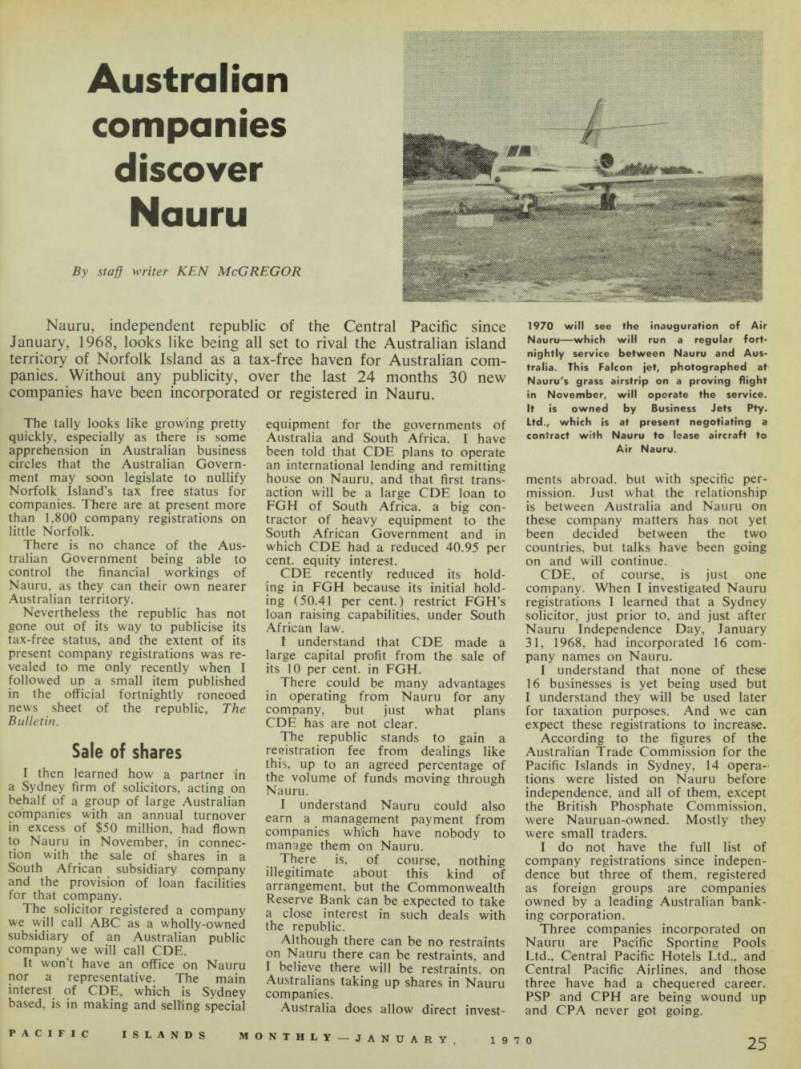
1970 will see the inauguration of Air Nauru —which will run a regular fort nightly service between Nauru and Aus tralia. This Falcon jet, photographed at Nauru's grass airstrip on a proving flight in November, will operate the service.
It is owned by Business Jets Pty.
Ltd., which is at present negotiating a contract with Nauru to lease aircraft to Air Nauru.