Sailing Round The Gilberts
pp. 63-67 · Read in the full issue
To Raise The British Flag
The British Empire in 1892 was at its height, and Her Majesty’s Navy had its orders to plant the flag in the Pacific. On May 23, 1892, it was the turn of Captain E. H. M. David, master of HMS Royalist, who proclaimed at Abemama Atoll, on behalf of Queen Victoria, a British Protectorate in the Gilbert Islands.
HMS Royalist then visited the other Gilbert Islands in turn to raise the flag, and Captain Davis was afterwards instructed to visit the Ellice Islands to discover whether natives there wished to claim British protection.
Like every other ship of its time, the Royalist kept a ship’s log; who wrote it has been forgotten, but it remains a fascinating account of life as seen with a statistician’s eye in the Gilberts shortly before it became part of the British Empire. The extracts from the ship’s log were transcribed by Mr. Robby Roberts, one of the longest serving civil servants in the GEIC and today the colony’s acting Assistant Resident Commissioner.
When the Royalist visited Abe mama, in May and July, 1892, it found a population of 700, including 150 Protestants, and a 10-year-old monarch, King Paul. The ship’s log said: “Natives clean and of fine physique, nearly all well clothed.
Binoka, the old King, died at the end of last year and was succeeded by his brother Simon, who after 4i months died of drink.
King is trader
“The King does all the trading himself and does not appear to wish white traders in island. The King has a number of European-built boats. He owns everything.”
One of the few traders on the island, where copra, taro, breadfruit and pandanus were the main pro duce, was a former cook to old King Binoka, Johnny, who claimed Ame rican nationality and exported 150 tons a year.
Later the same month Royalist visited the 1,050 Protestants of Onotoa and found “among other laws, a fine of 10 nuts imposed on any native not attending church three times a week.
About 60 natives away in Mexico, Fiji and Samoa and 50 in Honolulu.
“A native was hanged about three months previous to our visit, for
murder. He was allowed to hang himself in the Maniaba or meeting house.”
Tamana was next in the Royalist’s course and there the natives were “far from clean . . . church a large building 150 ft long . . . laws include fine of $5O and flogging for adultery by both parties, 1,000 nuts and flogging for illicit connection. 1 told the ‘Old Men’ the Queen would be sorry to hear women were flogged on Tamana and suggested they should rescind the law as to the flogging of women. crratpfnl ” j 3 g On June 2, 1892, the Royalist
found 1,779 natives on Nikunau, of whom 1,621 were Protestants and 158 were Roman Catholics, and the next 'day put into Bern where all the population were Protestants, » foun f thc v, I lla se of Tabotaki, where « a 8 hoisted, very dirty compared with most islands and bad smelling. Two small freshwater lakes ls an< L B°°d fish in them, 9. Men own the fish .. . natives allowed to fish in these lakes once a
ear •
Next stop was Nonouti where the population of 3,000 was evenly split James Cory, trading on his own account. Said the log: “Natives not over clean and have thievish pro-
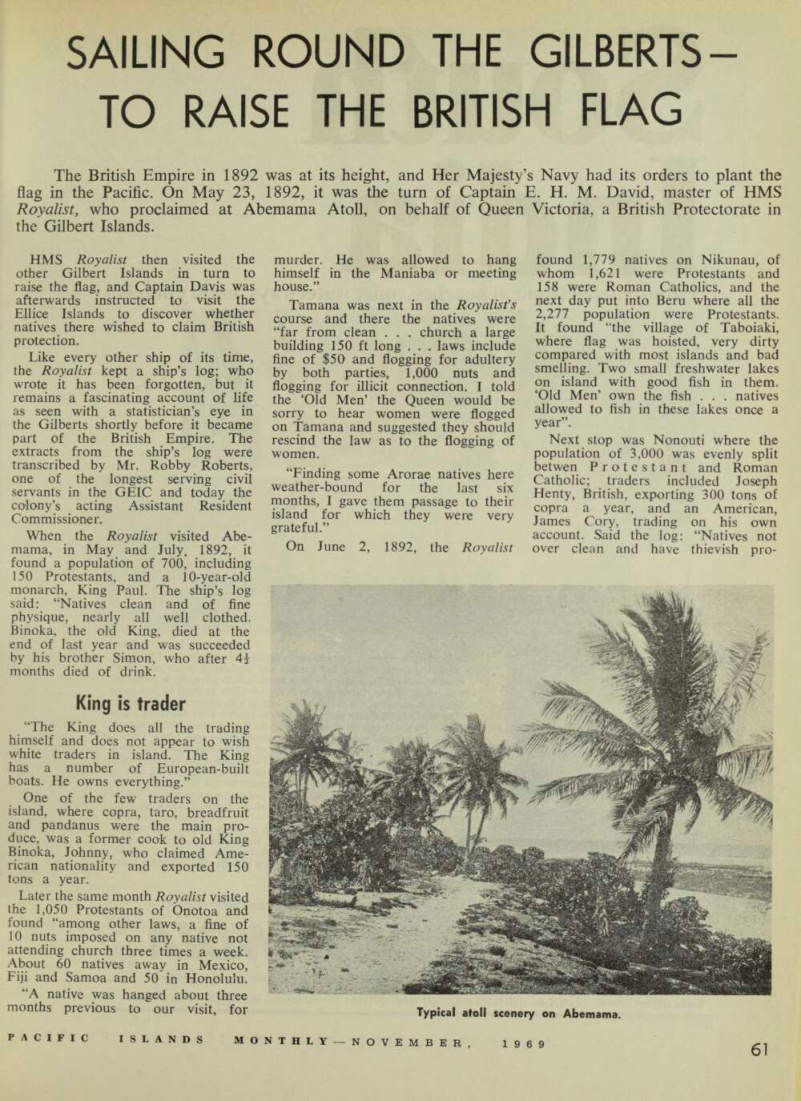
Typical atoll scenery on Abemama.
Too much toddy
pensities . . . natives taken in 1884 by French ship to Tahiti and returned in 1887, many having embraced the Catholic faith . . . have petitioned Bishop to send priest to the island.
“Catholic Mission landed in Group in 1888, this island is their head quarters. Pere Bontemps in charge with four other Europeans, This mission appears to make great head way in the Group . . . resident traders speak very well of it.
“There are very few laws in this island. Around Betumah in the north almost anarchy prevails. Spoke to natives about toddy drinking ... a great deal existing on the island. A British trader fined $lO for selling spirits to natives ... 10 natives, guilty of assault on a Fiji labour schooner, were fined.”
On June 6 the Royalist called off Aranuka, population 100, and found “too much sea to land in ship’s boats ... no canoe came off . , . everything on the island belongs to the King of Apamama”.
On six occasions between June and July the Royalist put into Tarawa where traders included Chinese, Nai Yong, trading for On Chong and Co., who exported 500 tons of copra yearly, and Edward Meyer, a German trading in copra for Jaluit Gesellschaft.
Fine physique
The log reports: “Natives of fine physique . . . island appears poor owing to civil war existing between north and south. Having got both chiefs on board, a peace treaty was signed. King asked me to take arms away ... I agreed to accept them . . . after flag was hoisted the King had some difficulty in getting arms in . . . requested assistance which I gave him.
“King fined 100 natives for dis obedience of orders . . . received in all 180 guns. Many of these had been procured from American traders who sell spirits to the natives also ... took steps to prevent this in future.
A native of this island was tried, found guilty, and executed here by order of the King for the murder of Ah Sam, a British subject at Butari tari in 1883. Previous to execution the man confessed his guilt.
“The King here appears a weak man . . . has ruled for three months.
The late King was killed in the war, shot by a native while asleep. This man, together with the chief of Abaiang (who had taken a very active part in the late war) con tinuing to give trouble and refusing to deliver up arms, and the King
requested they should be removed from the island. They were placed on board and placed on separate islands in the Ellice Group.”
Six times in the same two months the Royalist visited King Raia and his 2,700 subjects on Abaiang and found “a good deal of immorality reported here among children. A trader, Chinese (British subject) sentenced to 12 months imprisonment and S5O fine for murderous assault on a native. Taken to Fiji on Royalist”.
Traders on the island included Ah Mee, a Chinese, and Thomas Tilton, “possibly” an American Negro, trading on their own account.
At Marakei the Royalist found
King Tantatoon a “fairly good ruler”.
They also found “polygamy and infanticide still exist to a small degree . . . finding fines imposed by HMS Miranda in 1886 still unpaid, and enforced them”.
All the 2,000 population of Butari tari, except for 20 Roman Catholics, were found to be Protestants. About King Tebarimoa the log said; “Laws appear to be made to suit the King’s pocket . . . money fines very heavy, out of all proportion to offences com mitted.
“Population decreasing, probably on account intermarriage of relations.
Found a United States commercial agency established here. The King (recently returned from a visit to
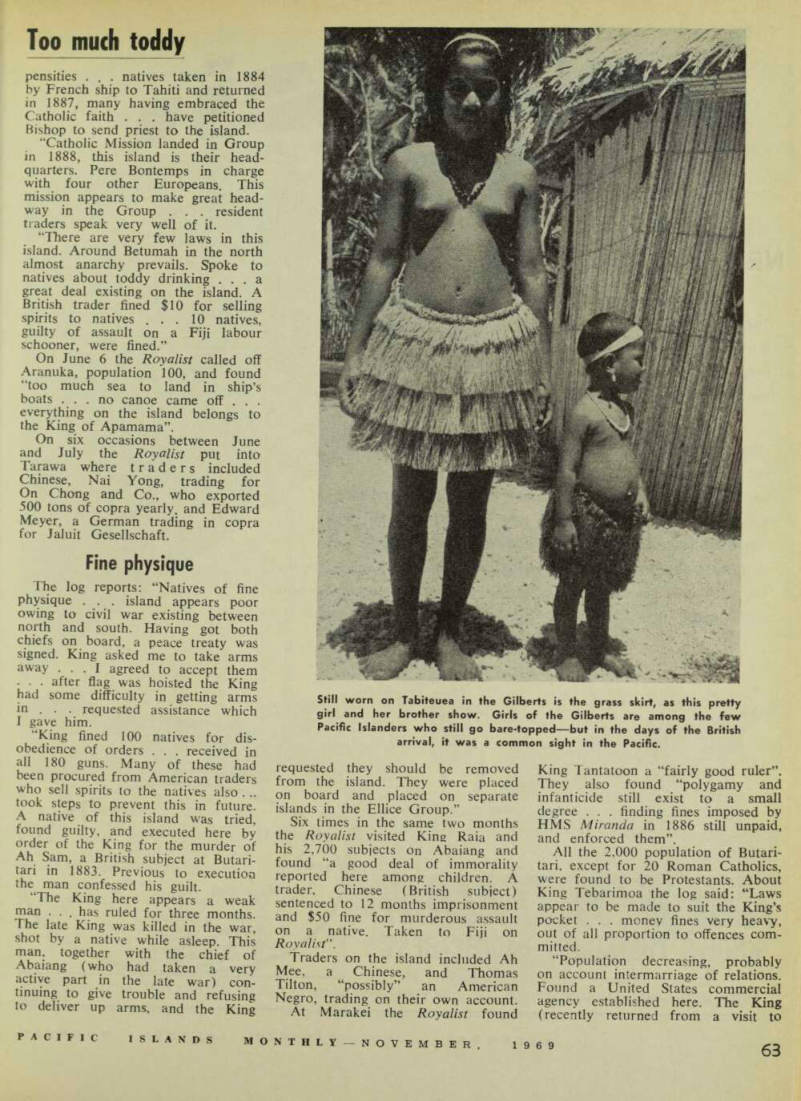
Still worn on Tabiteuea in the Gilberts is the grass skirt, as this pretty girl and her brother show. Girls of the Gilberts are among the few Pacific Islanders who still go bare-topped—but in the days of the British arrival, it was a common sight in the Pacific.
American monopolists
San Francisco) appears to be a weak man and inclined to be led by the few American would-be monopolists.
“Gave him much advice as to reforms necessary on the island, which he promised to carry out; among others the paying off of debts due to traders, amounting to $40,000, Petition presented to me signed by traders present, with the exception of late United States agent, asking that Resident be appointed.”
After sailing through the Gilberts to hoist the flag, the Royalist entered the Ellice Group to ask the islanders if they wanted “Her Majesty’s pro tection”.
At Namumea “after a meeting of the people, the King asked to have the British flag hoisted. Among other laws a divorced woman cannot marry until her former husband is again married. Very little immorality on the island”.
At Niutao the penalty for “adultery and fornication” among the natives was to “make five fathoms of road”.
Only trader found on the island of 615 Protestants was Jno. W. Buck land, British, trading for Henderson and McFarlane. who exported “about 50 tons of copra in a good season”.
Fines for adultery
The natives were “not very clean” at Nui while at Nukufetau, under King Uta, the 270 Protestants were “poor and half starved. The King no better in appearance than anyone else . . . the missionary here does not appear to be over zealous”.
Among the 231 Protestants of Funafuti, “fines for adultery and illicit connection if discovered are enforced years after occurrence, even after the death of one of the parties.
The lagoon is remarkably free from dangers, there is a good anchorage in it. Coal might easily be shipped here”.
The weather was too rough on August 4, 1892, to effect a landing on Niulakita (Sophia Island), but the crew of the Royalist were able to see that “no canoes came off from the shore. Several natives appeared on the beach and hoisted a royal ensign. After waiting some time, proceeded on course”. • The latest bugbear on Tarawa, the GEIC’s capital, is dust—and the government recently warned drivers of buses, lorries and cars running between Bairiki and Bikenibeu, and on Betio, to travel slowly through villages. It’s an offence to go over 10 mhp through a village, when there’s dust around.