now "urgent
pp. 55-62 · Read in the full issue


Pacific starfish now "urgent danger"
So seriously is the South Pacific taking the threat to its coral reefs of the crown of thorns starfish, it will ask the South Pacific Commission and the United Nations for help. This was decided at the Ninth South Pacific Conference, held in Noumea in October, and attended by leaders from all Islands territories.
Following a long report on the latest situation on the crown of thorns (Acanthaster planci), delivered to the conference by the delegate from Guam, Mr. Antonio Palomo, the conference moved a motion drawifig the attention of the SPC, to the urgent danger created by the increase of many areas of the South Pacific of the crown of thorns starfish, and requested the SPC, in cooperation with the United Nations Development Programme and other organisations, to examine ways in which the problem could best be tackled T , • . „ r In his report to the conference Mr.
Palomo said: The member territories of the South Pacific Conference are no doubt well aware of the potential biological catastrophe that is threatening the coral reef dominated areas of the Pacific Ocean.
The news media of the United States and Australia have been giving priority coverage to the recent population explosions of coral polypfeeding crown of thorns starfish, Acanthaster planci.
A , „ . ... .
A. planci, unlike the typical starnnmbp^nn^n ! 9t P e Th rmS ’- *¥• number up to 21. The animal is dark green to bluish-grey, and is covered with numerous sharp spines that are often reddish m colour. This starfish frequently reaches sizes in excess of 20 in. (50 cm).
Tnc spines of the animal are toxic
and capable of inflicting a painful wound. But the real danger to man is not from the spines but because the animal feeds upon the living part of reef corals. The starfish crawls up on coral heads, everts its stomach through the mouth and digests the coral animal (polyp) leaving only the bleached skeleton of the coral ( .. , lo ° ne of he first questions that the la y man as^s our scientists is why concerned about an animal ls destr °y m g c< JT al ?_ Man y. of the P eo P les of the Pacific consider coral as an inedible stone , seem jugly useless to man. But marine biologists and geologists give us a somewhat darker picture of what rnight happen should the starfish destroy our living reefs,
What thp HanriPrc aro
3T Qan 9 er S First of all the tiny polyps that ma k e up the living part of the coral are , responsible for laying down the underlying coral skeleton of calcium carb °uate. The constant wave attack °£ our coral reefs, along with the ettect of other marine animals that hore into the reef, subject the corals to constant erosion. Thanks to the industri °us work of the coral polyp, more coral is added to counteract these losses and provide a net gafn to the reef structure „ , Jr tn ,f. star ush eats the coral polyp. tben V llB g ain is not realised and there is a gradual eroding away of reef structure
The corals are not the only calcium carbonate secreting organisms, but they do play an important role in this phenomenon and the loss of their contribution might well be responsible for serious erosional problems on reefs. Were this to occur, then the land mass itself comes under attack from the ever present ocean wave energy.
The results of land erosion could be disastrous to the Pacific Islanders, especially those of low islands.
Change in reefs
The second problem brought about by the death of corals and their subsequent erosion is the possible change in the coral reef ecosystem.
The coral provide shelter, and either directly or indirectly, much of the food for other reef organisms.
Hence, the corals play a vital role m the tropical reef ecosystem. Dis turbance of any part of the ecosystem invariably leads to an imbalance of nature and adverse changes may occur.
For instance, the-e mav be a decrease in o’’r fisheries which would create a serious problem for areas that are protein deficient.
Many marine biologists all over the
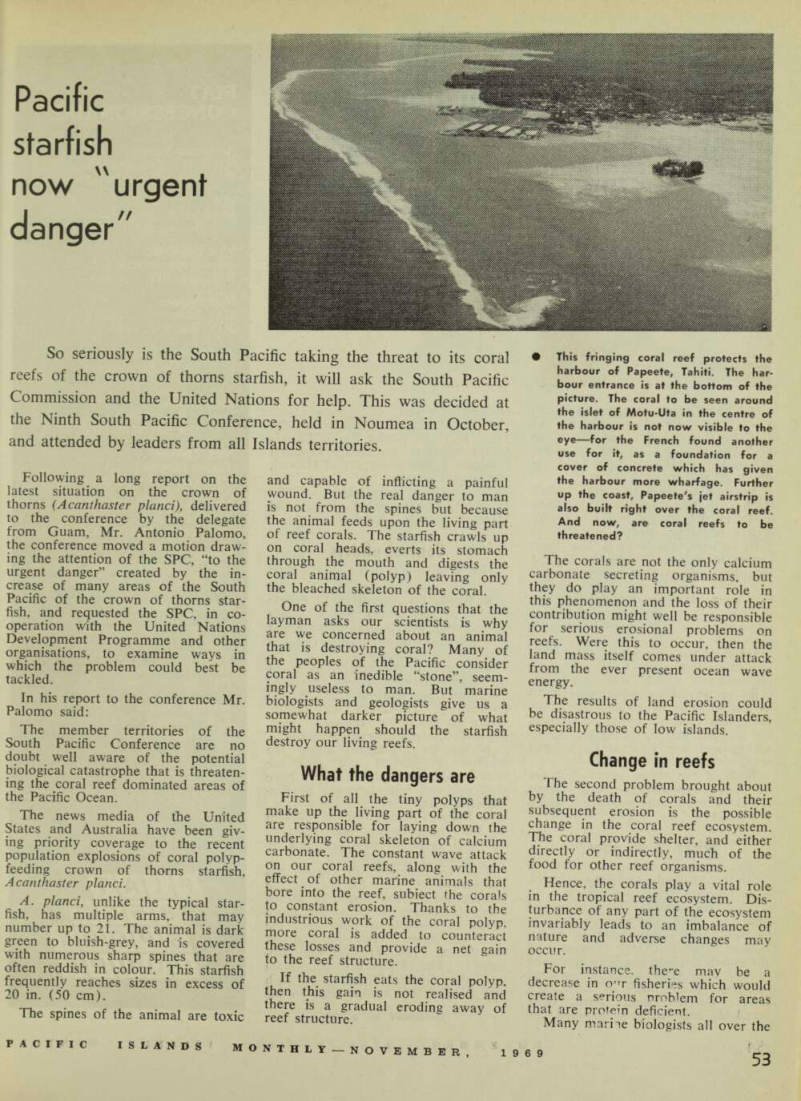
• This fringing coral reef protects the harbour of Papeete, Tahiti. The har bour entrance is at the bottom of the picture. The coral to be seen around the islet of Motu-Uta in the centre of the harbour is not now visible to the eye—for the French found another use for it, as a foundation for a cover of concrete which has given the harbour more wharfage. Further up the coast, Papeete's jet airstrip is also built right over the coral reef.
And now, are coral reefs to be threatened?
world have begun research to deter mine what these effects may be but until the results of these efforts are available, we must assume the worst and make preparations to counter the effects of this menace.
Another question frequently asked is, hasn’t this starfish always been living in the Pacific and if so why is it a problem now?
It is true, the animal has been known in our area from the earliest recording history, but never in such numbers. Heretofore, the creature has been considered rare but for reasons as yet unknown, they are undergoing a vast population ex plosion.
Some of our marine scientists tell us that this may be a cyclic phenomenon which occurs periodi cally in anywhere from, say, a 20 to a 1,000-year cycle, and the corals eventually recover. Other researchers tell us that this is the first such in vasion and that it must be stopped now.
Both of the above approaches are as yet hypothetical, and these scientists need time to prove which is correct.
What to do now?
The problem facing the SPC is what should we do while the research is in progress?
That the starfish is capable of inflicting rapid and serious damage to reef corals is no longer in doubt.
Nearly one-half of the fringing reef surrounding Guam has been destroyed in less than three years and several hundred square miles of Australia’s Great Barrier Reef have been attacked and either destroyed or
severely damaged.
A recent survey conducted in the Trust Territory of the Pacific Islands by the Westinghouse Ocean Research Laboratory, the University of Hawaii, and the University of Guam has shown serious infestations in the Marshall, Ponape, Truk, Palau and Mariana districts of the territory.
Control efforts
The SPC should make every effort to; • Notify the citizens of the Pacific Islands of the danger and ask their co-operation in reporting damage and new outbreaks of the starfish in areas previously not infested. • Assist in the centralisation of such information. It is requested that this be sent to the Marine Laboratory, University of Guam, where it will be centrally filed, duplicated, and dispersed as needed. • Support research into the control of starfish and into the reasons why the explosion might have occurred and how it could be pre vented in the future. • Support research in the problem of the rehabilitation and recovery of coral reefs already damaged by the starfish.
The Government of Guam has provided $U527,000 for part of the present fiscal year and has shown every indication of providing more funds as needed to help save the reefs of Guam. (For the first six months of 1969, $15,000 was pro vided). The University of Guam and the Guam Division of Fish and Wildlife are co-operating in the
(Continued on p. 56)
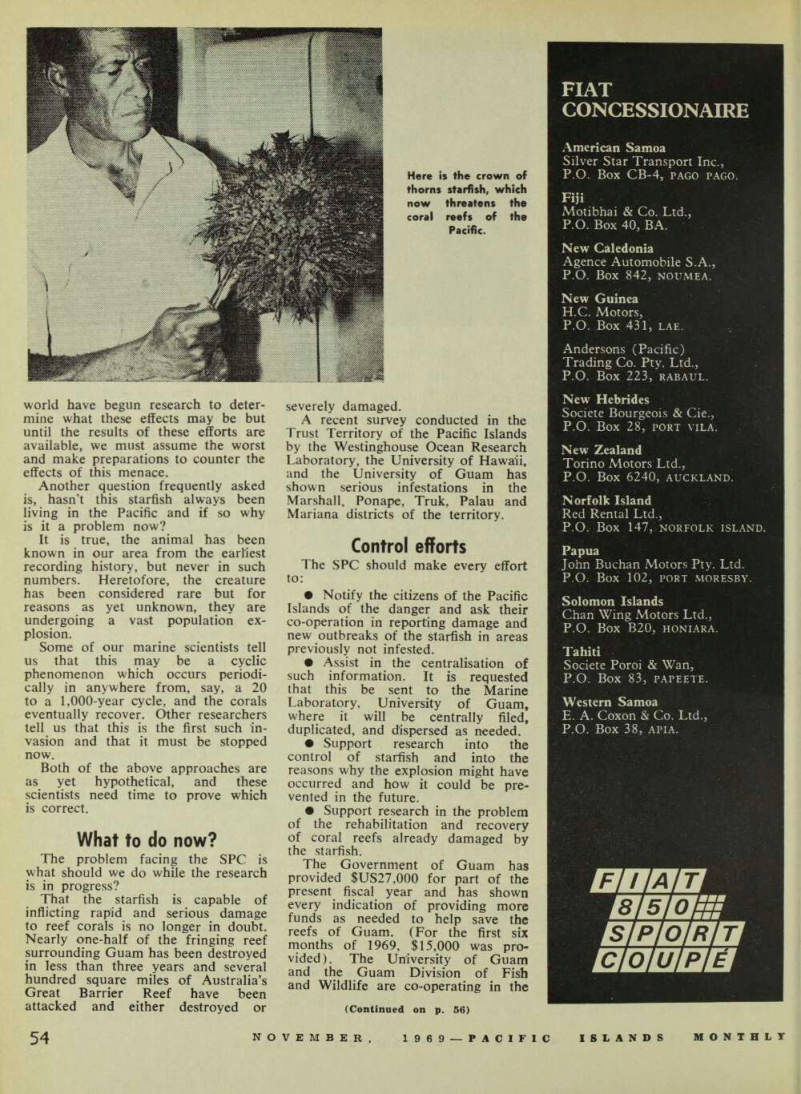
Here is the crown of thorns starfish, which now threatens the coral reefs of the Pacific.
control programme.
The US Department of the Interior is providing funds in excess of $200,000 to help control the starfish pest.
Methods to control the starfish used thus far have been; (1) Re moval of the animals from the reef. (2) Injection of toxic substances into the starfish with special injector devices.
Other methods proposed and now under investigation: (1) Electrical or chemical barriers to prevent the spread along the reef. (2) Biological control efforts, i.e., production of larvicides or disease organisms that attack the starfish.
Future plans
Representatives from the University of Hawaii and the University of Guam have been invited to attend an Acanthaster workshop in October, sponsored by the American Institute of Biological Sciences. The purpose of this meeting is to review research already done, and evaluate what could and should be done about the problem in the future.
Hopefully one of the results of this meeting would be to schedule and find funding for a larger meet ing on an international level that would bring together the efforts and resources of many nations to attack the problem. The SPC should be vitally interested in supporting such a meeting and send representatives to it.
In conclusion, the SPC must be aware of the starfish problem, and the danger it poses to us.
We must urge our scientists to continue their investigation of the problem and we must be prepared to support financially their labour and the control methods they may recommend.
From a Papeete correspondent The deadly crown of thorns star fish, has now reached Tahiti in force.
In mid-October, Tahiti’s news papers called for volunteers to take part in a “campaign of assassination” against the starfish on Saturday, October 18.
The campaign is sponsored by the Service de la Peche (Fisheries Department) with the backing of the island’s municipal councils.
A recent survey of Tahiti’s reefs by fisheries experts has revealed heavy concentrations of the starfish off the districts of Punaauia and Paea, and the western side of the island, opposite Moorea.
In these areas, the starfish is reported to be 300 times as numerous as elsewhere, and it is here that the “campaign of assassination” is to take place.
Bustling, Spreading
Port Moresby
th ’I* • dmIn » ,f ?«ve heeclquerter. of Papua-New Guinea, h as its critics. One writer in ”'l " 1 ° n ,he ( ’V/"Tn'r , !r d ° n P ' 97> describas it as "a cancer on the emerging nation of in Pan Z ’ Many of 1 °' 00 ? New Guineans, 10,000 Europeans and 400 Chinese who currently live durfno ,h m u? h >9ree ' bu ’ for ,hose who have been in ,he *own for any length of time—especially ft Port Mnr h 7 9 r °wjh period of the last few years-usually have some kind words to say for from th by can b f brash ' but " has 1,5 charms, not the least of them the views that can be gained now h \ h f S "° W cllmbm 9 U P ,he hills to the right and left of the isthmus. New suburb after suburb years Wh *’ I™ ,h * hi " ,eda " d ' a " d if baa baa " for ma^y hi th i? , Morasby m, ° ° ne dear aarlal photograph. In the foreground of this picture, taken recently by the Department of Territories, is the main business centre of Port Moresby. These days othef busfne s activities |US, as bustling have developed in the suburbs and some residents cbim, with obllous satisfachon! that they never have to go into town anymore, thank God!"
Honiara, The New Town,
Tulag1 The Old
Honiara, main town in the British Solomon Islands Protectorate and seat of the Western Pacific High Com missioner, who has responsibility for Britain's affairs also in the Gilbert and Ellice Island Colony in the north and the New Hebrides Condominium in the south, is a town whose beauty has developed slowly. Honiara didn't exist before the war. Headquarters for the Solomons then was Tulagi, a small island close to Florida.
But Tulagi was wiped out in 1942, although today it is important again for its slipway, built on the edge of a well protected harbour. Some of the old wartime quonset huts may still be seen at Tulagi in the recent picture on the opposite page, but in the main town area of Honiara they are being replaced by modern new buildings in a vigorous rebuilding programme. Honiara has more than 8,000 people, nearly all of them Melanesian. The point at left in this aerial picture by Bruce Adams (who also took the one of Tulagi) is historic Point Cruz, near where Mendana landed in 1568. Now it is the site of the main Honiara wharf and extensive reclamation work.
• These two attractive Island girls are pupils of the Elaine Bernacchi High School at Bikenibeu, Tarawa, Gilbert and Ellice Islands. You have already seen some of them on this month's cover. Bruce Adams took the photograph for PIM.