in developing economy"
p. 51 · Read in the full issue
Cook Islands face "difficulty in developing economy"
By W. H. PERCIVAL, in Rarotonga
Minister of Finance, Mr. A. R. Henry, presented the budget to the Cook Islands Legislative Assembly recently, and gave the good news that the balance in reserve had not fallen as low as the budget forecast of $NZ50,537.
The actual reserve on March 31 was $138,740, and this was mainly due to much less expenditure on capital projects which were under spent by $266,650. However, this expenditure was only deferred, not avoided, and the government was faced with stepping up the capital works programme in the coming year.
Salaries and wages paid out by the government in 1968-69 rose to $2,107,825, about $lOO,OOO more than the New Zealand subsidy for that year.
As the Cook Islands Government had to find the money from its own resources for all building materials, plant, equipment, vehicles, fuel, general stores, transportation costs and advances, it was faced with a difficult task in continuing to develop the economy, Mr. Henry said.
No wage increase
The government could still not afford to pay the Public Service the ruling rate increases granted in NZ without a corresponding increase in aid, and as a result the government has had to defer merit increments m the current year. For the same reason it could not afford increases in the local basic wage rate.
The first thing the government had to consider for 1969-70 was a programme of works and capital ex
penditure regarding the preparation and development necessary for the new Rarotonga airport construction and the advent of tourism.
Tourism promises to expand the internal economy of the Cooks and make them less dependent upon external grants and improve the standard of living, but it will also place a strain upon the social structure, and special efforts will be required to preserve traditional culture.
Adequate control
Government policy is to promote tourism under adequate control.
Present problems are investments in roads, water supply, sewerage, improved health services, power ex tensions and telephone services.
As a result, more will be spent on these facilities in 1969-70 and less on agricultural projects. *,^ n <nA nC ; eaSe , fr ° m $78 ’ 300 to M 6 7,500 for electric power supply is designed to double the generating capacity to meet the demands of airport, hotels, motels and normal expansion in consumption.
Expenditure on education rises from $52,600 to $75,750. This is mainly for new school buildings.
Progress in the building of Raro tonga’s new hospital is reflected in the extra $75,000 provided for it.
The Internal Affairs Department is to get an extra $BO,OOO required as loan finance under the Housing Improvement Scheme. Many ap plicants for housing loans have been kept waiting for a long time because funds for housing loans were in adequate. This problem has been made worse because of the need to re-settle people displaced from their homes due to the reconstruction of Rarotonga airport.
The total capital estimates are just short of $1 million, and a little more than half of this will be pro vided in grants from New Zealand An additional $250,000 will be loaned by NZ, and the Cook Islands will have to find the rest by drawing on reserves and raising loans on the savings of the community.
Revenue won't keep pace
Revenue is not expected to keep pace with the increase in expenditure on ordinary services, Mr. Henry said, and it would be necessary to draw on the last of the reserves to bridge £?» *?£’ *J?®. amo V n ' required being jhoo.yjo. This took into account the results of trading activities, expected to contribute a total of $134,000 in revenue.
In order to get the people to do more to help themselves, and in order to tester a spirit of participation, the government has introduced the PAYE system, a welfare services tax, and an increased tax on non-resident companies to provide more internal revenue in 1970.
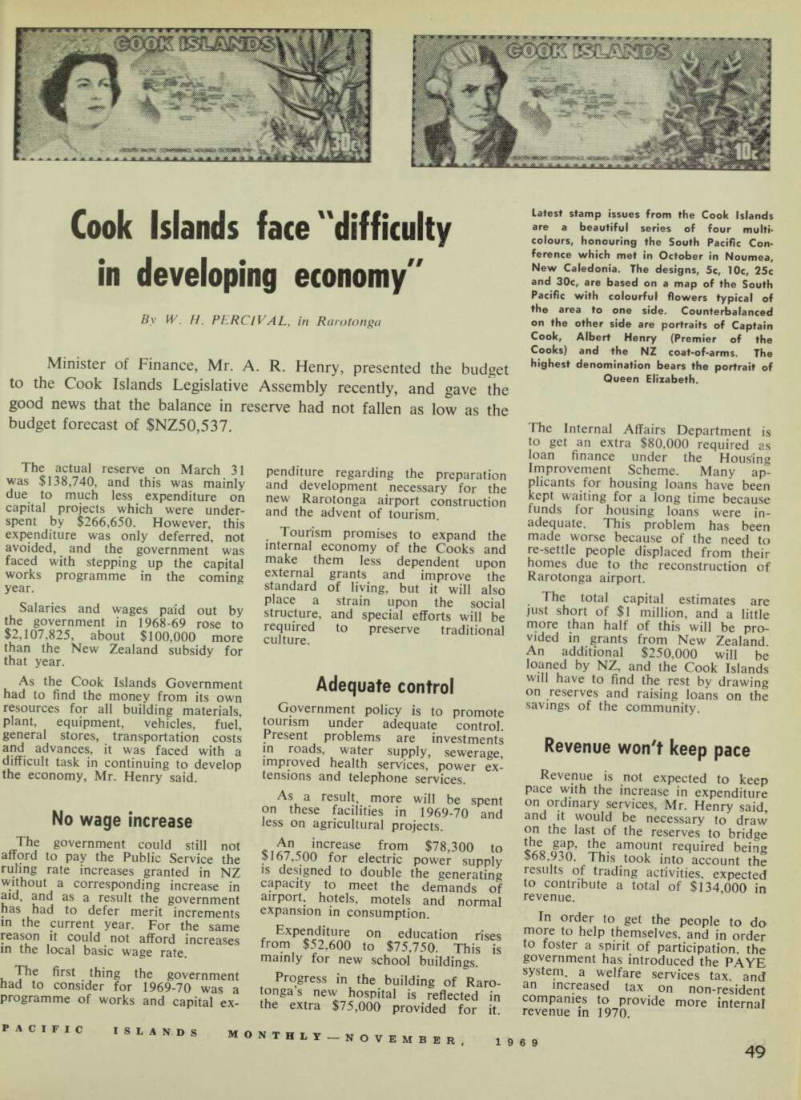
Latest stamp issues from the Cook Islands are a beautiful series of four multi colours, honouring the South Pacific Con ference which met in October in Noumea, New Caledonia. The designs, 5c, 10c, 25c and 30c, are based on a map of the South Pacific with colourful flowers typical of the area to one side. Counterbalanced on the other side are portraits of Captain Cook, Albert Henry (Premier of the Cooks) and the NZ coat-of-arms. The highest denomination bears the portrait of Queen Elizabeth.