... Don't lose touch
p. 49 · Read in the full issue
Economic Advisor Warns Tongans ...
... Don't lose touch with the land
From a Rarotonga correspondent “It seems to me absolutely inevitable that the most important sector to which we must look for economic growth is agriculture.”
This is how leading British economist, Professor Geoffrey Meynard, lecturer in economic theory and development at the UK’s Reading University, said recently after a stay in Tonga to provide technical advice on a new five-year plan for the kingdom.
With his experience, reinforced by a number of similar study tours of underdeveloped countries in an advisory capacity, he was able to come up in a comparatively short time, with some very clear ideas of Tonga’s requirements when she intro duces her second five-year plan in July of next year.
In her first five year plan, launched in July, 1965, Tonga has been able to renew many essential services and build others. Completed projects include a deepwater wharf, a modern air-terminal building, a post office and police training and administration centre and most important, a new fresh water supply system, and reticulation on the main island as opposed to rain water storage.
In the fields of health, education and agriculture, several important, continuing projects have been started like the national tuberculosis cam paign and the establishment of clinics for mother and child care and family planning. A modern two storey hospital to accommodate 200 patients including a maternity annex is near ing completion.
Most notable advance in the agri cultural sector has been the intro duction, under FAO leadeship, of a long term coconut replanting scheme, geared to add 4,000 acres of new palms a year, to replace old and un productive plantations.
For the 80,000 people living in a benign feudal state in the Pacific’s last surviving kingdom, this has been a major break-through, achieved at the modest cost of only SAS million by the time the current programme ends in mid-1970.
Of this, the Tongan Government has contributed at least half, while the balance has come from various overseas sources by way of grants, technical aid and soft interest loans,
with treaty partner, Britain, bearing the lion’s share.
It waj precisely for the purpose of studying its progress through this initial stage of development as well as its capacity for continued ex pansion that Professor Meynard came to Tonga, He feels it will be necessary to lay down the main lines of develop ment for a period of at least 10 years. This will enable the land, firstly, to provide the necessary in crease in subsistence and cash crops for domestic consumption and cash crops (including the processing of them) for export.
And secondly, it will enable the land to absorb, at rising levels of real income the explosive increase in population, the main part of whom must find employment on the land.
The long-term plan should be based on a survey of potential land use investigating the possibilities of crop diversification, expansion of crops on existing land and bringing into cultivation present unused land.
Education
He gave equal emphasis to educa tion but warned that, “the aim should not be to meet consumer demand for education, which can be unlimited and rather wasteful, but to meet the manpower needs of the economy.
“This could best be done by a manpower requirement study and although this may involve some delicate problems, it seems essential that the major policy problems should be resolved by the Education Department before the 1970-75 Plan is formulated.
“Given that Tonga already pro vides universal primary education (though not necessarily of the most appropriate sort), priority should be given to the expansion of secondary
education with a vocational and in particular, an agricultural bias.”
The important considerations given to agriculture and education were also applicable to the fishing industry and the health services. The islanders were well placed geographically to derive employment and much of the protein content of their diet from a greater harvest of the sea as well as of the land.
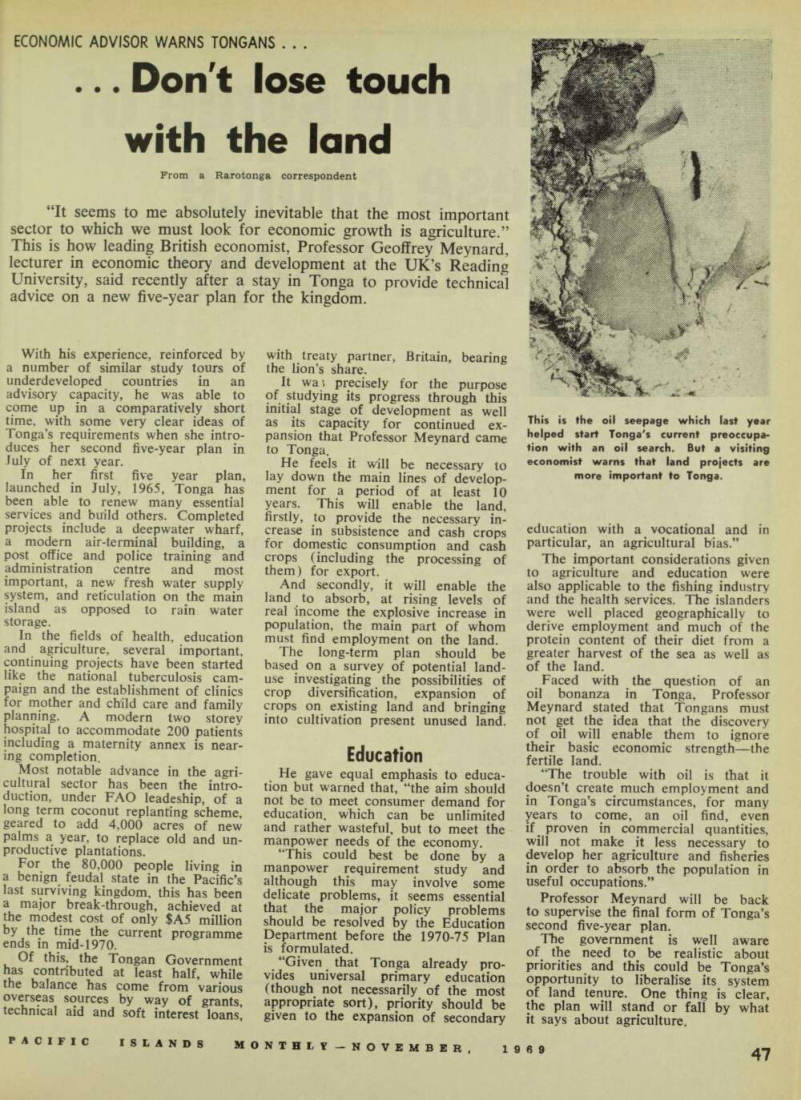
Faced with the question of an oil bonanza in Tonga, Professor Meynard stated that Tongans must not get the idea that the discovery of oil will enable them to ignore their basic economic strength—the fertile land.
“The trouble with oil is that it doesn’t create much employment and in Tonga’s circumstances, for many years to come, an oil find, even if proven in commercial quantities, will not make it less necessary to develop her agriculture and fisheries in order to absorb the population in useful occupations.”
Professor Meynard will be back to supervise the final form of Tonga’s second five-year plan.
The government is well aware the need to be realistic about priorities and this could be Tonga’s opportunity to liberalise its system of land tenure. One thing is clear, the plan will stand or fall by what it says about agriculture.
This is the oil seepage which last year helped start Tonga's current preoccupa tion with an oil search. But a visiting economist warns that land projects are more important to Tonga.