to repeat history
pp. 41-42 · Read in the full issue
Governor Risterucci leaves N. Caledonia
While talking about Noumea’s big conference, the most colourful social engagement of a week of colourful social engagements for delegates to the South Pacific Conference was the invitation to a cocktail party from the High Commissioner of the French Republic in the Pacific Ocean and Governor of New Caledonia and De pendencies, Governor Jean Risterucci.
The party was at the magnificent Governor’s residence in the heart of Noumea, built only two years previ ously, and overlooking the port of Noumea. A never-ending flow of guests shook hands with the Gov ernor and Mrs. Risterucci before entering the high ceilinged reception rooms, which are a satisfying com bination of traditional and modern French architecture.
The white uniforms and gold braids of officers of the French Pacific forces mixed freely with the sulus, tapa and dark grey lounge suits of the South Pacific. And there were a couple of French hippies who nobody could identify and who added to the colour of the occasion.
Good French champagne flowed even faster than the good Scotch whisky as smartly dressed waiters fought to keep up a generous supply of liquor to the biggest throng that had packed into the residence since it was opened.
For this magnificent cocktail party was more than a gesture to the dis tinguished delegates to the SPC. It was a farewell function, by Gov ernor Risterucci, who left Noumea two days later after nearly five years in New Caledonia.
His successor, Mr. Louis Verger, previously Prefect of the Department of Isere in France, has since arrived in Noumea.
The Governor’s departure was officially announced only at the be ginning of October and was followed a week later by a radio farewell broadcast by Mr, Risterucci.
After outlining the developments achieved during his term, the Gov ernor regretted not having been able to lay the first stone for the con struction of bridges on New Cale donia’s East Coast, where five wide rivers still have to be crossed by punts. After many years of promises and waiting, Mr. Risterucci declared this problem was now “resolved”, although he didn’t say how.
The Governor also expressed his satisfaction at what he termed the recent degree of harmony achieved
between the Administration and cer tain parties in the Territorial As sembly and said he was convinced this would end the “war of harass ment” which has existed between the two sides.
Governor Risterucci’s term in the South Pacific has been an unusually long one for a senior French ad ministrator.
Pitcairners invited
to repeat history
The 83 inhabitants of Pitcairn Island, most of whom are over 50, have been invited to repeat history and leave their homes to re-settle on Norfolk Island, where in 1856 they started the original community.
Young people of the island are drifting away to look for work and older members are finding it increas ingly difficult to keep their island home going. Thoughts are being ex pressed on Norfolk Island that crown land should be made available for any Pitcairners who might wish to re-settle there.
The original inhabitants of Pit cairn were mutineers from the Bounty who settled on the island in 1780 with 12 Tahitian women.
The Pitcairn community continued
to grow until the British Government decided that the Morayshire should pick up the 194 inhabitants in 1856 and transfer them to Norfolk Island, then uninhabited.
Norfolk, discovered by Cook in 1774, had been a convict settlement until 1856. But many Pitcairners were unhappy in their new home and, when they could, left to return to Pitcairn.
Population on Norfolk in June was 1,232 of whom 589 are descendants from Pitcairn Island.
An editorial in an October issue of the Norfolk Islander said: “In 1864, the last of the returning descendants of the Bounty mutineers left Norfolk for Pitcairn. Like their relations on Norfolk, the Pitcairners have gone through hard and trying times. Both islands have witnessed an exodus of their young people to the mainland of Australia and New Zealand.
“Fortunately for Norfolk this trend, thanks to many factors, has been reversed and since 1964 we have witnessed a steady return of young people to the island, which can now offer a reasonable degree of security for their future.
“Unfortunately for Pitcairn this is not the case. At the moment two thirds of the population are over 50 years of age, there are a small number in the 30 to 40 age group, none in
their 20’s and only 12 children.
“With the increasing release of Crown land on Norfolk Island for both development and domestic pur poses, would it not be possible to offer once more some of this land to the folk on Pitcairn, who would, if re-settlement becomes a necessity, find it much easier to fit into our way of life on Norfolk?”
Some direct words
on education
The report of the Fiji Education Commission, which should be re leased in a week or two, will be a comprehensive, very direct document, from what we hear. It will certainly be a basic document in the educa tional history of Fiji.
The six-man commission under the chairmanship of Sir Philip Sherlock, a former vice-chancellor of the Uni versity of the West Indies, made its exhaustive survey in September and early October.
The commissioners were impressed with the tremendous effort of self help by local education committees, which resulted in 85 per cent, of eligible children being at school in Fiji. This is a high proportion for a country like Fiji. But the com missioners were also impressed, in a different way, with the fact that one-quarter of all Fiji’s teachers are not trained.
The commission’s views on what should be done to overcome this grave teacher shortage are likely to pose problems for both the govern ment and the opposition.
Noumea's "affair
of September 2"
There is probably more behind the riots of Noumea of September 2 than were at first obvious. The riot, reported in PIM in October (p. 36), was said to have been sparked off by a roneoed leaflet advocating an armed uprising against authority. It was distributed by natives of Mare and it resulted in about 300 people, mainly Melanesian, smashing pro perty in the town of Noumea.
But since then some people in Noumea have been examining the background, and they regard as significant that the principal figure, plus others involved in the drama, have since been released from detention.
The whole affair triggered off with the arrival at Magenta airport, on the morning of September 2, of young student Nidoishe Naisseline.
This son of the paramount chief of Mare island, Loyalty group, was
arrested and taken to Noumea police station for questioning on matters relating to the distribution of so called “subversive literature”.
Naisseline’s young friends followed him to the police station, and were joined outside by other Mare islanders. When, at midday, the chief’s son had not been released, the crowd increased. By 5.30 p.m. there were about 150 persons con gregated outside.
Meanwhile the vice-president of the Territorial Assembly, Mr. Yan Celene Uregei, who is from the Loyalty Islands, intervened, he claims to try to warn the police of the possible consequences of their action.
Anoarently the warning passed un heeded: the police remained inside their station and it was not until about 7.30 p.m. that gendarmes with rifles arrived to disperse the crowd.
Shortly afterwards Naisseline was taken to hospital. Later he was re ported as suffering from “nervous disorders”.
Then, under cover of dark, a group of some 30 larrikins took the op portunity of stoning street lights, shop windows and signs around the centre of town.
In October, 11 men who had been detained since the disturbances were released after a court hearing.
Two men were given two months suspended gaol sentences, eight were given one month, the period for which they had already been detained, the eleventh was acquitted.
A few days later Nidoishe Nais seline was also freed. He was allowed to board a plane to return to his studies in Paris.
Now the citizens of Noumea are asking why Naisseline’s apprehension for questioning was handled in such a way? Why was the gathering out side the police station not dispersed earlier?
It’s almost as if the Noumea authorities wanted to see some trouble develop.
The lepers move
from Makogai
The dedicated life and work of Patrick Joseph Twpmey, the Leper Man, will be commemorated in a new Leprosy Hospital for Fiji, open ing in November on Tamavua Heights, four miles out of Suva.
Mr. Twomey worked for lepers and other sick people in the South Pacific for more than 40 years and it is in appreciation of his efforts that the Fiji Government has decided to call the new institution the P. J.
Twomey Memorial Hospital. Doctors, nurses and patients are at present preparing for the move from the famous old hospital on the island of Makogai to the new Suva home.
For decades, the Central Leprosy Hospital, Makogai, was the only leprosarium in the South Pacific and at the outset, the work of the Lepers’
Trust Board was concentrated on providing comforts and amenities for the patients there. It has contributed over $lOO,OOO to the new hospital.
Makogai was originally known as the Island of Death because lepers were sent there simply to die, but with the aid of the Roman Catholic Sisters of Mercy, who staffed the hospital, there have been tremendous advances—notably by the use of the sulphone drugs.
The move to the mainland will bring the new leprosy hospital right to the outskirts of Suva. This rep resents a great advance in the public attitude towards the disease. There has been no outcry against the presence of leprosy patients so close to the city. Segregation is no longer necessary if the disease is diagnosed in time and doctors hope that bring ing the patients to Suva will help them to take a normal place in society as soon as they are cured.
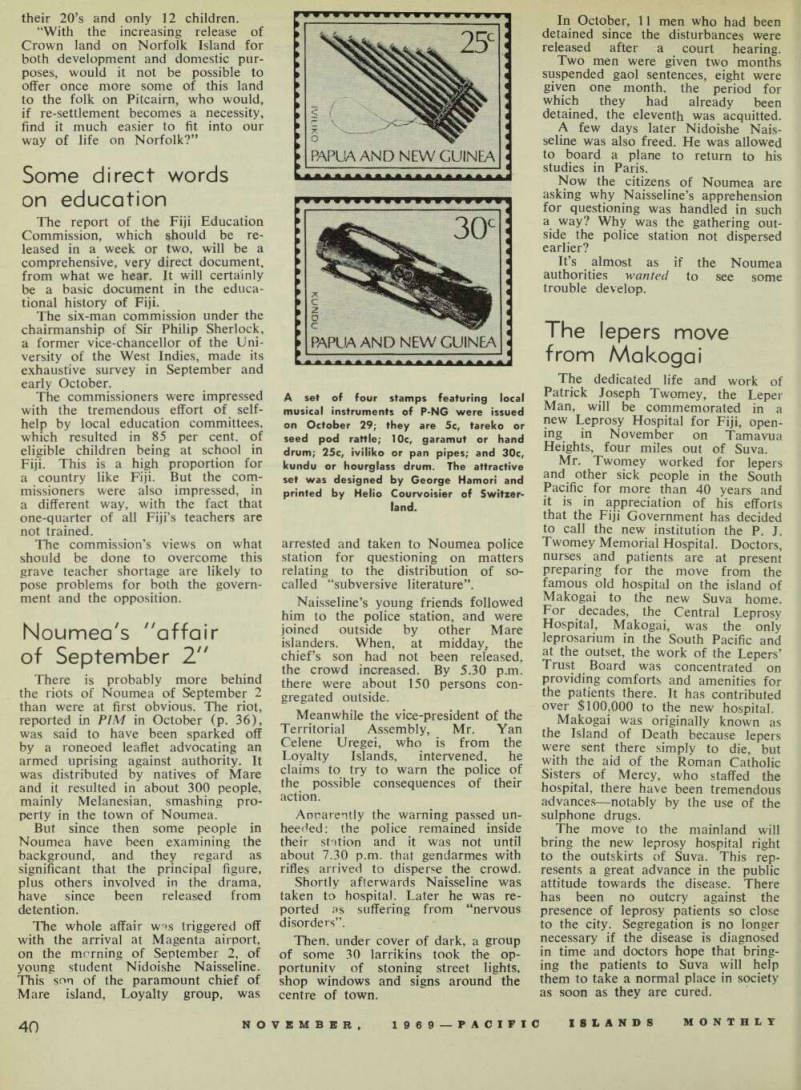
A set of four stamps featuring local musical instruments of P-NG were issued on October 29; they are 5c, tareko or seed pod rattle; 10c, garamut or hand drum; 25c, iviliko or pan pipes; and 30c, kundu or hourglass drum. The attractive set was designed by George Hamori and printed by Helio Courvoisier of Switzer land.