Tropicalities
p. 40 · Read in the full issue
The Foundation for the Peoples of the South Pacific, which has been in imminent danger of losing face because its biggest project bogged down in the Gilbert and Ellice Islands, now seems to have overcome its problems.
Its executive director, Father Stan Hosie, of New York, impressed delegates to the South Pacific Con ference in Noumea in October with a list of the foundation’s achieve ments during the year and an outline of its future objectives. Objectives included a plan for solving the GEIC problem building a causeway between Betio and Bairiki islets on Tarawa.
The Foundation for the Peoples of the South Pacific (FSP), is a private non-profit organisation launched in New York in 1966 to assist development in the Islands.
Need for it was seen by Mrs. Maurice Silverstein, of New York, who spent her early life in Australia as actress Betty Bryant, and who is now the foundation’s president, and Father Hosie, who is an Australian priest interested in community work.
Last year the FSP appointed a projects director, who toured the Islands for several months before she and the FSP suddenly parted company. The cost of keeping her in the field turned out to be too ex pensive, and the foundation decided to cut its cloth a different way.
No money
Father Hosie told a delighted Noumea conference that he had been asked “whether it was true that the FSP had $9O-million to give away to the Pacific”. The truth was that the FSP had a girl in its New York office “who looks like a million dollars”, but apart from that, “it has no money!”
He said that as a result of its experience so far, the FSP had decided to switch its energies in a different direction—it would start to seek funds from various sources on behalf of Islands projects that couldn’t get them in other ways.
FSP directors would first decide if a proiect had a reasonable chance of helping in the socio-economic development of the local people. If it did. the project would be put on the FSP programme for the coming
Foundation
Finds Its
Feet
year and the FSP would work to find a grant for it from a suitable inter national aid organisation.
A project would need to be a “grass roots” one, contributing to local development at individual or village level. It would have to be wanted by the local people and there would have to be somebody locally to give it responsible direction.
Father Hosie said that already in 1969, as a result of the change in foundation policy, the FSP had found grants for a wide range of Islands projects, including: In New Guinea, 5U55,600 for an agricultural school on Buka; in the Solomons, $3,000 for a Malaita hos pital and $5,600 for a slipway; in the New Hebrides, $7,000 for a manual training centre at Aoba, $4OO for a building society; in Fiji, $6,000 for a farm mechanics work shop, $l,OOO for a YWCA, $5,000 for a maternity centre, $4,000 for a housing co-operative; in Western Samoa, $5,600 for an agricultural development, $lO,OOO for an agri cultural college, $5.000-$7 500 for a water supply; in Tonga. $6,000 for a village development, $47,000 for the Hango Agricultural College, $2,600 for a beef cattle project.
Father Hosie also gave details of extensive grants to the South Pacific Commission for various projects.
He explained that last year’s plan to raise $lOO,OOO for the supply of a dredge and an engineer to build the causeway in Tarawa, using and training local labour, had been dead locked because the GEIC govern ment had finally urged that the causewav be built by outside con tract. This was too expensive for the
Fsp ( Pim, Oct., P. 35).
“But now the problem has been resolved,” said Father Hosie. “The
GEIC’s acting Resident Commissioner has agreed to accept the FSP offer of a dredge, provided that the expert engineer both initiate and continue with the project. The GEIC will provide Public Works Department personnel and facilities to comple ment the FSP dredge and engineer.
“As a result, FSP will renew its drive for a dredge for Tarawa. We already have $20,000 in hand”
Father Hosie added that he wanted to bring to the attention of the various territories the “avail ability of hospital and dental equip ment in the United States”. A US Government freight subsidy could be obtained to ship this equipment to territories which guaranteed duty free entry of the shipment.
Father Hosie was in Sydney in late October, where he was to be joined bv Mrs. Silverstein. Both planned to visit New Guinea, the Solomons and Fiji to discuss ways in which the foundation could help further.
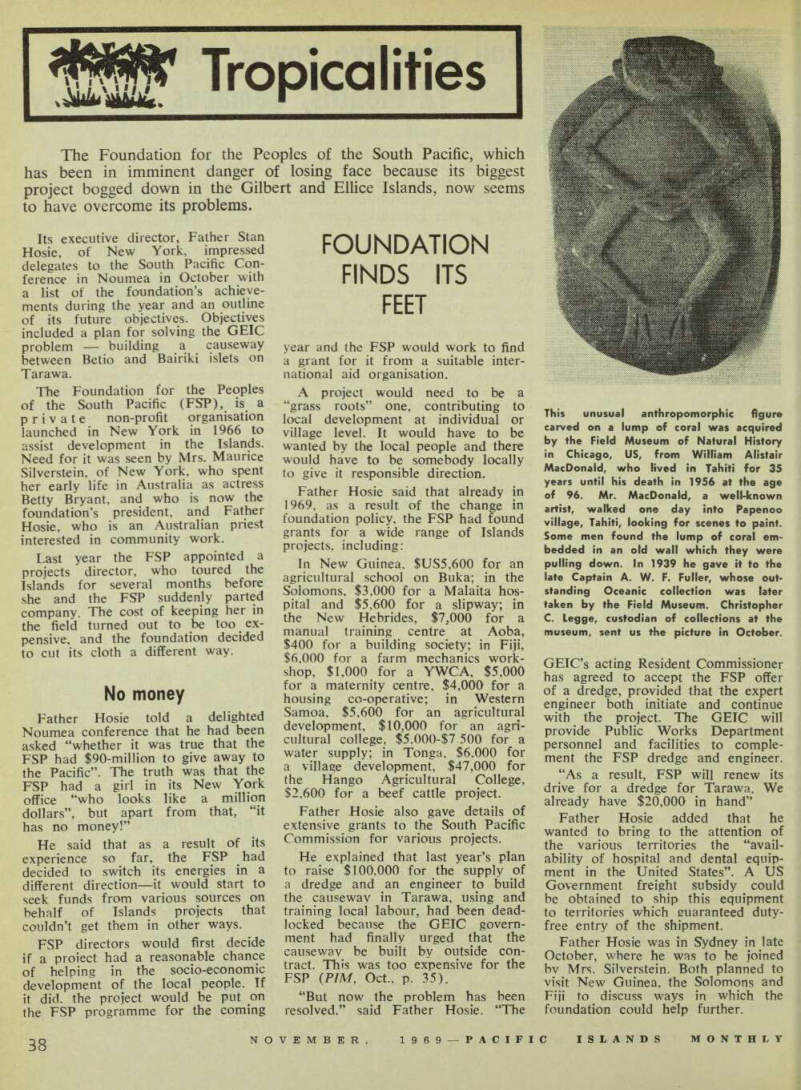
This unusual anthropomorphic figure carved on a lump of coral was acquired by the Field Museum of Natural History in Chicago, US, from William Alistair MacDonald, who lived in Tahiti for 35 years until his death in 1956 at the age of 96. Mr. MacDonald, a well-known artist, walked one day into Papenoo village, Tahiti, looking for scenes to paint.
Some men found the lump of coral em bedded in an old wall which they were pulling down. In 1939 he gave it to the late Captain A. W. F. Fuller, whose out standing Oceanic collection was later taken by the Field Museum. Christopher C. Legge, custodian of collections at the museum, sent us the picture in October.