Pacific industry
pp. 92-93 · Read in the full issue
Researcher asks Islanders to ...
Spot a turtle and help build a new Pacific industry
By Dr. H. ROBERT BUSTARD of the Australian National University.
Have you seen any turtles with metal tags attached to their front flippers or with a small portion cut out of the rear of the upper shell?
These turtles were tagged on the Great Barrier Reef of Australia at Heron or adjacent islands of the Capricorn-Bunker Group or at Bundaberg on the Queensland Coast. When the turtles are legally taken, rewards are offered for the return of the tag or in the case of clipped turtles for the return of the carapace.
Scientists at the Australian National University became interested in sea turtles six years ago and started a research programme into their ecology, and conservation require ments. The programme, initiated and carried out at the Research School of Biological Sciences in the A.N.U. is a population study. The work has much relevance to problems involved in operating an efficient turtle fishery and turtle hatcheries. I believe that sea turtles are potentially a very valuable resource if properly managed and could provide big money to the Pacific.
Suicidal methods
Present methods of fishing, which rely heavily on taking female turtles when they are out of the water to lay their eggs, are suicidal. They prevent regeneration of the stocks (if the females are taken before the eggs are laid) and put the “fishing” emphasis on the breeding females.
Fishing should take place on the feeding grounds. The green turtle, the most valuable commercial species, feeds mainly on green seaweeds growing in shallow seas. Work in progress will determine the most economic size at which to fish turtles.
One aspect of the work is involved
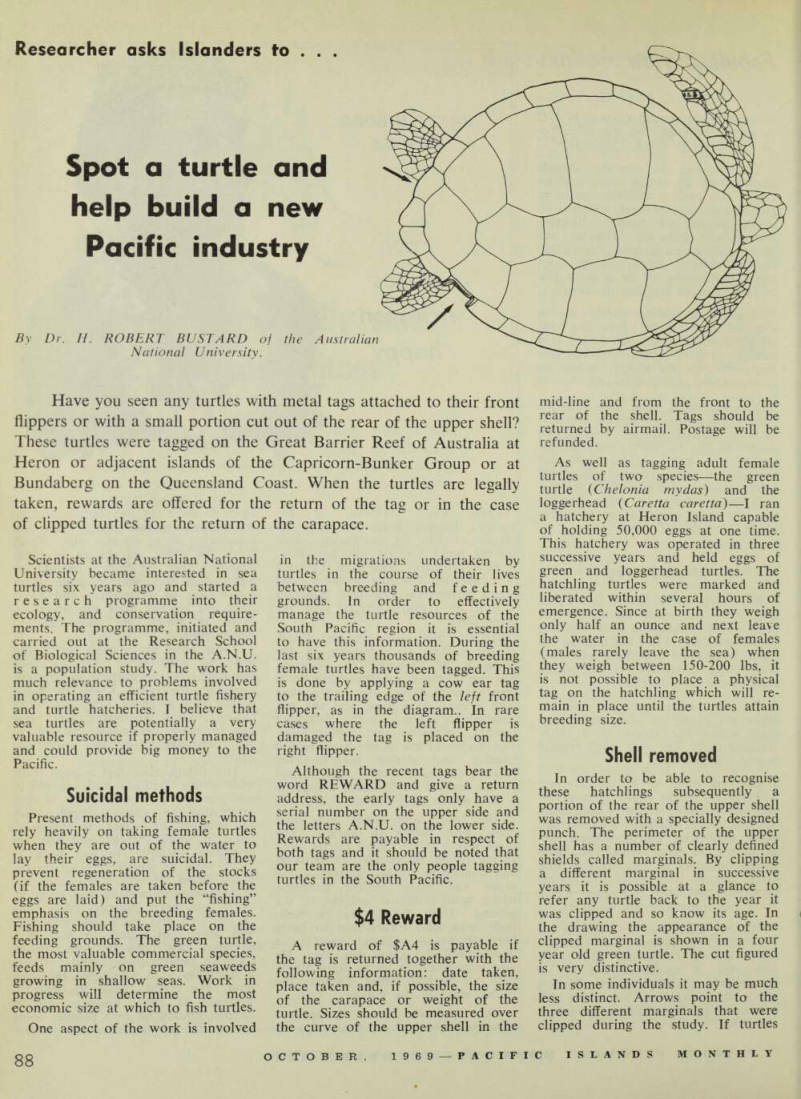
in the migrations undertaken by turtles in the course of their lives between breeding and feeding grounds. In order to effectively manage the turtle resources of the South Pacific region it is essential to have this information. During the last six years thousands of breeding female turtles have been tagged. This is done by applying a cow ear tag to the trailing edge of the left front flipper, as in the diagram.. In rare cases where the left flipper is damaged the tag is placed on the right flipper.
Although the recent tags bear the word REWARD and give a return address, the early tags only have a serial number on the upper side and the letters A.N.U. on the lower side.
Rewards are payable in respect of both tags and it should be noted that our team are the only people tagging turtles in the South Pacific.
$4 Reward
A reward of SA4 is payable if the tag is returned together with the following information: date taken, place taken and, if possible, the size of the carapace or weight of the turtle. Sizes should be measured over the curve of the upper shell in the
mid-line and from the front to the rear of the shell. Tags should be returned by airmail. Postage will be refunded.
As well as tagging adult female turtles of two species—the green turtle (Chelonia my das) and the loggerhead (Caretta caretta ) —l ran a hatchery at Heron Island capable of holding 50,000 eggs at one time.
This hatchery was operated in three successive years and held eggs of green and loggerhead turtles. The hatchling turtles were marked and liberated within several hours of emergence. Since at birth they weigh only half an ounce and next leave the water in the case of females (males rarely leave the sea) when they weigh between 150-200 lbs, it is not possible to place a physical tag on the hatchling which will re main in place until the turtles attain breeding size.
Shell removed
In order to be able to recognise these hatchlings subsequently a portion of the rear of the upper shell was removed with a specially designed punch. The perimeter of the upper shell has a number of clearly defined shields called marginals. By clipping a different marginal in successive years it is possible at a glance to refer any turtle back to the year it was clipped and so know its age. In the drawing the appearance of the clipped marginal is shown in a four year old green turtle. The cut figured is very distinctive.
In some individuals it may be much less distinct. Arrows point to the three different marginals that were clipped during the study. If turtles
Turtles tagged in thousands
are taken with clipped portions in any one of these three marginals the carapaces should be returned to Dr.
H. R, Bustard, Australian National University, P.O. Box 4, Canberra, Australia.
It is only necessary to send the upper shell. This should be forwarded C.O.D. by air freight. If freight has been paid it will be refunded and a reward of four dollars will be paid for every carapace returned. As before, the sender should state the date and location at which the turtle was taken. Where the carapace has an economic value to the finder (as a tourist souvenir, for instance), this sum will also be paid.
It is particularly requested that people possessing such carapaces return them as soon as possible as the data is essential for the turtle research programme which in turn will benefit the peoples of the Pacific Islands.
It should be emphasised that it is not possible to fake the appearance of the cuts and that rewards will not be paid in respect of shells with cuts other than in any of the positions arrowed in the figure. Furthermore, tagged or clipped turtles will be either green turtles or loggerhead turtles. So far we have not marked other species of sea turtles.
Three captures
Although we have seen most of our turtles several times when they returned to nest at Heron Island later in the same summer we have not received notification of many recaptures elsewhere. This is to be
expected because much of the Barrier Reef is totally uninhabited. Most of our recaptures have come from the Queensland coast.
However, we now have three international recaptures. Two are of green turtles tagged at Heron Island which were recaptured in south-east Papua and in New Caledonia. The third was a loggerhead turtle tagged at Bundaberg in south-east Queen land which was recaptured in the Trobriand Islands.
We hope that as a result of this article many more recaptures will be reported from the South Pacific.
We know that adult turtles make long migrations from our own work and reports elsewhere. For instance the turtles feeding on the Brazilian coast go out to mid-Atlantic to Ascension Island to breed.
Nothing is known about the travels of baby turtles between hatching and maturity. We hope that as a result of this article we will have a number of recaptures from the Pacific in the future.
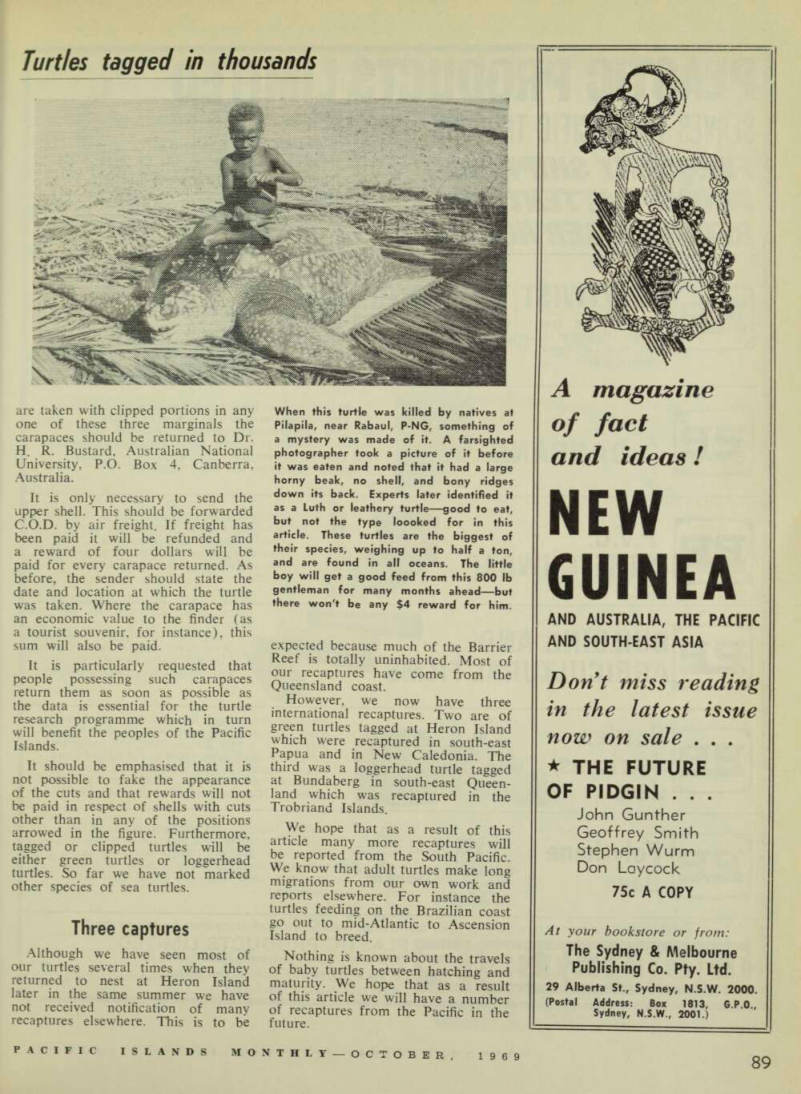
When this turtle was killed by natives at Pilapila, near Rabaul, P-NG, something of a mystery was made of it. A farsighted photographer took a picture of it before it was eaten and noted that it had a large horny beak, no shell, and bony ridges down its back. Experts later identified it as a Luth or leathery turtle—good to eat, but not the type loooked for in this article. These turtles are the biggest of their species, weighing up to half a ton, and are found in all oceans. The little boy will get a good feed from this 800 lb gentleman for many months ahead—but there won't be any $4 reward for him.