US military chiefs look towards Micronesia
pp. 58-63 · Read in the full issue
John Griffin, staff man with the Honolulu Advertiser, Hawaii, is an Alicia Patterson Fund award winner. In this, the second of his articles we’ve published, he takes a look at the American presence in Micronesia—and its intentions. He says the days when an American congressman, asked what he thought of Micronesia, said, “Mike who?”, may be over. Then why the sudden US interest in these Pacific Islands?
For years the US in its ostrich-like way had colonies (or as we call them, territories) without facing up to the need for a colonial policy. Now events involving Micronesia—the Trust Territory of the Pacific Islands ruled since World War II under United Nations mandate—have forced us to adopt a policy. Briefly, this policy seems to involve having our cake, offering and getting world credit for giving the people self determination, and eating it too, in terms of having them accept a form of regular US territorial status and the presence of American bases.
Guam is a separate, regular US territory due soon to have an elected governor and other advancements; in the long run, however, its fate seems bound with the ethnically related Mariana Islands which are part of the surrounding Trust Ter ritory. American Samoa, a tiny ter ritory of only 28,000 people, re mains a dependent economic chal lenge just starting to explore the potential for its uncertain political future.
So from the outside as the decade ends, it would seem the US is doing quite a bit better than when it started. But both the needs and international stakes are also much higher.
Micronesia is the hottest political
situation and story in the Pacific. A year ago, even six months ago, it was equally hard to find new reading material or someone interested and able to talk about this Trust Ter ritory. Few worried about the tiny islands spread across an area larger than the US yet holding only 100,000 people on total land area smaller than the island of Oahu, which makes up the city county of Hono lulu.
There were some in Hawaii and Washington who knew and cared, of course. Still the tired old story about the Congressman who, when asked what he thought about Micro nesia, responded, “Mike who?”—that is no joke.
Now, however, there is almost too
much to read. The list includes an excellent article in Foreign Affairs, various magazine pieces, a good new book on the political background (The Congress of Micronesia by political scientist Norman Meller; University of Hawaii Press), speeches and news reports of political developments turned out by Micro nesian News Service. There is even tourism material from Air Micro nesia, At the least, Micronesia’s islands, spread almost from Hawaii to the Philippines, are a geographical buffer; the US certainly would not want any other power to have them or have bases there. There are other, humanitarian elements in American policy towards this area, but the strategic and defence considerations (nuclear bomb tests, the missile shooting range at Kwajalein, CIA training for Chinese National gueril las, and now fallback bases) have seemed to predominate.
Leave Okinawa
A Micronesian student-critic of US policy put the current situation this way: “If you didn’t have to get out of Okinawa, you wouldn’t be in such a hurry in the Trust Ter ritory”.
The Micronesian situation rests un easily between American political promises and military pressures; somehow the two must be reconciled in the months ahead The Micronesian situation has been moving on several levels that could mean conflict, potentially embarassing and even degrading, for the United States unless it is handled right.
Two years ago the young Con-
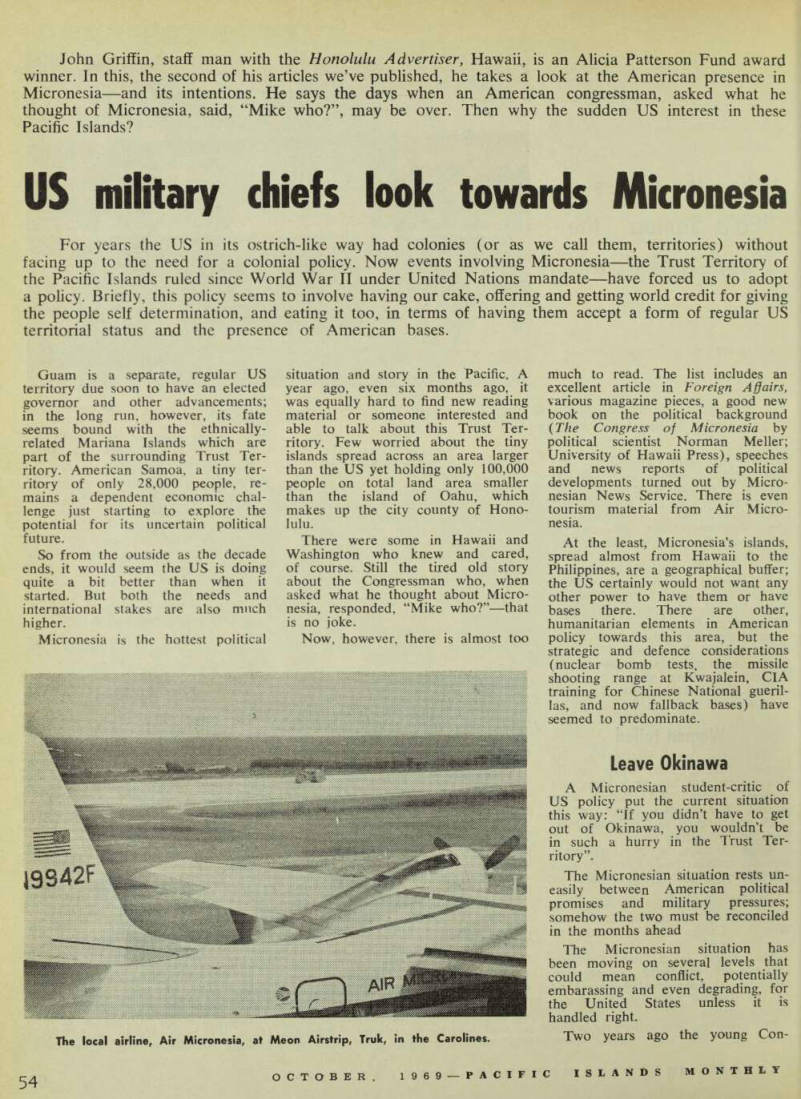
The local airline, Air Micronesia, at Meon Airstrip, Truk, in the Carolines.
gress of Micronesia set up its future status commission to explore pos sibilities, taking the initiative from the Johnson Administration which was considering the idea of its own status commission. The Micronesian group studied, discussed, and travelled widely. Its members talked openly about the possibility of seeking independence, and there was the fear in some American circles that the group would become so committed on that level that it would be hard to compromise later.
Like Puerto Rico
But on April 19 it recommended “that the Trust Territory of the Pacific Islands be constituted as a self-governing state, and that this Micronesian state internally self governing and with Micronesian control of all branches, including the executive negotiate entry into free association with the United States”.
What’s pictured is a state with considerable internal autonomy, such as Puerto Rico, or the relationship of the internally self-governing Cook
Islands with New Zealand. The Micronesian status group foresaw an agreement on American bases in return for considerable financial com pensation for use of the land. In total, the eloquently-written Micro nesian proposal was more moderate than some had expected.
As the Micronesians were moving, so was the Pacific strategic situation and the US military. US policy is now to end the Vietnam war, reducing immediate military needs in Asia. We are expected to return Okinawa to Japanese rule in the very early 19705. The future status of Okinawa’s vast complex of American military bases is uncertain, but at a minimum it would seem nuclear weapons will be banned and possibly “prior consultation” required, as in Japan itself, for any offencive use.
Military bases
With this handwriting on the wall, the American military has been look ing at Micronesia for replacement bases. Ranking military leaders and survey teams have been appearing in western Micronesia with in creasing frequency. Some very ex tensive preliminary or tentative plans for air fields, naval facilities, and troop areas seem to have been made.
What remains is the fact that, while the US can legally put in bases now under the UN Tust Territory agreement, these islands are not American territory. For the military, this means a continuing measure of uncertainty. For others, it raises questions of morality:
Micronesians have the right— which we have reaffirmed —to choose their own political future, a choice which also implies the right to accept or reject US bases.
Although both the Micronesians and the US military were moving in their own independent ways, the Nixon Administration got off to a slow start on the Trust Territory this year. With a suddenness that indicated a bureaucratic political goof, it accepted the resignation, in February, of Democratic-appointed High Commissioner William Norwood, a Hawaii man ver> popular with the Micronesians Washington also let Norwood’s ex perienced deputy leave soon after while the choice of a new high com missioner bogged down in a pat ronage battle.
It was April and weeks of White House delay before the appointment went to Edward E. Johnston, Hawaii state chairman of the Republican Party, a moderate conservative insurance man with good political and administrative skills and a new but seemingly good grasp of the problems facing the US in Micro nesia.
Nixon's interest
Since April, however, the Nixon Administration has shown both interest and action. Interior Sec retary Walter Hickel flew out to Micronesia in early May to install Johnston and make a major policy statement. Hickel promised long needed improvements in Micro nesian participation in government
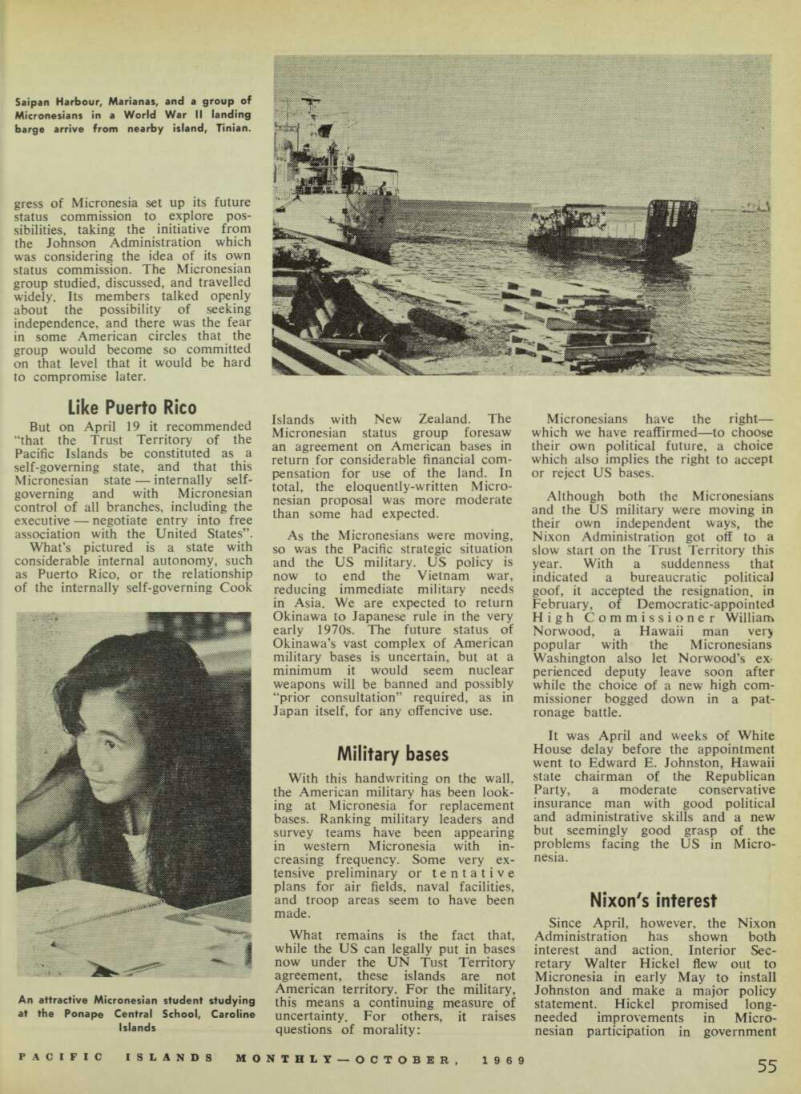
Saipan Harbour, Marianas, and a group of Micronesians in a World War II landing barge arrive from nearby island, Tinian.
An attractive Micronesian student studying at the Ponape Central School, Caroline Islands
US defence
and more economic benefits. He also said there would be no arbitrary US takeovers of land (meaning for bases) and joint decisions on all important matters in the future.
He didn’t talk about plans for bases, although back in Washington he said the Trust Territory could become an important part of a new US defence perimeter. Nor did he talk about some specific future political status, although it is clear the US wants Micronesia to become an American territory.
The Micronesian reaction was to welcome Hickel’s interest and pro mises, but key leaders made a point of later saying the US should not expect to buy future Micronesian political affiliation with economic benefits.
This was the situation as the Con gress of Micronesia opened regular session in mid-July to consider the status commission report and future steps, Washington expects a Micro nesian group will fly there later in the year for talks on a variety of economic improvements—plus dis cussions of a new political arrange ment. This may mean some “organic act” or “constitution”, sources say;
whether it will be near the ultimate arrangement both sides foresee is uncertain.
There are indications the Micro nesians, which have some very talented top leaders, will not be alone in future negotiations with Washington. The status commission has retained a noted civil rights lawyer, Harrup Freeman. Senators such as Fulbright, Kennedy, and
McCarthy have been contacted and reportedly have expressed an interest.
Various US groups, including some in the New Left, are now following the Micronesian situation. And the UN will be more than a casual spectator.
At the same time, the US military continues surveys, and plans include a B-52 facility on the old World War II B-29 base on Tinian in the Marianas between Guam and Saipan.
Some who have been following the situation see strong evidence Washington has already decided on where it will build what bases and that it wants them as soon as pos sible.
There is a co-ordinating group, but it is no secret that over the years there have been strong differences between the Interior and State Departments on one hand and the Pentagon on the other. Said one source who knows the situation: “There are those in Washington and in the Pacific military who don’t give a damn about the Micronesians’ land or political aspirations.
“They see the place strictly as a military reservation”. The view that the UN is not important is said to be even more widely held, including among those sensitive to Micro nesian hopes. Hard bargaining seems ahead.
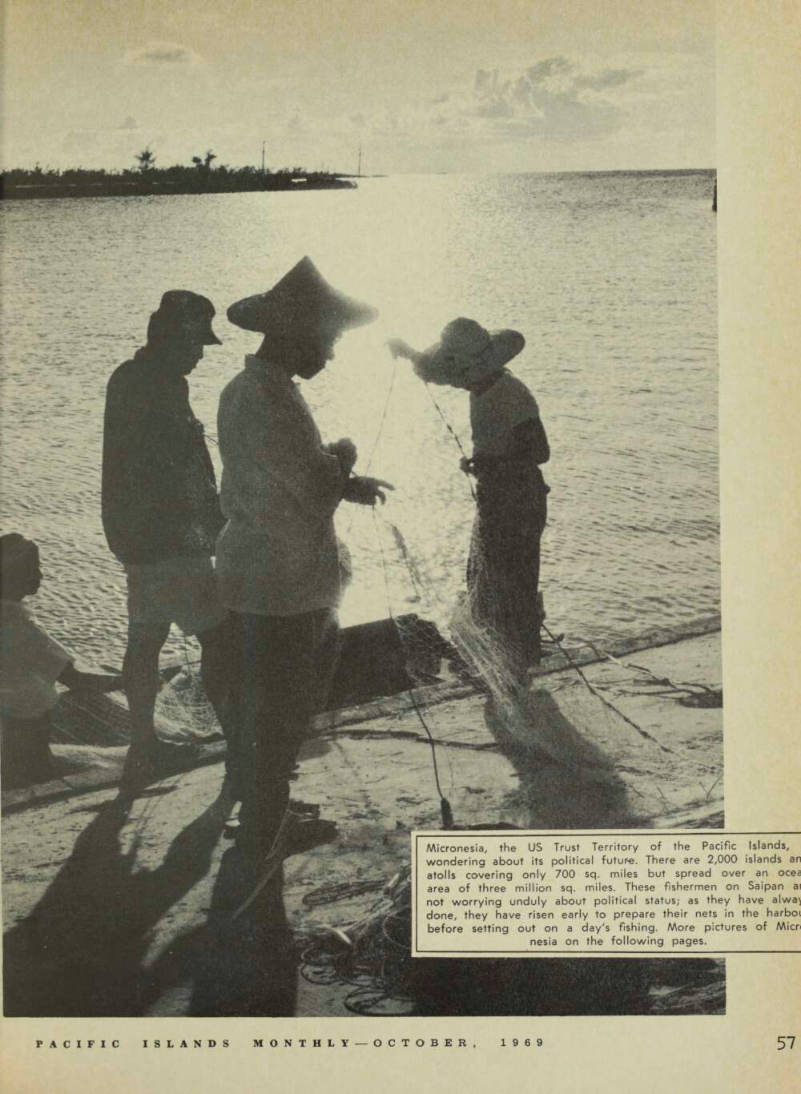
Micronesia, the US Trust Territory of the Pacific Islands, wondering about its political future. There are 2,000 islands an atolls covering only 700 sq. miles but spread over an ocea area of three million sq. miles. These fishermen on Saipan a[?] not worrying unduly about political status; as they have alway done, they have risen early to prepare their nets in the harbo[?] before setting out on a day's fishing. More pictures of Mien nesia on the following pages.
The sea is never far away in the Micronesian islands; right, on Ponape agoon locals set off in their traditional out-rigger canoes. Above, [?]he Xavier High School on Moen Island, one of the 100 Truk Islands, which was used by the Japanese during World War II as a naval communications centre.
No one knows who built these ruins of Manmatol (opposite page) made of huge crystals of basalt, but they are spread over more than 100 swampy islets on Ponape lagoon. This page, right, a mother holds her beautiful child at Kolonia, on Ponape.
Taxi drivers, above, wait for customers outside the newly con structed Taga Hotel on Saipan.
Right, efficient members of the Palau District Constabulary go on parade on Koror Island.