When the Ladies go
p. 57 · Read in the full issue
"Fa'a Samoa", the work gets done
From GLEN WRIGHT in Apia
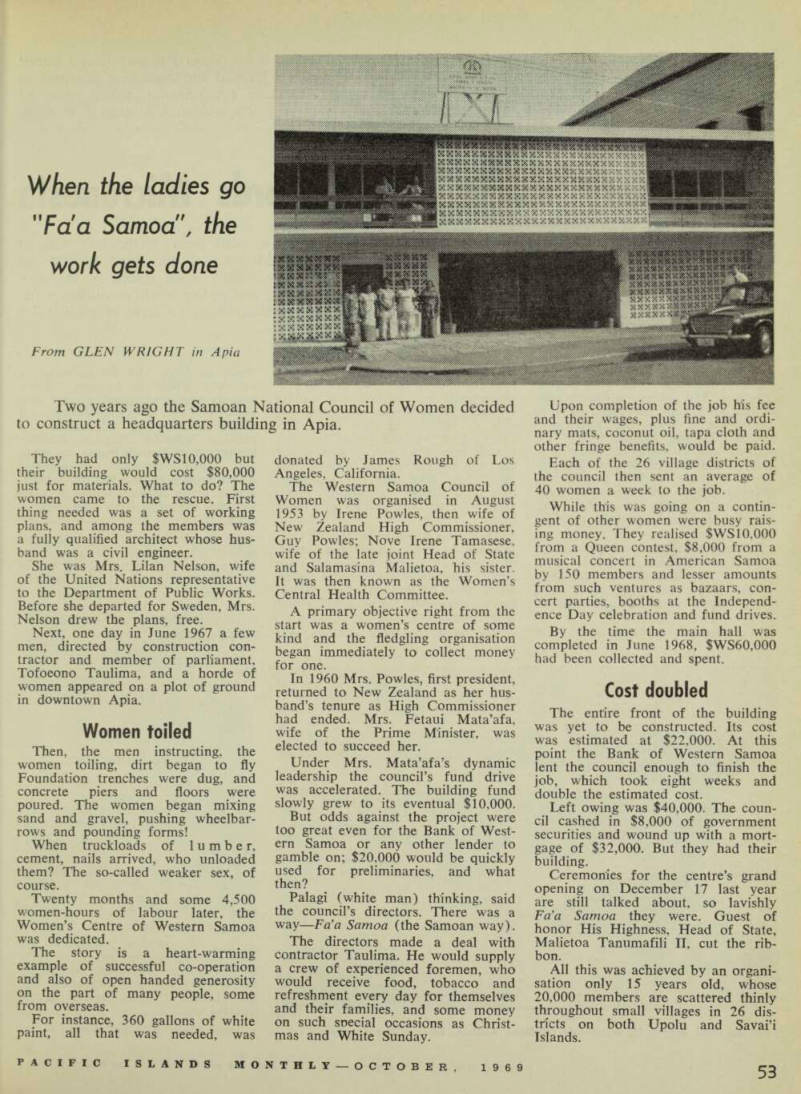
Two years ago the Samoan National Council of Women decided to construct a headquarters building in Apia.
They had only SWSIO,OOO but their building would cost $BO,OOO just for materials. What to do? The women came to the rescue. First thing needed was a set of working plans, and among the members was a fully qualified architect whose hus band was a civil engineer.
She was Mrs. Lilan Nelson, wife of the United Nations representative to the Department of Public Works.
Before she departed for Sweden, Mrs.
Nelson drew the plans, free.
Next, one day in June 1967 a few men, directed by construction con tractor and member of parliament, Tofoeono Taulima, and a horde of women appeared on a plot of ground in downtown Apia.
Women toiled
Then, the men instructing, the women toiling, dirt began to fly Foundation trenches were dug, and concrete piers and floors were poured. The women began mixing sand and gravel, pushing wheelbar rows and pounding forms!
When truckloads of lumber, cement, nails arrived, who unloaded them? The so-called weaker sex, of course.
Twenty months and some 4,500 women-hours of labour later, the Women’s Centre of Western Samoa was dedicated.
The story is a heart-warming example of successful co-operation and also of open handed generosity on the part of many people, some from overseas.
For instance, 360 gallons of white paint, all that was needed, was
donated by James Rough of Los Angeles, California.
The Western Samoa Council of Women was organised in August 1953 by Irene Powles, then wife of New Zealand High Commissioner, Guy Powles; Nove Irene Tamasese, wife of the late joint Head of State and Salamasina Malietoa, his sister.
It was then known as the Women’s Central Health Committee.
A primary objective right from the start was a women’s centre of some kind and the fledgling organisation began immediately to collect money for one.
In 1960 Mrs. Powles, first president, returned to New Zealand as her hus band’s tenure as High Commissioner had ended. Mrs. Fetaui Mata’afa, wife of the Prime Minister, was elected to succeed her.
Under Mrs. Mata’afa’s dynamic leadership the council’s fund drive was accelerated. The building fund slowly grew to its eventual $lO,OOO.
But odds against the project were too great even for the Bank of West ern Samoa or any other lender to gamble on; $20,000 would be quickly used for preliminaries, and what then?
Palagi (white man) thinking, said the council’s directors. There was a way— Fa’a Samoa (the Samoan way).
The directors made a deal with contractor Taulima. He would supply a crew of experienced foremen, who would receive food, tobacco and refreshment every day for themselves and their families, and some money on such snecial occasions as Christ mas and White Sunday.
Upon completion of the job his fee and their wages, plus fine and ordi nary mats, coconut oil, tapa cloth and other fringe benefits, would be paid.
Each of the 26 village districts of the council then sent an average of 40 women a week to the job.
While this was going on a contin gent of other women were busy rais ing money. They realised SWS 10,000 from a Queen contest, $B,OOO from a musical concert in American Samoa by 150 members and lesser amounts from such ventures as bazaars, con cert parties, booths at the Independ ence Day celebration and fund drives.
By the time the main hall was completed in June 1968, SWS6O,OOO had been collected and spent.
Cost doubled
The entire front of the building was yet to be constructed. Its cost was estimated at $22,000. At this point the Bank of Western Samoa lent the council enough to finish the job, which took eight weeks and double the estimated cost.
Left owing was $40,000. The coun cil cashed in $B,OOO of government securities and wound up with a mort gage of $32,000. But they had their building.
Ceremonies for the centre’s grand opening on December 17 last year are still talked about, so lavishly Fa’a Samoa they were. Guest of honor His Highness, Head of State, Malietoa Tanumafili 11, cut the rib bon.
All this was achieved by an organi sation only 15 years old, whose 20,000 members are scattered thinly throughout small villages in 26 dis tricts on both Upolu and Savai’i Islands.