Anglican Church In P-Ng
p. 53 · Read in the full issue
Takes Independence
By Susan Young
The Anglican Church in Papua-New Guinea is now a self governing diocese within the world-wide Communion.
The unspectacular but historic step to independence was taken in Sep tember when the General Synod of the Church of England in Australia, meeting in Sydney, passed for the territory church a new constitution which gives it administrative autonomy.
The Synod was told by the Bishop of New Guinea, the Rt. Rev. David Hand, that self-rule was a natural development for the Church. “It was deaf to us,” he said, “that we in the Church must get on with the job, not just so that we would not be dragging our feet behind political developments, nor merely to keep up with the political Joneses, but be cause it is right and fitting that the Church should be leading the way.”
We trust them
Bishop Hand said he had “the utmost confidence in my people’s adulthood and ability. The sooner we can trust them with full re
sponsibility the better. We won’t let down the mother Church in Aus tralia, but what is more important now I believe is that we shall not let down our own people in Papua- New Guinea.” P ...
Elect bishops
r The chief result of independence will be that the territory Church can now elect its own bishops, instead of having them chosen by the Aus tralian Church. It will also be able to decide whether it wishes to re main part of the Australian Church or form a new Province in the Pacific.
But independence may bring other changes of a kind which could prove a lot less acceptable to the Aus tralian church. , j. °J ay be that t n e form of synodical government which the Papua-New Guinea Church will de velop will not be the same as any body else’s,” said Bishop Hand. “It
may be, as time goes on, that there will be a demand for decisions to be made not by majority vote, but by our traditional Papua-New Guinea method of consensus.
“It may be that they will want for their bishop a different type from the type we expatriates might choose.”
Conflict of ideas
Sydney Diocesan Registrar, Mr.
John Denton, prophesied possible changes which, even as an uncertain long range forecast, must have seemed to General Synod even more disturbing. He foresaw a time when the needs and circumstances of a developing Papua-New Guinea could compel the territory Church into actions, statements and demands which might come into “fundamental conflict” with the ideas and outlook of the Australian Church.
If and when that happened, he said, the Australian Church must react “with charity and understand ing.” (The new territory Church will continue to take substantial financial and staff support from the Australian Church).
Whether or not any of these things come to pass remains to be seen. In the meantime, the newly autonomous Church is already busy getting up its own steam. The new constitution will be officially announced in the diocese in November and then work will start on drawing up legislation to bring before the Church’s first Diocesan Synod.
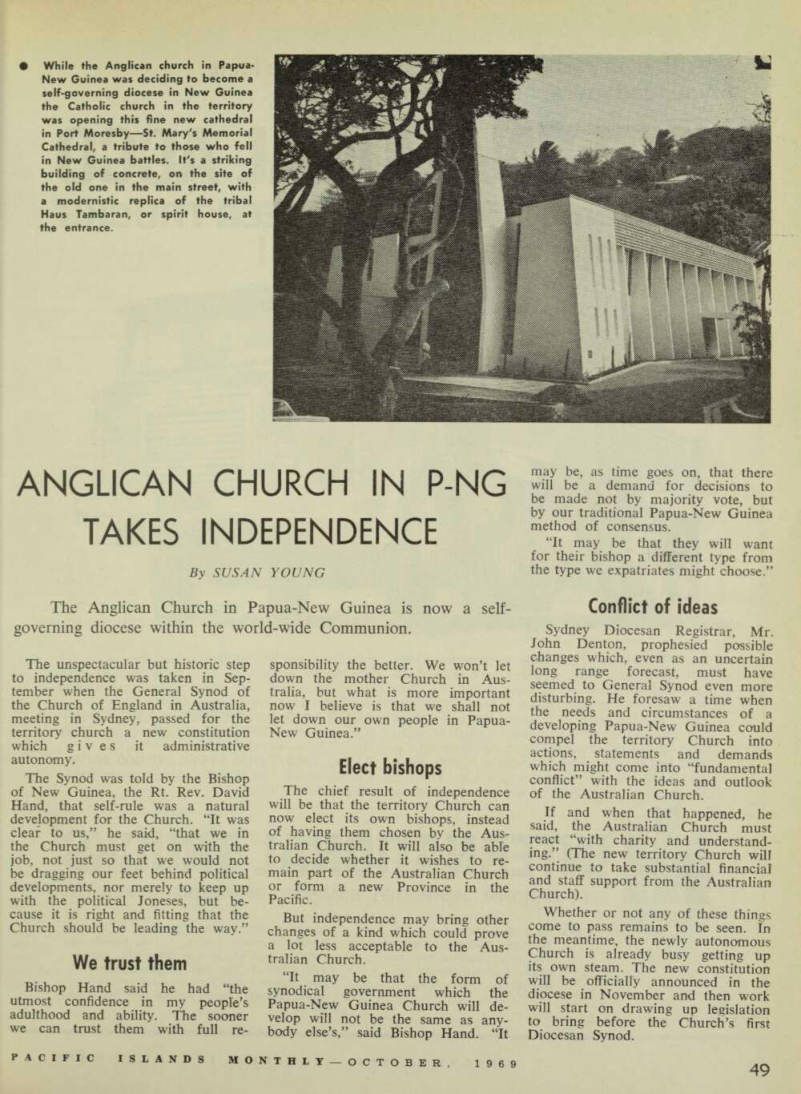
While the Anglican church in Papua- New Guinea was deciding to become a self-governing diocese in New Guinea the Catholic church in the territory was opening this fine new cathedral in Port Moresby—St. Mary's Memorial Cathedral, a tribute to those who fell in New Guinea battles. It's a striking building of concrete, on the site of the old one in the main street, with a modernistic replica of the tribal Haus Tambaran, or spirit house, at the entrance.