Press Freedom "Could Lead To Anarchy "
pp. 51-52 · Read in the full issue
Giving greater freedom to Tonga’s only newspaper—the govern ment owned Chronicle —would lead to “anarchy”, eventual destruc tion and a chance of “Communist or Labour Party” infiltration, said members of the Parliament of Tonga, at a recent meeting.
During a straight-talking session of the parliament one member, Noble Luani, said: “Why should they (the Chronicle) criticise the leaders in government? Why should a banana grower or fisherman say this should be this and so-on? Are we going to obey them?”
Main criticism was directed at the paper’s “Citizen Survey” column, in which members of the public are invited to air their opinions on various matters. But one member also thought that some film adver tising in the newspaper was both “distasteful and misleading”.
The Chronicle replied by reporting the debate on an entire page, and devoted its two middle pages to King Taufa’ahau, who made a speech defending the freedom of the Press.
The Chronicle —edited by Ameri can Peace Corps volunteer, Jack Richard Schwartz—was not the only medium of communication to feel the lash of Hon. Luani’s tongue. At a later sitting he accused the gov ernments’ ZCO radio station of broadcasting news that resulted in undesirable behaviour by some listeners.
His motion, that a committee should be formed to “examine” all local and overseas news items on ZCO, was defeated by 16 to two.
The parliament agreed to two motions affecting the Chronicle. A committee is to be formed to
formulate the presentation of news and whether a news item should be printed. Distribution of the paper is to be speeded up as sometimes it takes a month or longer to reach the outer islands.
A “more mature and reliable person” is also to be appointed “to assist the reporters and clerks because there have been many instances of wrongful or disrespect ful use of some Tongan words”.
The parliament threw out a motion that a special person should be employed to criticise the govern ment in the paper.
Spearheading the attack on the Chronicle, the Hon. Luani, declared: “This motion if passed will open the door for some to criticise your work.
The Chronicle staff, for the work they have done, should be given a pay rise, but reject this motion” to employ a critic.
Backing the attack, Mr. S. Tu’akoi said the House was “one of unity” and that the suggestion that criticism of the government be allowed was a doctrine from “Communist or Labour Party countries”. More criticism would lead to anarchy.
He added: “Mr. Speaker, all ideas put forth by the Chronicle, the ZCO and the hotel, because of the people who are running them, lead only to destruction. For who would be criticised? The King. The features of these new developments will some day lead only to destruction.
“You should watch closely develop ments in this country; they are the factors that start divisiveness in the
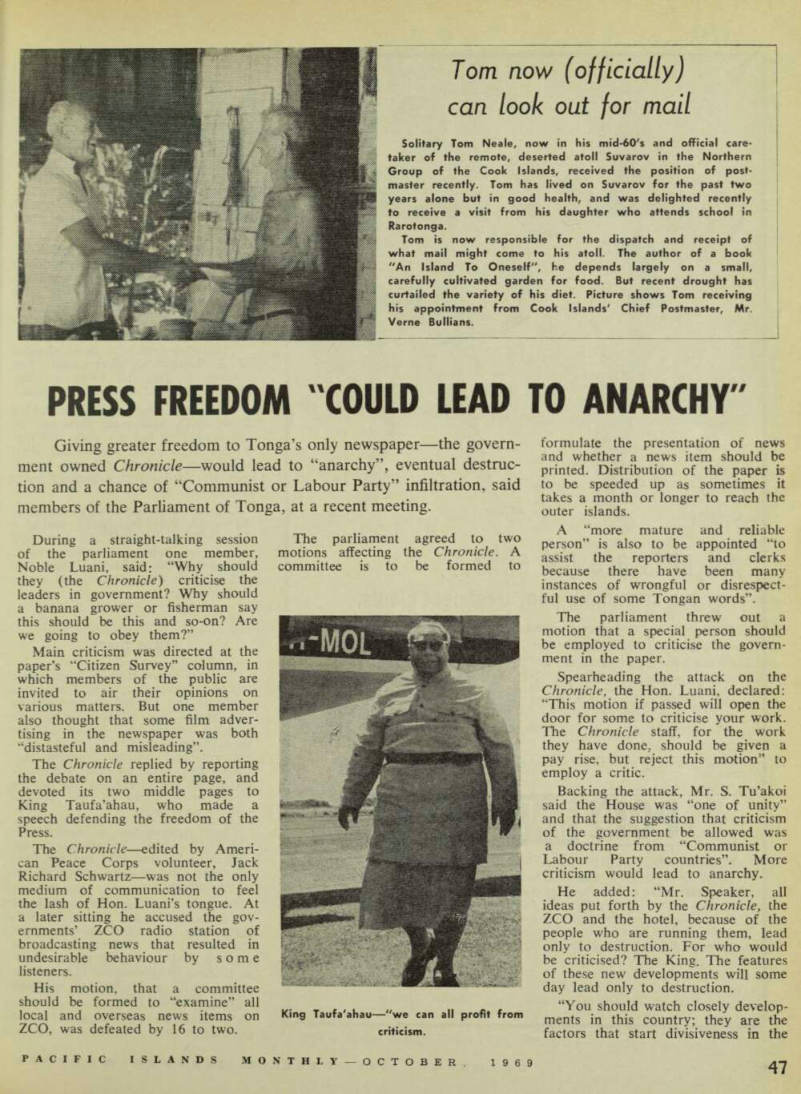
King Taufa'ahau—"we can all profit from criticism.
Free to speak
land. Developing is all right but the ideas pumped into it are dangerous.”
Mr. S. L. Unga pleaded for the right of the Chronicle to criticise, because Tonga should not be like “Communist China and Russia” where none dare to open their mouths.
The Premier, Prince Tu’ipelehake, suggested there was hardly enough space for more opinion material in the newspaper’s present size. He added: “One of the provisions of our constitution is that we are free to speak, to listen and so on.
“This freedom is a basic element of a democratic government. For anyone is free to listen to our deliberations and comment on them.”
Later, the Hon. Luani, attacking Radio ZCO, said some films had an age restriction but the radio did not.
Young ones could understand what was being broadcast. All news broad cast should be first examined by a committee.
Citizens were too fond of imitating others. A man had, after seeing a Tarzan film, imitated the hero and ended up with a broken back.
Students at Queen Salote College had unexpectedly demonstrated and shown their feelings.
Ease fears
To ease some fears of a complete return to censorship, King Taufa’ahau spoke in the Chronicle. Because the newspaper was financed by the Tongan government he said, from time to time employees of the gov ernment and officials thought that what was said by the Chronicle might be misinterpreted to be the views or attitudes of the Tongan Government itself, “Such nervousness is understand able,” he added. “These views are only held because they are not used to newspapers making comments on public affairs.
“I should say, had they experience in a country where a free Press is rather the rule than the exception, they would find governments in that country tend to develop a hide about as thick as a rhinoceros’ hide. News paper, radio and television criticism simply bounces off.
“I think we can all profit from criticism.”