Consolidated
p. 63 · Read in the full issue
Shy Man Who
An Empire
The life-story of James Bums, who passed away in Bowral, NSW, on August 5, at the age of 87, would serve as a model for any man— and especially any man bom to riches, and the power given by riches.
When his father died in 1923, and (then aged 41) he took command of Burns Philp & Co. Ltd. as chairman and managing director, he already had a creditable record as student, soldier, traveller and rouseabout executive in the Big Firm; and his subsequent career as the active con troller of the BP group of companies was exemplary.
From 1923, for 44 years, the at tendance of chairman James Burns, at his modest offices at 7 Bridge Street, Sydney, was as regular as the Post Office clock, and his service and judgment just as dependable.
James Burns took no part in public affairs, but he was loved and re spected in his private life, and greatly esteemed by his associates in big business. In his 44 years of chair manship, the growth of Burns Philp was phenomenal—soundly based on good management, shrewdly cautious in boom times and careful in slumps.
High standards
Every investor knows the story— it is written indelibly in a half-century of annual balance-sheets, and in stock exchange history around the world.
Mr. Bums would have been the first to insist that little of the credit was his. He was handed a magnificent business by the company’s founder, Sir James Bums, KCMG, and he accepted as his guide the standards set by that far-seeing, redoubtable pioneer; and he had at his side some able and loyal helpers and advisers, in his directors and chief executives.
Good leadership has the quality of attracting good lieutenants; and the young men who had been brought into the firm by the dvnamism and humanism of James Burns I were ready to carry on when the leader
ship was passed to James Bums II —provided the new boss was worthy.
And so the James Burns II era, which was conspicuously successful, really was shaped by a little group, in which Joseph Mitchell, 46 years as general manager, who retired in 1966, and P. T, W. Black, who now is general manager, were very pro minent. That triumvirate Bums, Mitchell, Black probably was among the happiest and most respected in the history of Sydney commerce.
Mr. Burns’ main interest was finance, and the effective use of BP’s ever-accumulating funds. His investments were usually shrewd and profitable—for instance, he was mostly responsible for BP’s acquiring large interests in Broken Hill Pty.
“Joe” Mitchell’s policy usually was “save money”; James Burns believed in making the money work in de velopment and enterprise; and Black probably held the balance nicely between them.
After World War 11, “diversifica tion” became the rule of certain big trading companies with funds to in vest, and James Burns followed that general policy, but cautiously. As a result, BP’s today are not only Islands merchants and shipowners: their interests are spread over a score of industries.
James Burns died as plain “Mr.”
According to well-established politico economic practices he should have been knighted long since—he surely earned the honour. Actually, long years ago, the Bruce-Page Govern ment was ready to recommend knight hoods for the respective heads of the Pacific Islands trading companies; but self-effacing James Burns begged to be excused. He was curt in avoid ing publicity; but, out of limelight, he was a courteous, kindly man.
James Burns was born in 1881, educated at Kings School and was only 17 when he joined the service of the company established by his father in 1883. He gained a com mission in the NSW Lancers (of which his father was colonel); and he fought with the Light Trench Mortar Battery of the AIF, in France, in World War I, and wounded.
His brother Robert was killed in that war, and his brother John, after Middle East service, died in 1921.
It is interesting to note that the Burns family was linked by marriage with the well known Union Steam Ship Co. of New Zealand. In 1913, James Burns II married the daughter of David Mills, of Dunedin, NZ, who, with his brother, Sir James Mills, founded Union Co. in 1875.
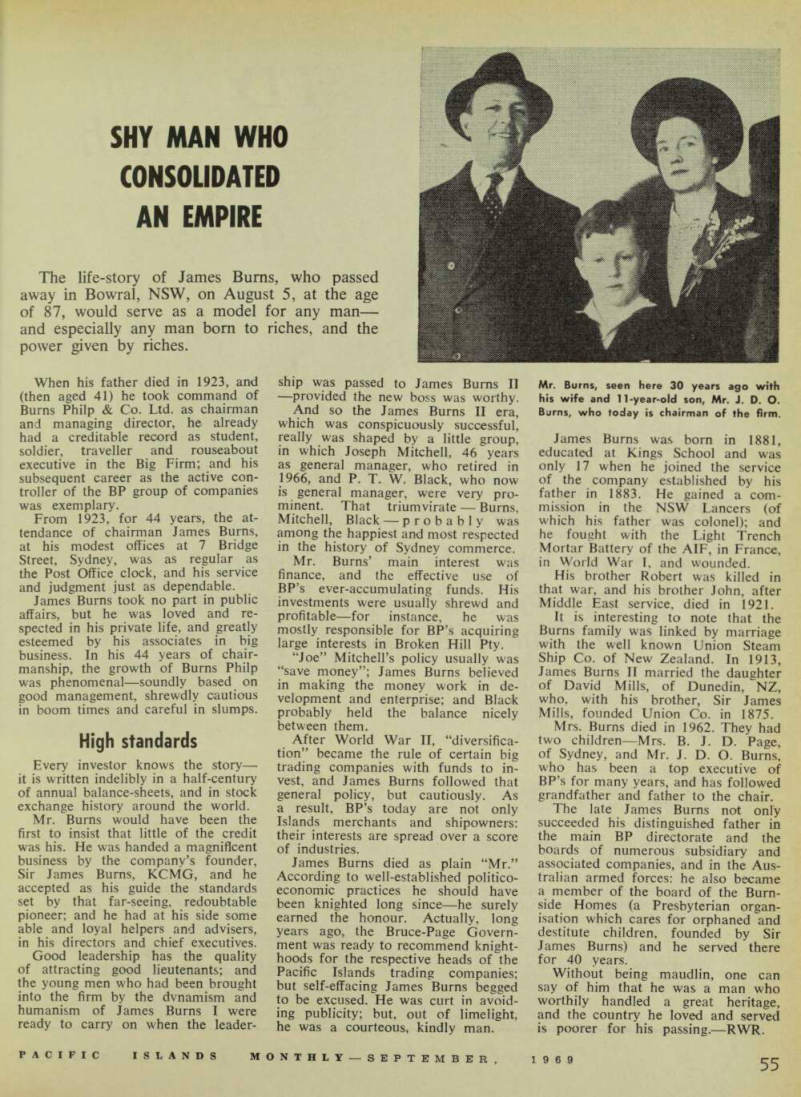
Mrs. Burns died in 1962. They had two children—Mrs. B. J. D. Page, of Sydney, and Mr. J. D. O. Burns, who has been a top executive of BP’s for many years, and has followed grandfather and father to the chair.
The late James Bums not only succeeded his distinguished father in the main BP directorate and the boards of numerous subsidiary and associated companies, and in the Aus tralian armed forces: he also became a member of the board of the Burn side Homes (a Presbyterian organ isation which cares for orphaned and destitute children, founded by Sir James Burns) and he served there for 40 years.
Without being maudlin, one can say of him that he was a man who worthily handled a great heritage, and the country he loved and served is poorer for his passing.—RWR.
Mr. Burns, seen here 30 years ago with his wife and 11-year-old son, Mr. J. D. O.
Burns, who today is chairman of the firm.