Self-government a step closer
p. 61 · Read in the full issue
for American Samoa?
Economic, social and political independence leading to full self government —that is America’s intention in American Samoa, said the territory’s new Governor, John M. Hay don, in his inaugural speech in Pago Pago on August 6.
Although he offered no specific constitutional timetable, he said that President Nixon was looking at Samoa’s newly formed Political Status Commission “with personal interest”.
President Nixon wanted the terri tory’s problems solved without hesita tion and as rapidly as possible, said Governor Haydon. He himself was pledged to carry this philosophy out, for the “future of American Samoa and the United States lies in a significant political relationship based on co-operative effort and mutual understanding”.
“American Samoa is a small nation lacking in many natural resources”, he said. “But it is rich in human and physical resources. Our goal is to develop the resources that will en able the people of American Samoa to be fed and housed and clothed and educated as well as anyone else in all the rest of America.
“But these goals must be achieved in ways that will guarantee that the priceless Samoan environment and natural beauty will be guarded and maintained so that Samoa remains a place in which you and your children and their children after them, can live with pride.
Declared U.S. Goal
“The declared goal of the United States in its relationship with Ameri can Samoa is ‘the promotion of economic, social and political de velopment leading to a full measure of self-government and the active participation of residents of this territory in the life of the nation.’ ”
Governor Haydon dedicated him self to reach this goal in “creative, imaginative ways that will give American Samoans the fullest possible voice in the determination of their own future”.
He continued: “You have a need to determine your own future and the opportunity to participate will be offered fully to you, for all of us involved in the administration of American Samoan affairs must be lieve in the people ruling the gov ernment.
“We do not believe that Washing ton should impose its will on the
American Samoan people. Rather it is our belief that government in Washington, DC, should voice the will of the American Samoan people.
“This calls for the most serious and dedicated leadership by Ameri can Samoans as well as for the palagis ... for the responsibility of achievement is mutual in its obligations”.
Governor Haydon added he was not there to “distinguish between races”. He and his staff were there to help “fellow Americans” achieve goals and national progress and standards “which are common to all of us.”
TV helps education
First step to achieve common goals, he continued, would be for the governmental structure to “make certain its own house is in order”.
A complete assessment and inventory of programmes and management would be necessary, as would an in ventory of government practices and properties.
In the field of Samoan education.
Governor Haydon said television had “improved it immensely” but as “those who studied your system have pointed out,” he added, “sometimes an institution so stresses the pursuit of one goal that it exerts a negative influence on the achievement of other goals.
“It must be concluded that the present (television) system is succeed ing in many respects, but it is not suc ceeding completely in meeting the educational needs of American Samoa.”
To achieve these goals, continued the governor, a Governor’s Advisory Council on Education was to be appointed to work with him in “de veloping policies and methods which will give American Samoa the type of complete and effective educational system it needs so urgently”.
There were plans to improve adult education, continue and improve the pre-school education programmes, the training of teachers and the use of qualified Samoans in positions of authority. Also to be established as
soon as possible was a vocational training programme in the territory’s school system designed to meet the “specific requirements” of the economy and also to help those “who choose to leave Samoa and compete for employment in other areas.”
The policy of a dual wage system on jobs held by stateside employees would be abolished as quickly as “proper procedures can be worked out”, he promised. Qualified Samoans would receive the same basic salaries as the US citizens who had been re cruited to fill the jobs originally.
To assist in working out procedures for the elimination of the dual wage system, a Governor’s Advisory Coun cil on Employment and Wages would be appointed. A system of manpower training and development would also be developed so that Samoans could take over these jobs “at the earliest possible moment”.
“Qualifications, full qualifications, will be the key, for I am certain that the American Samoan people have no desire for ‘symbolic’ employment which could prove harmful to your governmental system,” Governor Haydon added.
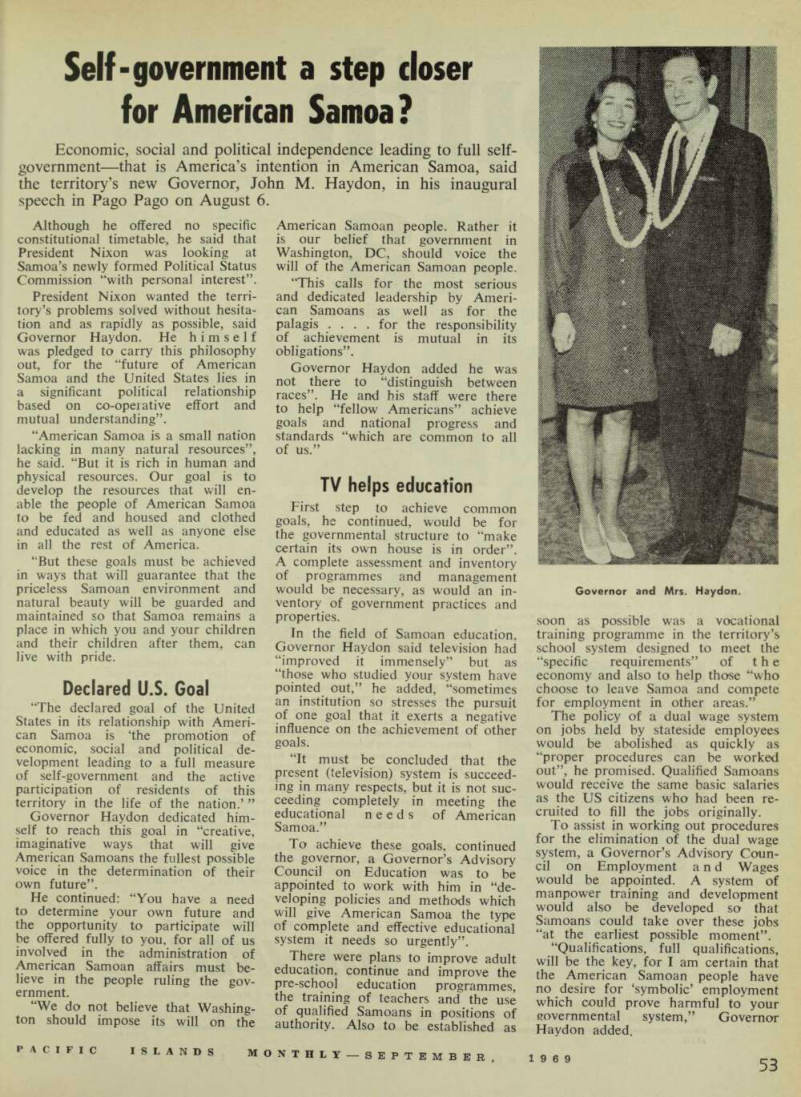
Governor and Mrs. Haydon.