Only the top
pp. 49-50 · Read in the full issue
Indonesians care about Irian
By staff writer JOHN ECCLES, just back from Indonesia
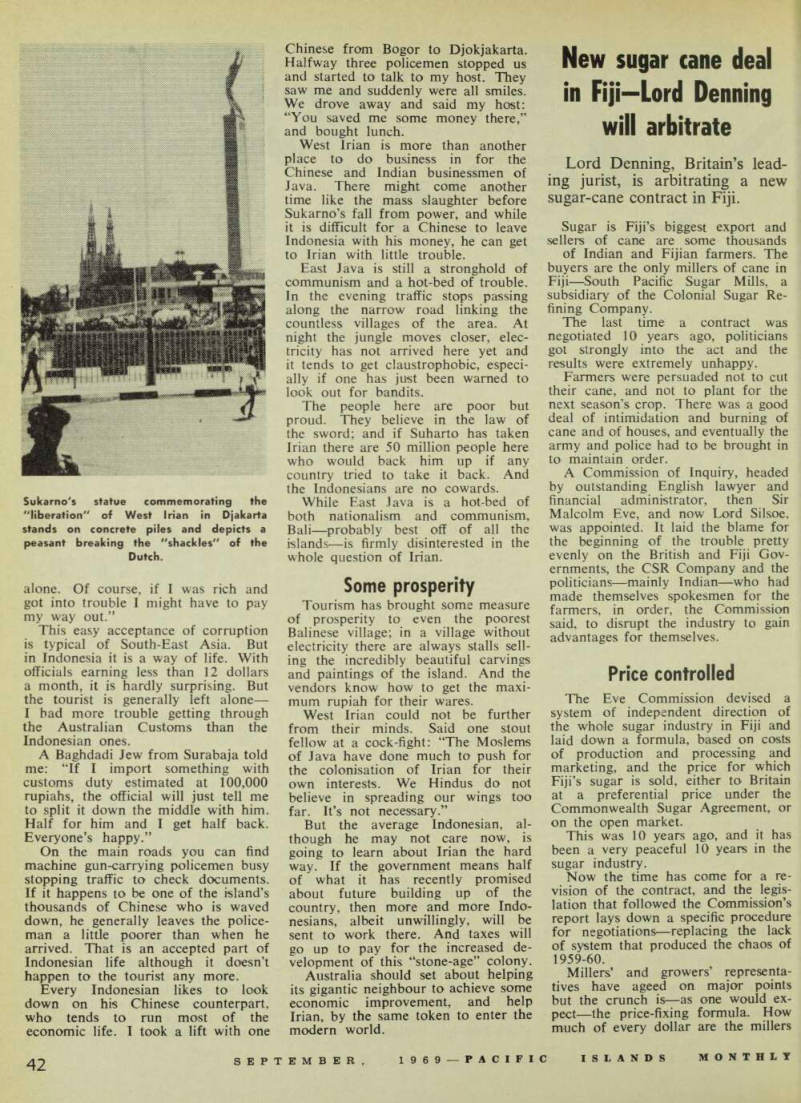
Towering over Djakarta’s sky-line is the statue of a titan standing arms outstretched on 100 ft high concrete blocks. It honours the “liberation” of West Irian and for those in the know in Indonesia’s capi tal it remains a standing joke that the statue cost more than the government has spent in West Irian rince taking over from the Dutch.
If one is tempted to take an Indo nesian official to task over this, it is likely he will point across the city at another Sukarno monument standing in a dusty park. The solid gold torch at the top, he will say, repre sents the entire gold reserves of Indonesia.
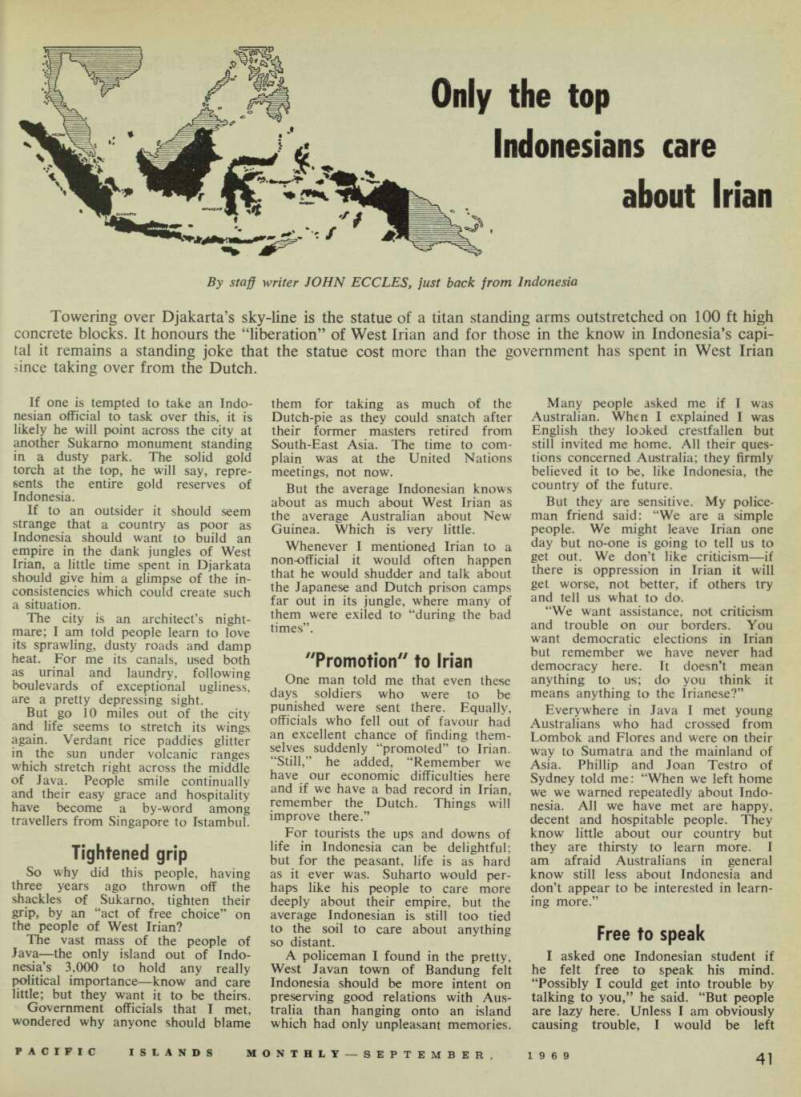
If to an outsider it should seem strange that a country as poor as Indonesia should want to build an empire in the dank jungles of West Irian, a little time spent in Djarkata should give him a glimpse of the in consistencies which could create such a situation.
The city is an architect’s night mare; I am told people learn to love its sprawling, dusty roads and damp heat. For me its canals, used both as urinal and laundry, following boulevards of exceptional ugliness, are a pretty depressing sight.
But go 10 miles out of the city and life seems to stretch its wings again. Verdant rice paddies glitter in the sun under volcanic ranges which stretch right across the middle of Java. People smile continually and their easy grace and hospitality have become a by-word among travellers from Singapore to Istambul.
Tightened grip
So why did this people, having three years ago thrown off the shackles of Sukarno, tighten their grip, by an “act of free choice” on the people of West Irian?
The vast mass of the people of Java—the only island out of Indo nesia’s 3,000 to hold any really political importance—know and care little; but they want it to be theirs.
Government officials that I met, wondered why anyone should blame
them for taking as much of the Dutch-pie as they could snatch after their former masters retired from South-East Asia. The time to com plain was at the United Nations meetings, not now.
But the average Indonesian knows about as much about West Irian as the average Australian about New Guinea. Which is very little.
Whenever I mentioned Irian to a non-official it would often happen that he would shudder and talk about the Japanese and Dutch prison camps far out in its jungle, where many of them were exiled to “during the bad times”.
"Promotion" to Irian
One man told me that even these days soldiers who were to be punished were sent there. Equally, officials who fell out of favour had an excellent chance of finding them selves suddenly “promoted” to Irian.
“Still,” he added, “Remember we have our economic difficulties here and if we have a bad record in Irian, remember the Dutch. Things will improve there.”
For tourists the ups and downs of life in Indonesia can be delightful; but for the peasant, life is as hard as it ever was. Suharto would per haps like his people to care more deeply about their empire, but the average Indonesian is still too tied to the soil to care about anything so distant.
A policeman I found in the pretty, West Javan town of Bandung felt Indonesia should be more intent on preserving good relations with Aus tralia than hanging onto an island which had only unpleasant memories.
Many people asked me if I was Australian. When I explained I was English they looked crestfallen but still invited me home. All their ques tions concerned Australia; they firmly believed it to be, like Indonesia, the country of the future.
But they are sensitive. My police man friend said: “We are a simple people. We might leave Irian one day but no-one is going to tell us to get out. We don’t like criticism—if there is oppression in Irian it will get worse, not better, if others try and tell us what to do.
“We want assistance, not criticism and trouble on our borders. You want democratic elections in Irian but remember we have never had democracy here. It doesn’t mean anything to us; do you think it means anything to the Irianese?”
Everywhere in Java I met young Australians who had crossed from Lombok and Flores and were on their way to Sumatra and the mainland of Asia. Phillip and Joan Testro of Sydney told me: “When we left home we we warned repeatedly about Indo nesia. All we have met are happy, decent and hospitable people. They know little about our country but they are thirsty to learn more. I am afraid Australians in general know still less about Indonesia and don’t appear to be interested in learn ing more.”
Free to speak
I asked one Indonesian student if he felt free to speak his mind.
“Possibly I could get into trouble by talking to you,” he said. “But people are lazy here. Unless I am obviously causing trouble, I would be left
alone. Of course, if I was rich and got into trouble I might have to pay my way out.”
This easy acceptance of corruption is typical of South-East Asia. But in Indonesia it is a way of life. With officials earning less than 12 dollars a month, it is hardly surprising. But the tourist is generally left alone— I bad more trouble getting through the Australian Customs than the Indonesian ones.
A Baghdadi Jew from Surabaja told me: “If I import something with customs duty estimated at 100,000 rupiahs, the official will just tell me to split it down the middle with him.
Half for him and I get half back.
Everyone’s happy.”
On the main roads you can find machine gun-carrying policemen busy stopping traffic to check documents.
If it happens to be one of the island’s thousands of Chinese who is waved down, he generally leaves the police man a little poorer than when he arrived. That is an accepted part of Indonesian life although it doesn’t happen to the tourist any more.
Every Indonesian likes to look down on his Chinese counterpart, who tends to run most of the economic life. I took a lift with one
Chinese from Bogor to Djokjakarta.
Halfway three policemen stopped us and started to talk to my host. They saw me and suddenly were all smiles.
We drove away and said my host: “You saved me some money there,” and bought lunch.
West Irian is more than another place to do business in for the Chinese and Indian businessmen of Java. There might come another time like the mass slaughter before Sukarno’s fall from power, and while it is difficult for a Chinese to leave Indonesia with his money, he can get to Irian with little trouble.
East Java is still a stronghold of communism and a hot-bed of trouble.
In the evening traffic stops passing along the narrow road linking the countless villages of the area. At night the jungle moves closer, elec tricity has not arrived here yet and it tends to get claustrophobic, especi ally if one has just been warned to look out for bandits.
The people here are poor but proud. They believe in the law of the sword; and if Suharto has taken Irian there are 50 million people here who would back him up if any country tried to take it back. And the Indonesians are no cowards.
While East Java is a hot-bed of both nationalism and communism, Bali—probably best off of all the islands—is firmly disinterested in the whole question of Irian.
Some prosperity
Tourism has brought some measure of prosperity to even the poorest Balinese village; in a village without electricity there are always stalls sell ing the incredibly beautiful carvings and paintings of the island. And the vendors know how to get the maxi mum rupiah for their wares.
West Irian could not be further from their minds. Said one stout fellow at a cock-fight: “The Moslems of Java have done much to push for the colonisation of Irian for their own interests. We Hindus do not believe in spreading our wings too far. It’s not necessary.”
But the average Indonesian, al though he may not care now, is going to learn about Irian the hard way. If the government means half of what it has recently promised about future building up of the country, then more and more Indo nesians, albeit unwillingly, will be sent to work there. And taxes will go up to pay for the increased de velopment of this “stone-age” colony, Australia should set about helping its gigantic neighbour to achieve some economic improvement, and help Irian, by the same token to enter the modern world.
Sukarno's statue commemorating the "liberation" of West Irian in Djakarta stands on concrete piles and depicts a peasant breaking the "shackles" of the Dutch.