An Unequalled View From
pp. 67-69 · Read in the full issue
The Upside-Down Pub
Why not build a high-rise Islands resort upside down? . . .
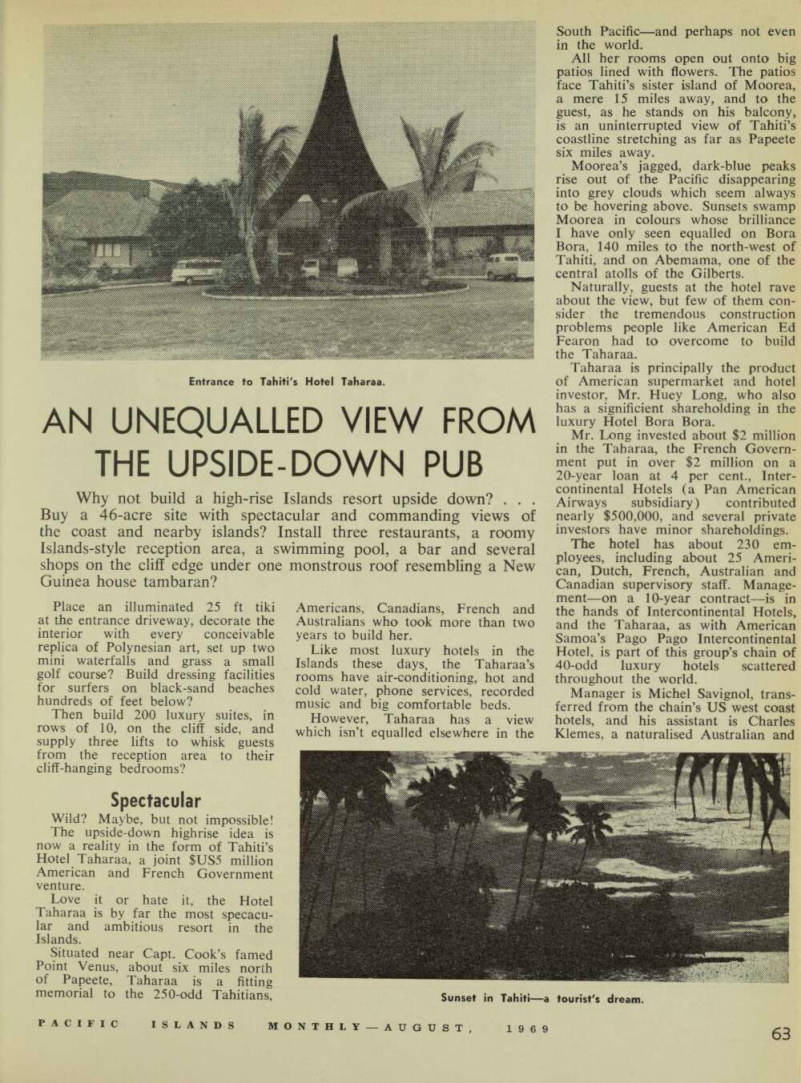
Buy a 46-acre site with spectacular and commanding views of the coast and nearby islands? Install three restaurants, a roomy Islands-style reception area, a swimming pool, a bar and several shops on the cliff edge under one monstrous roof resembling a New Guinea house tambaran?
Place an illuminated 25 ft tiki at the entrance driveway, decorate the interior with every conceivable replica of Polynesian art, set up two mini waterfalls and grass a small golf course? Build dressing facilities for surfers on black-sand beaches hundreds of feet below?
Then build 200 luxury suites, in rows of 10, on the cliff side, and supply three lifts to whisk guests from the reception area to their cliff-hanging bedrooms?
Spectacular
Wild? Maybe, but not impossible!
The upside-down highrise idea is now a reality in the form of Tahiti’s Hotel Taharaa, a joint SUSS million American and French Government venture.
Love it or hate it, the Hotel Taharaa is by far the most specacu lar and ambitious resort in the Islands.
Situated near Capt. Cook’s famed Point Venus, about six miles north of Papeete, Taharaa is a fitting memorial to the 250-odd Tahitians,
Americans, Canadians, French and Australians who took more than two years to build her.
Like most luxury hotels in the Islands these days, the Taharaa’s rooms have air-conditioning, hot and cold water, phone services, recorded music and big comfortable beds.
However, Taharaa has a view which isn’t equalled elsewhere in the
South Pacific—and perhaps not even in the world.
All her rooms open out onto big patios lined with flowers. The patios face Tahiti’s sister island of Moorea, a mere 15 miles away, and to the guest, as he stands on his balcony, is an uninterrupted view of Tahiti’s coastline stretching as far as Papeete six miles away.
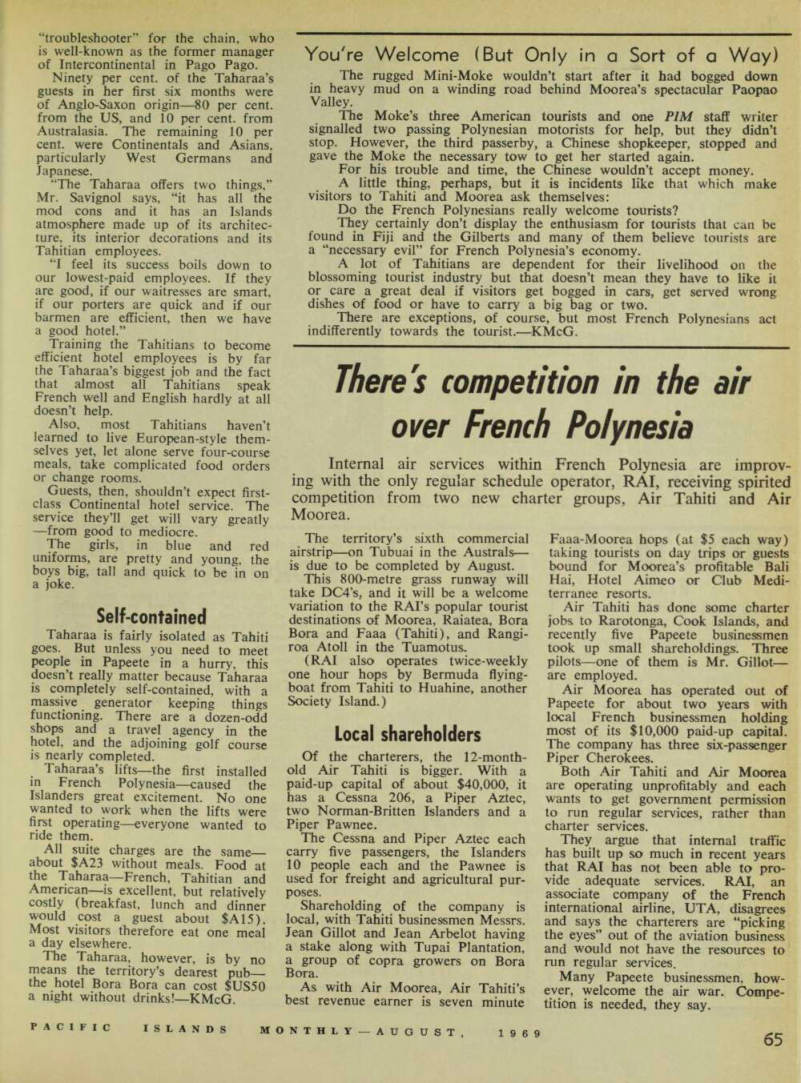
Moorea’s jagged, dark-blue peaks rise out of the Pacific disappearing into grey clouds which seem always to be hovering above. Sunsets swamp Moorea in colours whose brilliance I have only seen equalled on Bora Bora, 140 miles to the north-west of Tahiti, and on Abemama, one of the central atolls of the Gilberts.
Naturally, guests at the hotel rave about the view, but few of them con sider the tremendous construction problems people like American Ed Fearon had to overcome to build the Taharaa.
Taharaa is principally the product of American supermarket and hotel investor, Mr. Huey Long, who also has a significient shareholding in the luxury Hotel Bora Bora.
Mr. Long invested about $2 million in the Taharaa, the French Govern ment put in over $2 million on a 20-year loan at 4 per cent., Inter continental Hotels (a Pan American Airways subsidiary) contributed nearly $500,000, and several private investors have minor shareholdings.
The hotel has about 230 em ployees, including about 25 Ameri can, Dutch, French, Australian and Canadian supervisory staff. Manage ment—on a 10-year contract—is in the hands of Intercontinental Hotels, and the Taharaa, as with American Samoa’s Pago Pago Intercontinental Hotel, is part of this group’s chain of 40-odd luxury hotels scattered throughout the world.
Manager is Michel Savignol, trans ferred from the chain’s US west coast hotels, and his assistant is Charles Klemes, a naturalised Australian and
Entrance to Tahiti's Hotel Taharaa
Sunset in Tahiti—a tourist's dream.
“troubleshooter” for the chain, who is well-known as the former manager of Intercontinental in Pago Pago.
Ninety per cent, of the Taharaa’s guests in her first six months were of Anglo-Saxon origin—80 per cent, from the US, and 10 per cent, from Australasia. The remaining 10 per cent, were Continentals and Asians, particularly West Germans and Japanese.
“The Taharaa offers two things,”
Mr. Savignol says, “it has all the mod cons and it has an Islands atmosphere made up of its architec ture, its interior decorations and its Tahitian employees.
“I feel its success boils down to our lowest-paid employees. If they are good, if our waitresses are smart, if our porters are quick and if our barmen are efficient, then we have a good hotel.”
Training the Tahitians to become efficient hotel employees is by far the Taharaa’s biggest job and the fact that almost all Tahitians speak French well and English hardly at all doesn’t help.
Also, most Tahitians haven’t learned to live European-style them selves yet, let alone serve four-course meals, take complicated food orders or change rooms.
Guests, then, shouldn’t expect first class Continental hotel service. The service they’ll get will vary greatly —from good to mediocre.
The girls, in blue and red uniforms, are pretty and young, the boys big, tall and quick to be in on a joke.
Self-contained
Taharaa is fairly isolated as Tahiti goes. But unless you need to meet people in Papeete in a hurry, this doesn’t really matter because Taharaa is completely self-contained, with a massive generator keeping things functioning. There are a dozen-odd shops and a travel agency in the hotel, and the adjoining golf course is nearly completed.
Taharaa’s lifts—the first installed in French Polynesia—caused the Islanders great excitement. No one wanted to work when the lifts were first operating—everyone wanted to ride them.
All suite charges are the same— about SA23 without meals. Food at the Taharaa—French, Tahitian and American—is excellent, but relatively costly (breakfast, lunch and dinner would cost a guest about SAIS).
Most visitors therefore eat one meal a day elsewhere.
The Taharaa, however, is by no means the territory’s dearest pub— the hotel Bora Bora can cost SUSSO a night without drinks!—KMcG