And Enjoy The Place
pp. 63-65 · Read in the full issue
Forget The Myths About Tahiti
By staff writer KEN McGREGOR, just back from French Polynesia
“Tahiti has had it. Everything’s too expensive and too commercialised.” This is a popular view of Tahiti. It is also rubbish.
Of course Tahiti has changed. It will change more. No place can stand still, and it would be senti mental to suppose that Tahiti could remain an idyllic South Seas islands —if indeed any South Seas island was ever truly idyllic.
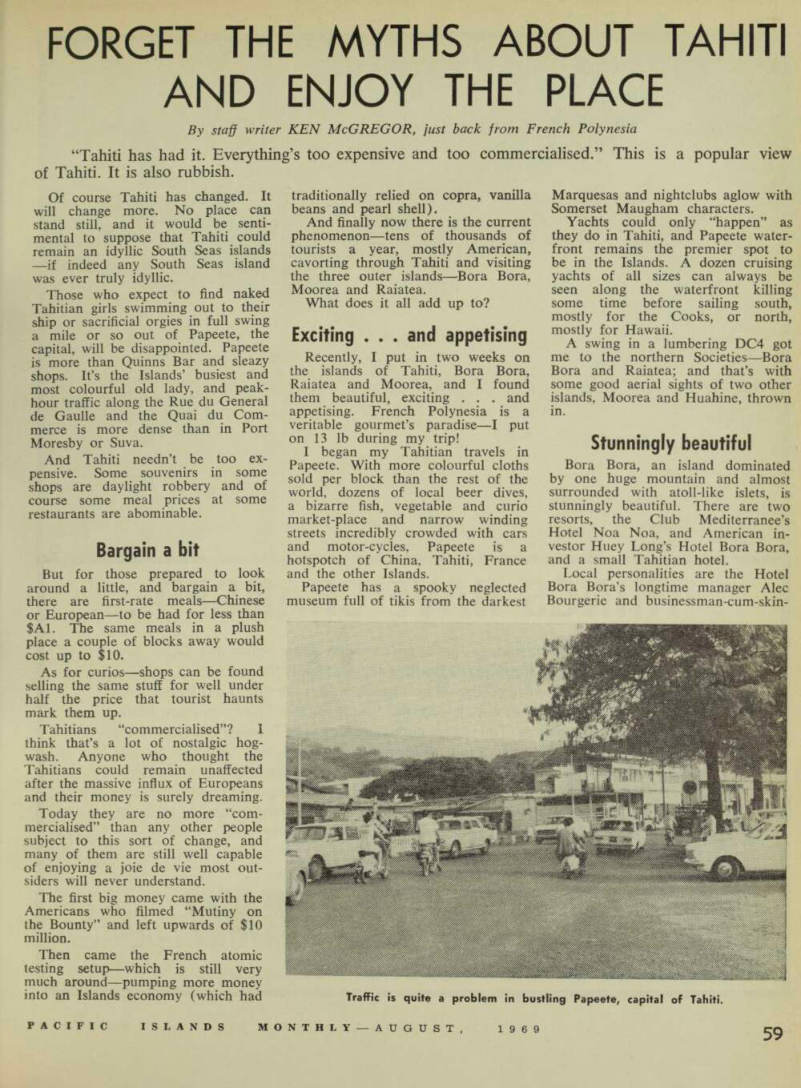
Those who expect to find naked Tahitian girls swimming out to their ship or sacrificial orgies in full swing a mile or so out of Papeete, the capital, will be disappointed. Papeete is more than Quinns Bar and sleazy shops. It’s the Islands’ busiest and most colourful old lady, and peak hour traffic along the Rue du General de Gaulle and the Quai du Com merce is more dense than in Port Moresby or Suva.
And Tahiti needn’t be too ex pensive. Some souvenirs in some shops are daylight robbery and of course some meal prices at some restaurants are abominable.
Bargain a bit
But for those prepared to look around a little, and bargain a bit, there are first-rate meals—Chinese or European—to be had for less than SAL The same meals in a plush place a couple of blocks away would cost up to $lO.
As for curios—shops can be found selling the same stuff for well under half the price that tourist haunts mark them up.
Tahitians “commercialised”? I think that’s a lot of nostalgic hog wash. Anyone who thought the Tahitians could remain unaffected after the massive influx of Europeans and their money is surely dreaming.
Today they are no more “com mercialised” than any other people subject to this sort of change, and many of them are still well capable of enjoying a joie de vie most out siders will never understand.
The first big money came with the Americans who filmed “Mutiny on the Bounty” and left upwards of $lO million.
Then came the French atomic testing setup—which is still very much around—pumping more money into an Islands economy (which had
traditionally relied on copra, vanilla beans and pearl shell).
And finally now there is the current phenomenon—tens of thousands of tourists a year, mostly American, cavorting through Tahiti and visiting the three outer islands—Bora Bora, Moorea and Raiatea.
What does it all add up to?
Exciting . . . and appetising
Recently, I put in two weeks on the islands of Tahiti, Bora Bora, Raiatea and Moorea, and I found them beautiful, exciting . . . and appetising. French Polynesia is a veritable gourmet’s paradise—l put on 13 lb during my trip!
I began my Tahitian travels in Papeete. With more colourful cloths sold per block than the rest of the world, dozens of local beer dives, a bizarre fish, vegetable and curio market-place and narrow winding streets incredibly crowded with cars and motor-cycles, Papeete is a hotspotch of China, Tahiti, France and the other Islands.
Papeete has a spooky neglected museum full of tikis from the darkest
Marquesas and nightclubs aglow with Somerset Maugham characters.
Yachts could only “happen” as they do in Tahiti, and Papeete water front remains the premier spot to be in the Islands. A dozen cruising yachts of all sizes can always be seen along the waterfront killing some time before sailing south, mostly for the Cooks, or north, mostly for Hawaii.
A swing in a lumbering DC4 got me to the northern Societies—Bora Bora and Raiatea; and that’s with some good aerial sights of two other islands, Moorea and Huahine, thrown in.
Stunningly beautiful
Bora Bora, an island dominated by one huge mountain and almost surrounded with atoll-like islets, is stunningly beautiful. There are two resorts, the Club Mediterranee’s Hotel Noa Noa, and American in vestor Huey Long’s Hotel Bora Bora, and a small Tahitian hotel.
Local personalities are the Hotel Bora Bora’s longtime manager Alec Bourgerie and businessman-cum-skin-
Traffic is quite a problem in bustling Papeete, capital of Tahiti.
Forget the myths
diver Erwin Christian. Things to do include enjoying one of several water sports in an excellent lagoon, and around-the-island trips by bus. But if you want, you can always enjoy some of the best relaxing in the South Seas. And for history, 42 maraes (ancient open-air temples) afford a great opportunity for tracking down the past.
A sister island, only 10 minutes flight away, Raiatea, is less spectacu lar but every bit as beautiful with an American Bali Hai Hotel the big resort.
Raiatea is extremely hilly with another skindiver’s dream of a lagoon and there are plenty of tiny uninhabited islets nearby. Two other hotels are planned, but nothing definite has yet been announced.
Orgy of colour
Original Polynesian houses have long been replaced by small fibro and wood two and one-room Euro pean houses on both Raiatea and Bora Bora but well-kept gardens make villages an orgy of colour.
There’s no bustle and these islands could be a 1,000, rather than a 100, miles away from Papeete. The beaches are nicer than many of the black sand Tahiti spots.
Moorea, much closer to Tahiti (12 miles away, either a seven-minute hop in light aircraft on an hour and a half ride by smallship), is a little busier. Its mountain peaks, valleys and tapering bays make it, however, the most beautiful island I’ve seen.
Few visitors would forget Captain Cook’s Paopao Bay which looks more like a painting than a bay.
There are three resorts—the American Bali Hai, and the two French setups, Hotel Aimeo and Club Mediterranee. Hotel Aimea, in Paopao Bay, boasts the best views and work is on hand to greatly expand guestroom accommodation.
It’s the Club Mediterranee, how ever, where I found the most lively crowd in French Polynesia.
No shirts
There is bure accommodation for 320 guests, 80 per cent, of whom are American, and with the help of the travel agency, American Express, which recently bought a financial stake in the club, room occupancies so far have been high (a result which has piqued new hoteliers).
It’s no wonder the club has done well, and it’s especially popular with those in the 20 to 40-year-old bracket. Under the eye of manager
Arnoux Serge, a resident for 20 years of French Pacific territories, every thing is casual from the word go.
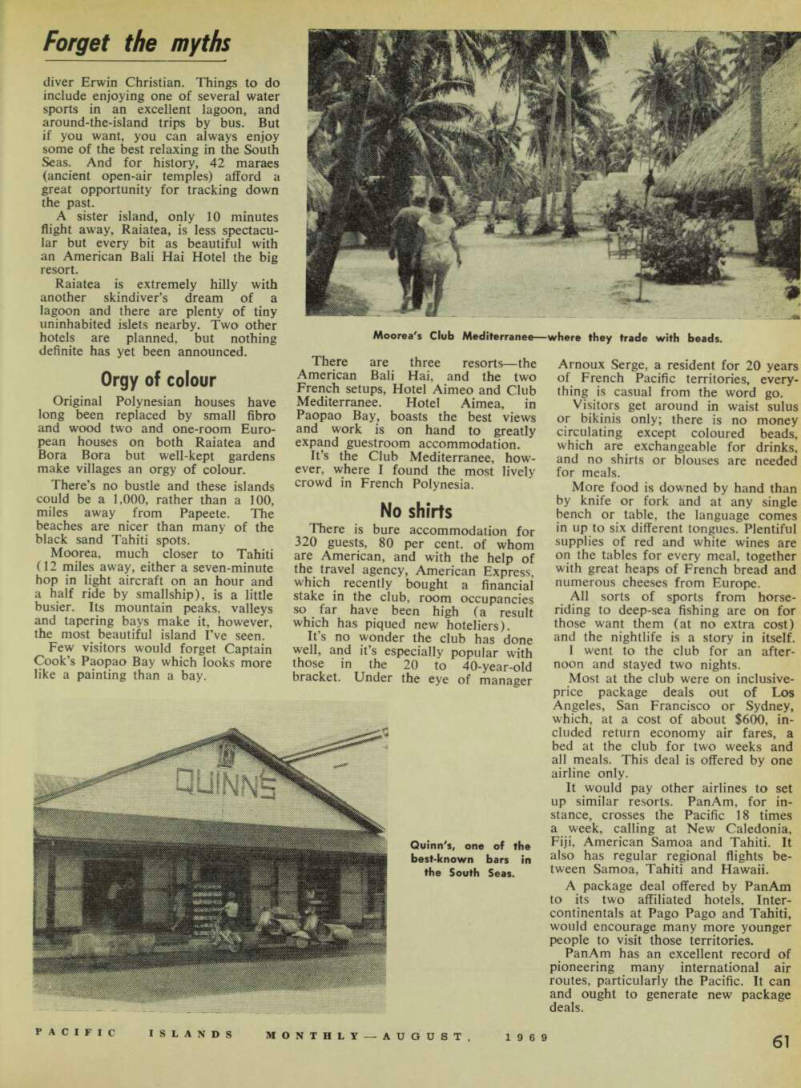
Visitors get around in waist sulus or bikinis only; there is no money circulating except coloured beads, which are exchangeable for drinks, and no shirts or blouses are needed for meals.
More food is downed by hand than by knife or fork and at any single bench or table, the language comes in up to six different tongues. Plentiful supplies of red and white wines are on the tables for every meal, together with great heaps of French bread and numerous cheeses from Europe.
All sorts of sports from horse riding to deep-sea fishing are on for those want them (at no extra cost) and the nightlife is a story in itself.
I went to the club for an after noon and stayed two nights.
Most at the club were on inclusive price package deals out of Los Angeles, San Francisco or Sydney, which, at a cost of about $6OO, in cluded return economy air fares, a bed at the club for two weeks and all meals. This deal is offered by one airline only.
It would pay other airlines to set up similar resorts. PanAm, for in stance, crosses the Pacific 18 times a week, calling at New Caledonia, Fiji, American Samoa and Tahiti. It also has regular regional flights be tween Samoa, Tahiti and Hawaii.
A package deal offered by PanAm to its two affiliated hotels, Inter continentals at Pago Pago and Tahiti, would encourage many more younger people to visit those territories.
PanAm has an excellent record of pioneering many international air routes, particularly the Pacific. It can and ought to generate new package deals.
Quinn's, one of the best-known bars in the South Seas.
Moorea's Club Mediterranee—where they trade with beads.