Yesterday
p. 98 · Read in the full issue
The real estate value of islands tends to increase—consider Manhattan—and the islands of the Pacific are no exception. In P/M for July, 1949, it was reported that a New Zealand company had put a Fiji island on the market. Price? A mere £lOO. The island, 25 miles from Suva, wasn’t exactly a gem—it had mangrove swamps— but it was an island. These days £lOO will barely buy you a week’s holiday on a Fiji island. As for buying one . . . well, Bob Hunter recently paid $340,000 for Fiji’s Wakaya Island.
Among other items in PIM for July, 1949: The wave of strikes causing in dustrial havoc in Australia 20 years ago had repercussions in PlM’s Pacific. Australian engravers had been hit by the strikes and because of this PIM was unable to print pictures in the magazine section in July, 1949.
The giant snails which were re leased by the Japanese in New Guinea as food during the war, and which had been causing such anxiety to planters in the territory, were becoming less of a problem in mid-1949. There were fewer of them than there had been just after the war. And they were smaller.
Nevertheless the NG Department of Agriculture still considered the snails a nuisance and was looking for ways to get rid of them once and for all. (It didn’t).
Papuan planters had sold no rubber for three months. The planters said that unless the Aus tralian Government gave them a temporary subsidy, or some other assistance, they would have to close down their plantations. The Admini strator was “gravely concerned” about the situation, and the Minister for External Territories, Mr. E, Ward, had agreed to meet repre sentatives of the Papuan Planters’
Association.
Not for the first time, and certainly not for the last, Australia was getting it in the neck at the UN. The Russians were criticising Australia’s Administration in NG and Nauru, though words in Aus tralia’s defence were being uttered by Britain, France, New Zealand and Belgium. The UN had decided to send a Trusteeship Council dele gation to New Guinea and Nauru.
The Australian Royal Com mission of inquiry into the circum stances of the NG timber-lease scandal had published its findings.
The Minister, Mr. Ward, was com
pletely cleared of the charge that he had had some monetary or improper interest in the attempt made by the Jock Garden syndicate to obtain a timber lease concession for Hancock and Gore, the Queens land timber firm; and that he received some portion of the £50,000 paid to the syndicate by Hancock and Gore.
The war had been over for four years, but people in New Guinea were still receiving war wounds.
In early 1949, a native had been killed handling old Japanese ammunition in Rabaul, and a saw mill operator (also in Rabaul) struck a belt of machine gun ammunition with a power saw causing more than £3OO worth of damage to the mill.
Tonga was feeling the post-war pinch—to the extent of refusing entry permits to potential residents.
A Darwin man who had applied for an entry permit with the idea of permanent settlement received the following reply from the Tongan Premier: “Owing to the difficulties of procuring accommodation and
supplies of essential commodities, prevailing in Tonga under post-war conditions, it is regretted that no permits can be issued at present for permanent residence in the kingdom”.
In the Cook Islands, 100,000 cases of oranges were waiting for ships to take them to an eager market in New Zealand. But there weren’t sufficient boats available, and PIM estimated that no more than 20,000 cases would eventually reach the Dominion. As though the waste weren’t enough, Cook Islanders were turning the oranges into bush beer.
Not surprisingly the beer tasted good, and, since it was also strong, it re sulted in some pretty gay bush beer parties.
Harry Jackman and Grainger Morris, Patrol Officers in New Guinea, were in Australia studying co-operative techniques. They in tended to pass on information to their charges in the territory.
In Fiji, fines for spitting had risen from a few shillings to £l. A mis guided Indian, caught spitting by a Fijian policeman, tried to save himself 15/- by offering the police man 5/- to forget all about it.
The result: in court the Indian was fined £1 for spitting and £l/10/for attempted official corruption.
And in Australia 3,000 pairs of sandals were being manufactured for native New Guinea feet. Policemen’s feet.
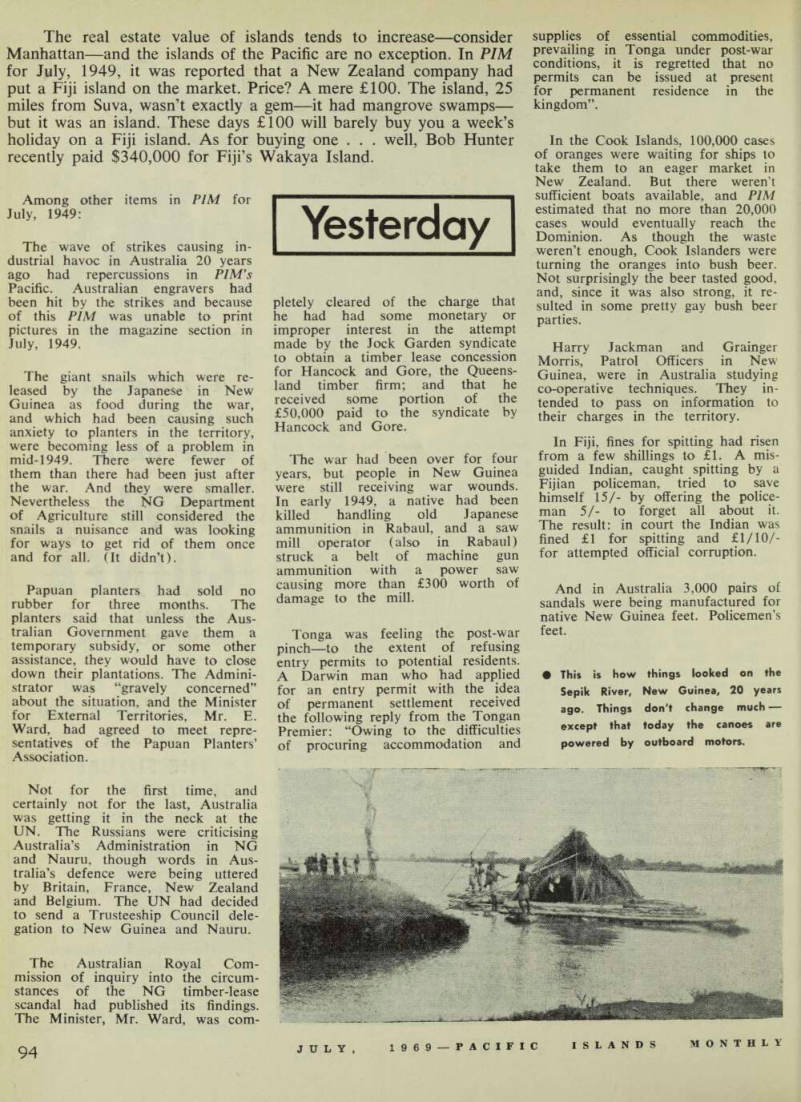
This is how things looked on the Sepik River, New Guinea, 20 years ago. Things don't change much except that today the canoes are
powered by outboard motors.