Magazine Section
pp. 87-97 · Read in the full issue


They Hunted Headhunters
Along The Fly River
By G. F. W. Zimmer
In late 1927 the people of the coastal area of the Western Division of Papua received a shock.
A rumour spread that there had been a mass head-hunting raid on the Fly River, and reports said that the Weriadai natives had been exterminated.
The mmour proved to be correct, in that a raiding party had come down the Fly and nearly correct about the extermination of the Weriadai natives. The facts were that raiders had killed 38 out of a total population of 45. In addition to killing these unfortunate people, the raiders had cut off their heads and disembowelled most of them, thus adding greater horror to the affair.
During the whole Administrative history of the Western Division, which dates back to 1886, this was the biggest mass raid recorded.
The information about the raiding party was very vague. No one had seen them come and no one had seem them go. The number of heads taken indicated that it had been a big raiding party, and it was logical to assume that they had travelled down river by canoe, as there was no known village immediately above Weriadai which could have produced enough men. Weriadai was the last permanent village of what might be considered the Lower Fly River settlement, and above this point there was a stretch of over 200 miles of river without any sign of habitation.
They just wanted heads
From this it can be gathered that this raid was in no sense a “pay back”, nor could it have been under taken as a means of eliminating “purri-purri” men, or sorcerers. It could have been nothing else than an expedition to collect heads, and Weriadai was unlucky enough to be the first of the coastal villages in the path of the raiders.
On November 30, 1927, I and a party of natives left Dam in two
boats, in search of the head hunters.
The boats were the larger Elevala, and the Aide, which was about 40
ft and driven by a 26 hp benzine engine. The launch was tawed in order to conserve fuel, and as she was to be my means of communica tion, every drop of fuel we could take up the river would be needed.
On board the Elevala were the resident magistrate, a European en gineer and myself together with most of the 18 armed native constables and 20 long-sentenced prisoners from the Dam gaol. These prisoners were to be employed in building a per manent camp and preparing a garden to enable the detachment to be as nearly self-supporting as possible.
The resident magistrate returned to Dam when the camp was established.
Terrifying
To enter the Fly River from the open sea—and I have had to do it several times—is a terrifying experi ence for those who are not good sailors. To begin with, the Fly is 60 miles wide at its mouth. The tremendous volume of water coming down the river, on meeting the sea, causes the most uncomfortable swell imaginable, especially if the tide is rising. Also, on account of the width of the mouth, one gets the full force of any wind which is blowing, and during the south-east season the seas can be very heavy indeed. Again on account of the width, certain deep water passages have to be fol lowed, as sand and mud banks are legion.
On our way up the river we picked up the village constable of Weriadai with three men from his village, who had been away at the time of the raid and had thus escaped the mass murder. They were no longer liv ing at the old village site. (over)
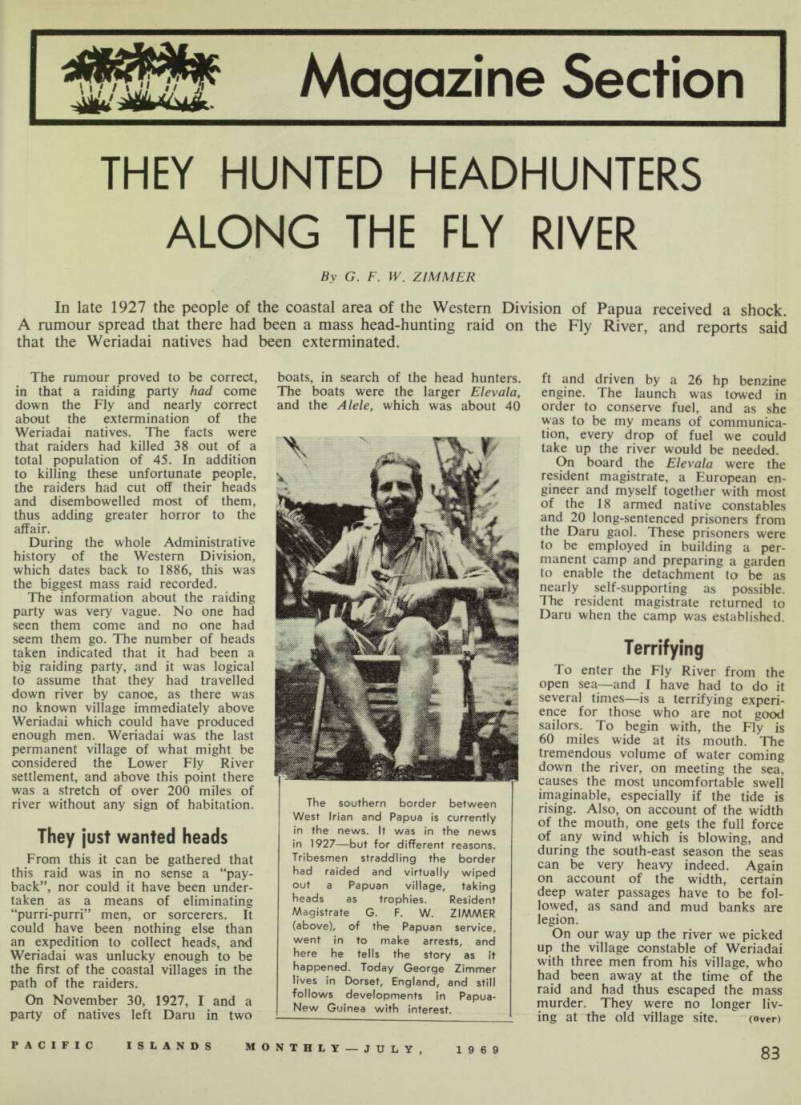
The southern border between West Irian and Papua is currently in the news. It was in the news in 1927—but for different reasons.
Tribesmen straddling the border had raided and virtually wiped out a Papuan village, taking heads as trophies. Resident Magistrate G. F. W. ZIMMER (above), of the Papuan service, went in to make arrests, and here he tells the story as it happened. Today George Zimmer lives in Dorset, England, and still follows developments in Papua- New Guinea with interest.
The plaintive screech
When we were once well into the river, beyond Kiwai Island, it was just a question of slogging upstream against the current, and of keeping to the deep water side of the many bends. One appreciates this mighty river when it is seen that even 100 miles from the mouth there are stretches where it is six miles wide between the banks.
These wide stretches are frequently studded with large islands, some of them several square miles in extent.
After the initial trip there are possibly few experiences more tedi ous than this passage up the Fly River. For about 160 miles dense jungle crowds down to both banks.
This is matted together with lawyer vine, so much so that one could not go ashore anywhere without scrub knives and a gang of boys to cut a track.
This scenery gets deady dull hour after hour in the damp heat, as, of course, not a breath of air gets into the dense, walled-up corridor which is the river. Only occasionally is the monotony relieved, as when one comes across a patch of that won derful creeper named -after the 19th century explorer D’Albertis.
Startling and brilliant
It is a most startling and brilliant sight. I would describe it as being like a massive wisteria, except that the flowers are a most brilliant scarlet, a scarlet with a touch of yellow in it to smooth out any harsh ness. The individual flowers are formed like the wisteria except that each blossom is about four times as large. They also hang in clusters like the wisteria, but again the clusters are much larger. I have seen patches of D’Albertis creeper a good hundred yards long, draped from a height of 80 ft right down to the water’s edge, and actually trailing in the stream.
What perhaps is equally striking is the reflection of this blaze of colour from the greeny-brown surface of the river. A trip up the Fly is well worth while if one is fortunate enough to see the D’Albertis creeper at its best, but unfortunately its flowering period is comparatively short and I often ascended the river without seeing a blossom.
Soon after passing Cassowary Island the nature of the river changes, and we come to flat swampy grass land, the river edge fringed with dense cane, growing 10 to 15 ft high.
If possible, this is even more dif ficult to penetrate. This type of country now extends for 200 miles beyond Eve rill Junction, where the Strickland River joins the Fly, at a point already 235 miles from the mouth.
Except for occasional clumps of bamboo, which always gladden the heart with their delicate grace, this stretch of the river is dreary and forbidding.
An alarming diversion one is likely to experience are crocodiles sleeping in the sun, or occasionally swim ming in the river. To kill one out right is a proof of ones markman ship. They are easy to hit but, if only wounded, always manage to get back into the river. They are dif ficult to kill outright. One can tell when a crocodile is hit through the
heart or brain: It seems to raise its head and tail forming a slight bow, holds this position for a second or two and then flops back and remains motionless. Not more than one shot m ten from a moving launch achieves tms result.
One is almost certain to come across large colonies of flying foxes, which are to be seen in their hundreds of thousands, mostly hanging from wild kapok and breadfruit trees, usually about 40 ft above the ground, On the approach of the launch they can be seen getting restless, and an occasional wing opens.
Then, as one gets nearer, a few break away and start flying over the colony; by the time you are abreast of them they are all in the air mak-
ing a curious flapping noise with their leathery wings, and giving utter ance to a rather plaintive screech.
They are dirty, evil-smelling beasts and very frequently mangy, but for all that they are much loved as food by the natives.
A favourite place for the flying fox to get his food is from young coco nuts, and it is a common sight to see numbers of them flapping about the coconut trees in any village. At dusk or on moonlight nights a native, who has no shotgun, will get pieces of stick about as thick as ones thumb and about 18 in. long, and sharpened at each end. They are thrown at the flying foxes while in flight in such a way that they spin on their longitudinal axis.
If the native is able to hit the flying fox outright it falls like a stone; or, if he is able to tear the leathery skin of its wing with the spinning stick, the fox is forced down in a fluttery dive and soon
despatched. I have seen this method used with very considerable success The reached Everill junction with the Alele in tow on the m oraing of , he fifth day and not a sign of a native had been seen f or t^e prev ious 200 miles. A few deserted hunting shelters on the river bank were the only signs fliat this country was inhabited at all.
The junction of the Fly and Strick iand seeme d to be the obvious place for a permanent camp, as one could then watch any movement up either stream . The Elevala was taken a a m j] e or two up t j, e pi y> j, ut t h e banks were all low and there was nothing but coarse cane grass and swamp, so we turned round and ex plored the Strickland, and within half
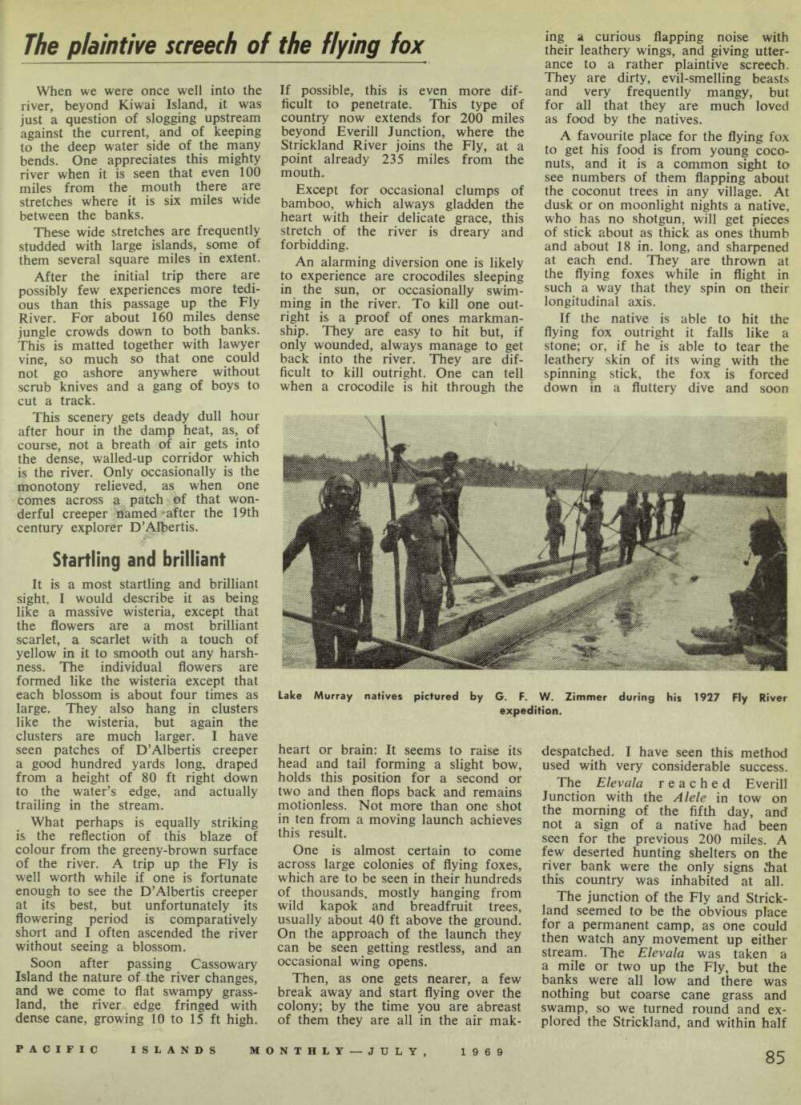
Lake Murray natives pictured by G. F. W. Zimmer during his 1927 Fly River expedition.
a mile of the junction a suitable strip of ground for a camp was found, with banks a good 8 ft above the river.
During the months we were to re main in this camp we daily watched white cranes travelling down the Strickland on drift wood. There were in fact two varieties of cranes, one standing about 2 ft high and the other perhaps a little over a foot.
We could watch them approach the camp down the half-mile straight, but I never saw one that had the courage to ride right past the camp.
They would invariably rise when about level with the centre of the camp, fly up river for a few hundred yards and settle on another log.
Mosquitoes and mosquitoes
During my many years in Papua I travelled from the then Dutch border in the west to the late Ger man New Guinea border in the east, and have been stationed in every division between these boundaries, but never have I seen anything to equal the myriads of mosquitoes in this area. Day and night they made life almost unbearable and we all carried a switch of some kind per petually. If I sat down to write for a moment my hands were black with mosquitoes. I tried using just my thumb for killing them, and found that on an average I killed seven with each jab, and that went for any piece of exposed flesh.
Curiously enough I did find that they eased off a little for about an hour before sunrise; they were still bad, of course, but not quite as bad as at other times. I naturally used this short period for doing my writ ing. This whole area for hundreds of square miles is mostly swamp, so that nothing can be done to ease the position. Fortunately I saw very few anopheles, the variety which carries malaria.
Three of the local boys slept in front of my tent one night, and I noticed that they swept every dead leaf and twig clear for quite a wide margin around their sleeping space.
They explained that this was to keep the mosquitoes away, but they also built a smouldering fire around them selves, which no doubt was more effective.
The hum from the mosquitoes at night had to be heard to be believed, but there was comfort in the noise, for that the unfortunate police on guard duty at night were never tempted to sleep while on post.
It is an indication of the tedious process of establishing good relations that I had been at the camp for over two months before I saw any
of the local women. They were very nervous and just as I photographed them they took fright and made a bee-line for their canoes. That was the first and last visit I had from them.
But our male visitors became so full of confidence and cheek that at times I found it very difficult to keep them out of my tent, and as long as any of them were at the camp I dared not go far away. I
had to think out a few simple methods of discouraging them from intrud ing.
One method that worked very suc cessfully was to put an alarm clock m an empty petrol tin, and set it so that it would go off after two or three minutes. The noise was terrific, and as they were unaware of its origin, it never failed to make them run away. After a moment or two they would laugh rather shamefacedly and come back but they kept well clear of the tent.
Likeable
There was something very likeable about these wild people, who seemed frank and childlike and could always smile and grin. I soon came to know many of their names, and in return they called me “mamoose”, which is a word used for a chief as far west as the Bensbach River; but I must admit that I was surprised to hear that word up in so remote an area.
A couple of years later, when I visited Warn Lagoon, in what is now West Irian, the natives called me tuan, the Malay word for master.
The first time we put on the gramo phone for their entertainment the result was very amusing. They be came very excited when they heard a woman’s voice. They knew that there was no woman in the camp, but walked all round the machine looking for one and frequently used their very expressive means of show ing wonder, namely, by putting a thumb behind their front teeth and flipping it forward, and at the same time drawing in their breath with a hissing sound.
We noticed after a while that, as we threw the old gramophone needles away, they were picking them up and putting them into their mouths.
Whether they hoped to produce similar sounds it is hard to say, but after that we took care to throw the old needles into the river.
And then it was Christmas Day.
There is no logical reason why one should be more lonely on this day than on any other, but we had now been up river just a month, and per haps that had something to do with an attack of low spirits. I did not feel that I had made much progress in finding out who took part in the raid, though a great number of the locals were now known to us by sight. We seemed to have been accepted as desirable neighbours, and I now had a considerable vocabulary.
One day we visited a village which had long since been deserted by the headhunters we were searching for.
We first inspected 13 shelters, all very much dilapidated, but still con-
Stuffed heads found by Zimmer on his expedition. Bottom picture shows how the heads are sewn up at the back.
They wanted to sell a stuffed head
taining their owners’ possessions, such as large bundles of arrows, sago making tools, stone adzes, and in one shelter we found two human skulls.
Most of the shelters contained large mysterious-looking bundles wrapped up in the bark hoods worn by the local women. These were not touched, but from their shape, and from what we were to see later, I have no doubt they contained stuffed human heads.
Going another 100 yards to the top of the cliff we came to the usual "mamifa”, or single men’s house, larger than any seen before. Here again were very many bows and arrows, a few stone disc fighting clubs, many drums, and in a crude rack along one wall were six dried and smoked human heads, the one at the end of the line being quite fresh and only partly cured: it was crawling with ants. This rather naturally made me wonder if this was a Wariadai head, but probably it was an even more recent trophy.
The necks of these dried heads were always out of proportion. This is due to the fact that when the head is cut off the skin is slit right across the chest and round the shoulders and then pulled back, and the neck and spine removed.
Rattles
One has to assume that the brain is also removed through the base of the skull, as they usually put in one or two pebbles, so that when moved about the head rattles! It is a fair conjecture, I think, that these heads are used for certain dances and other ceremonies.
A glance at the pictures (p. 87) will show that these heads were roughly sewn up at the back of the neck, rather as a boot is laced. I have seen heads of women where half the breasts are still showing. A long scar on top of one of the heads made me think that the victim was killed by a blow on the head from a stone disc club. My police came to the conclusion that the six heads represented those of four men and two women.
On another occasion on patrol, a canoe with eight men approached the launch, but kept a couple of hundred yards away, until the men finally decided to come alongside.
They had bows and arrows and a stuffed head, all of which they wanted to sell.
We bought the arrows, and though it seemed rather grisly trading in human heads, after a little considera
. T . i . .on, I came to the conclusion that ' h / Government Museum at Port Moresby should have at least smne of these relics, so a small axe was given in exchange for the head.
Later, a second canoe approached in which all the men had their faces painted yellow, the significance of which I was unable to discover. The second party would not come alongside until they saw that the first canoe got away safely. They had two stuffed heads as well as bows and arrows, and a very fine bamboo pipe. I admit that I was very surprised to find that there was a market for stuffed human headfc.
However, I bought these two, the last I ever acquired in this way. Not wanting to encourage this as a trade line I refused many more in later ... . - ..
We were now on that part of the river which forms the border bulge.
On that particular day we came to a large village with four houses on the eastern, or Papuan, side of
the Fly River, and nine on the western or Dutch side. Anchor was dropped and I went ashore. Some of the natives we had with us from downstream would not leave the launch, so evidently their friendly relations did not extend as far as this.
In the section of the village on the Dutch side of the river there were two houses of considerable interest.
The floor level of one of them was a good 40 ft above the ground, and the other about 30 ft. The houses were large and well built, the floor area being 35 by 30 ft.
In both cases the trunks of two growing trees were being used for supports, together with many cut poles. Entrance was obtained by climbing an inclined pole with notches cut in it which led to a square hole in the floor.
Nearly vertical
The river here has a big bend and the higher of the two houses was in a commanding position so that a long stretch both up and down the river could be watched. The whole idea would seem to be one of de-
Two Lake Murray natives who posed for Zimmer. Their heads are painted red and their bodies are smeared with clay. Note the bow guard—used to pre vent bow stings— held by the man on the left. Large shells cover their genitals.
fence. I did not feel that I could tackle a 40 ft climb up an inclined pole, which was nearly vertical and had no hand rail. I sent up one of the police boys, who reported that the tree houses were empty.
I was learning the language, which was becoming very useful, and we were now seeing a good deal of the natives. I obtained the names of several of the raiders by listening to their talk, especially at night.
These natives use their hands a lot and make many other gestures when talking, which are a great help in following their conversation. I learned that one man I knew, Zimukani, had taken four heads himself!
About this time I received in structions from Sir Hubert Murray, Lieutenant-Governor of Papua, to the effect that he thought sufficient preliminary work had been done at Hell’s Comer, which was our name for our base camp, and I should now make arrests and close the camp. This was obviously going to be difficult, as arrests would have to be made very quickly, and, if possible, I wanted to avoid undoing all the work I had done to gain their confidence. Of course, there would be only one opportunity in each dis trict, and we did not want to an tagonise these people for years to come. I had therefore a very con siderable problem to solve.
We knew by now which villages had been involved in the raid. We worked upstream, so as to keep ahead of reports of my actions—the speed of my launch compared with canoe travel being a big asset. We said goodbye to the base camp on April 15, 1928.
Because of the rainy season and the rise in the river many of the villages had been abandoned. But one day we found a small encamp ment lying back from the river, and I recognised one of the natives as Wamasi, who told me that his village was further up a creek. Wamasi seemed to have some authority over the others and he was among those we were satisfied were involved in the killings.
Towards civilisation
At this point I asked Wamasi if he wanted to go to Daru. He smiled, patted his chest and indicated that he would be very happy indeed to go to Dam and promptly told another seven men with him that they were going, too!
It was a mean trick, but I now had eight representatives of the head hunters without causing any disturb ance among the people, and I felt quite
confident that by the time they re turned to their village from Daru they would have learnt quite a lot about the government ways, and taken their first step towards elementary civilisation.
The natives came from near Weriadai, and there is little doubt that all the able-bodied men were actively concerned in the raid. Had I taken my eight police ashore and made arrests openly we would have been lucky to have got handcuffs on more than two. There would most likely have been some arrows flying about, for which it would have been hard to blame them, and the whole position would have become more complicated than ever, as these boys would have to be arrested later for firing on a government party.
Desperate
I noticed a new village, which was not there on our last visit. We landed, only to find the place also deserted, but a number of fires were still burning, and there were five canoes pulled up on the bank, so obviously the occupants were not far away. I got the police to call out but we got no response, so I set the police to cooking their mid-day rice.
It was 2 p.m. and we hoped that the owners would turn up in due course. However, after waiting for a considerable time without any sign of the returning natives, I began to get anxious and to feel that by some means or other they had got suspici ous of my intentions. At about 4 o’clock I began to feel desperate and had a feeling that they would not return until after we had left, so I told L/Cpl. Kau to take the canoe
back to the launch, while I remained hidden in the village with Cpl. Nada and three armed constables. Two of the latter were outstanding boys and were to accompany me all through my activities while in the Western Division My plan was rather a desperate one, and at best it meant a night alone with my four police without food, mosquito net or bedding. At the worst, if the natives got hostile and found that we were only a small party they might make things very uncomfortable for us, as the rest of the police could not possibly re turn before daylight.
However, my four police were all for mixing it a bit. I think they felt that so far things had been very tame and, of course, they were not concerned with future policy. What they wanted was a little justifiable shooting, and perhaps a little killing, so as to be able to add to the stories of their exploits, to be passed on in due course when they left the police force and settled down in their villages.
Tense
My surmise that these people had been hiding from us seemed to be correct, for, as soon as our canoe was three-parts across the lagoon, we counted five canoes leaving the grass edge, heading for where we were hiding.
It was rather tense watching them approach. We could only count eight figures but at that distance we could not distinguish between men and women, and it was very important that women should not land first and give the alarm.
This is how the village on the Fly bulge appeared to Zimmer's patrol. The house on stilts is 40 ft about the ground.
Nearly spoilt our plan
A canoe with a man standing in the bow, and three women and a small boy paddling, came straight for us. Whether by design or accident, the boy, aged about nine years, came running up to the house where we were hiding before the man had quite reached the shore, and nearly spoilt our plan.
Let out a yell
As soon as the boy found us and before he could yell out a warning, the police jumped on the man, who was ashore by then. He let out one yell and jumped for the water with the police after him. He was a big, powerful man and it took the com bined efforts of the four police to hold and handcuff him. Most of the struggle took place in water up to their armpits, and our prisoner’s head was kept under water for a good part of the struggle, which rather cramped his style.
There is no doubt he expected his head to be cut off, as doubtless would have happened had he been the at tacker, so it is not difficult to imagine how he fought. After we had the handcuffs on he was very agitated for some time, and called out at the top of his voice, but later when he saw me he quietened down.
No more trouble
I told him that we were taking him to Daru, after which he never gave us any more trouble, and in fact we became firm friends in the years to follow. Whenever we met in Dam while he was in gaol he always gave me a wide grin, and later on when he had served his sentence and was back up the river I frequently met him, and he always had a friendly greeting for me.
But to return to the lagoon. The other canoes had, of course, dis appeared. The women in the one that had landed had made a terrific noise, yelling at the top of their voices, and then they disappeared in the grass like redshanks, and the small boy hid in the lagoon with his head just above the water, yelling blue murder. All this noise was rather fortunate as the L/Cpl and the rest of the police heard it, although they must have been four miles away, and much to my 1 relief I saw the double canoe coming back towards us.
It was after 6 o’clock when the canoe arrived and nearly dark, but I
The West Irian-Papuan border was in 1927, as now, a troubled area.
Our map gives an inkling of the sort of inhospitable country through which Zimmer and his men sweated their way in search of head hunters. The swamp land on either side of the Fly, and around Lake Murray, is a breeding ground for mosquitoes. Zimmer found that at the junction of the Strickland and the Fly the mosquitoes were thick in the air. "If I sat down to write for a moment my hands were black with mosquitoes," he says. And adds: "Curiously enough I did find that they eased off a little for about an hour before sunrise; they were still bad, of course, but not quite as bad as at other times. I naturally used this short period for doing my writing". Most of Zimmer's 1927-8 activity was in the stretch of river that bulges into West Irian, around Asoer, and the Strickland and Lake Murray region.
was able to note that Fate had again been with us, as the police had with them another man who had been in the canoes, and he seemed quite con tent. Fearing that he might take fright when he saw the other man in handcuffs, I had the police handcuff him, too, but there was no struggle this time.
While waiting at the encampment where we made the capture I found a stuffed human head, and also a large wicker fish trap used by the coastal natives, which looked like a trophy stolen during the raid on Weriadai. Both these were confiscated, and I hoped that the fish trap would be recognised later.
Hung his head
When I showed our prisoner the human head, he hung his head as though ashamed, and after a moment or two said that it had come from Tinung, but there was no conviction in his reply, and he obviously had to think up some excuse. I had little doubt that he associated his arrest and the handcuffs with the presence of the stuffed human head.
Our party got back to Dam a little over five months since we had left it in the Elevala.
Our round-up had produced ten natives. In addition we had sent eight to visit Dam. All the eighteen were charged with having taken part
in the raid on Weriadai, which none of them denied.
Although we did not have very many prisoners out of the possible 250 who took part in the raid, we did have representatives from each district. I cannot pretend this was a very satisfactory round-up, but with our limited resources it was quite im possible to have arrested them all.
It was less a question of punishing all those who took part, than of the advancement of civilisation, and get ting new areas of Papua under gov ernment control, so that anything similar should never occur again.
The headhunters received sentences of one to two years’ imprisonment.
In the course of time I returned them to their villages; they had picked up quite a working knowledge of the Motuan language, and they never failed to greet the police like long lost brothers whenever a government party had reason to visit their district.
Some of the more intelligent were sent to Port Moresby, where they obtained even wider experience of the government and the ways of the white man.
The mouth of the Fly from the air. The delta is 60 miles wide, and contains many islands. The mass of muddy water coming down the Fly stains the ocean for many miles.