Hagen on the map
pp. 67-73 · Read in the full issue

The trail-blazers who put Hagen on the map
By Norman Camps
In 1896, a German botanist, Dr. Carl Lauterbach, while ex ploring the Sepik River and its eastern tributaries, ascended the Yuat River and made camp at its junction with the Sou. To view the surrounding country to the best advantage, he climbed a hill and saw for the first time the peaks and mountains surrounding the Wahgi Valley. He wrote in his diary; “To the South lies a striking mountain.” And he named it Mount Hagen in honour of Captain Kurt Von Hagen, the Acting Administrator of German New Guinea.
In 1916, another German, Captain Hermann Detzner, a former German Government surveyor who had taken to the bush following the Australian occupation of German New Guinea, claimed to have breached the Bismark Mountains and the range known today as the Wahgi Divide. He said that he had entered the Wahgi Valley at Chimbu and proceeded north west as far as Kerowagi.
Though Detzner’s claims have been described by historians as “so much fiction”, I have a personal doubt in Detzner’s favour, particularly in view of certain remarks in his book, He wrote: “The Hagen Mountains were there before us and the Sepik depression was 200 kilometres away, a distance now too great for us to cover. But I found consolation in the thought that I had penetrated into
regions that no white had ever visited ... 1 would like to establish the fact that instead of encountering uninhabitable mountain wildernesses in this region I have discovered a rich agricultural district of wide-open valleys, inhabited by natives of a Semitic type, which may be taken to represent the original Papuan stock.”
Detzner’s reference to the Hagen Mountains certainly indicates that he was aware of Dr. Lauterbach’s explorations and the approximate location of Lauterbach’s Mount Hagen. For had he, in fact, proceeded in a north-westerly direction from Chimbu to Kerowagi the Hagen Mountains would certainly have been before him.
However, a major cause for doubt of Detzner’s entry into the Wahgi remains, and that is that the native
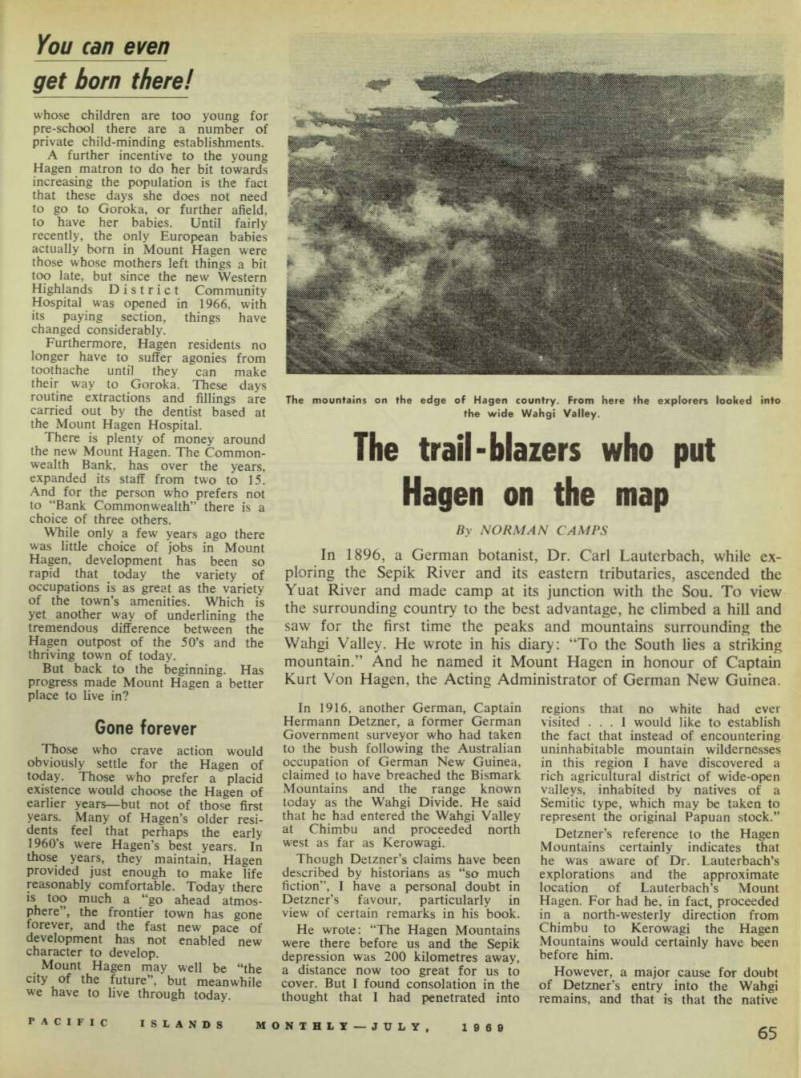
The mountains on the edge of Hagen country. From here the explorers looked into the wide Wahgi Valley.
people in the Chimbu and Kerowagi areas have no memory of a visit by white men before 1933 when the Taylor-Leahy expedition made the first authenticated entry into the Wahgi Valley.
The Taylor and Leahy party con sisted of Jim Taylor and a detail of native police representing the Admin istration, and Mick and Danny Leahy and surveyor Ken Spinks representing private enterprise.
Uninhabited mountains
On March 8, 1933, veteran pilot lan Grabowsky flew Major Harrison, the manager of New Guinea Gold fields, Jim, Mick and Danny Leahy into the “unexplored” region on the map and laid to rest for all time the theory that the centre of New Guinea was a mass of uninhabited mountains.
During his second air reconnaissance of the valley, Mick Leahy described the Wahgi as “an island of population so effectively hemmed in by mount ains that the rest of the world had not even suspected its existence.”
The ground exploration party of four white men and nearly 100 natives broke camp on the Bena Bena River early on the morning of March 28, 1933 and moved west towards the Wahgi Valley. The valley was breached just to the north of Mount Erimbadi and the general route through the valley proceeded along the north banks of the Wahgi River.
Directly to westward of the party an “enormous flat top mountain loomed”. It was decided that it must be the so-called Hagen range of Lauterbach and was thereafter called Mount Hagen.
Later observations by surveyor Ken Spinks made it clear that the Hagen range lay further to the north east and that the peak called Mount Hagen was a new mountain altogether. Lauterbach’s “Mount Hagen” could easily have been Mount Jaka, Sigul Mugal, Naginimp (Mount Spinks), Kuban Gama (Daniel) or even Mount Kubor (Leahy).
The expedition set up a base camp at Kelua and prospected and ex plored mainly towards the Baiyer, Yuat and Jimmi Rivers.
In 1934 the Leahys found gold at Ewunga Creek and Kuta was established, from the second base camp which had been positioned at Mogai near the site of the present Mount Hagen Catholic Mission.
The Leahvs had constructed an airstno at Kelua in 1933 and later established a second airstrip at Mogai.
This second airstrip served as the
supply strip for gold sluicing at Kuta and further exploration to the West.
Kuta became home for Dan Leahy and it still remains part of his present day property. Dan now lives in the Nabilyer Valley, directly below Kuta, and operates one of the finest farms and plantations in the Highlands.
Trail blazing
On April 1, 1934 Father Ross, Father Tropper and Brother Eugene arrived from Madang in time to witness the first aircraft landing at the Mogai airstrip. They had blazed a trail across virtually unmapped country and were the first party to enter the Wahgi Valley from the north coast.
The Catholic Mission station was established at Rebiamul and has played an important part in the development of the Western High lands, and Mount Hagen in particular.
Father Ross is still at Mount Hagen.
In the meantime, in 1934, Jack and Tom Fox had made their epic prospecting patrol to the west of Mount Hagen and it is thought that they at least reached the Dutch border. Their patrol is recognised as one of the great feats of New Guinea patrolling and bushmanship. Jack Fox is still a virile and active man and is employed by the P-NG Admin istration as an overseer at Korn Farm, near Mount Hagen.
The first Administration officer to establish the permanent Mount Hagen Patrol Post was Murray Edwards, who arrived in 1938, and exploration and pacification continued until the war years.
During late 1942 when the Japan ese occupied Madang, the Mount Hagen patrol post was evacuated.
The only people who remained were the officer in charge and native police.
The patrol post was bombed regularly by a Japanese float plane, but the raids were of nuisance value only. During the whole of the war, the Administration continued to exercise control over the Western Highlands District. The American forces established a recreation centre at Ogelbeng, a Lutheran Mission four miles north of Mount Hagen, and this was in use until 1945.
After the war Dan Leahy, who had served with the Australian forces in New Guinea, returned to Hagen and recommenced mining operations, and then, in 1946, planted tea and coffee at Kuta and established cattle. (Kuta, situated at 6,700 ft above sea level had proved to be unsuitable for general agriculture. However cattle and pigs thrived).
In 1950 Dan moved the bulk of his agricultural operations to Korgua and planted coffee. Coffee did well and the basis of the Wahgi Valley coffee industry was established.
The only private businessmen in Mount Hagen in 1954 were Dan Leahy, Harry Rudd (sawmiller and trader) and Frank Aveling (sawmiller and trader). However, Rudd and Aveling were established well out of town at Tuman River and Kundu.
The Lutheran Mission at Ogelbeng and Catholic Missions at Rebiamul and Kuli and the SDA Mission at
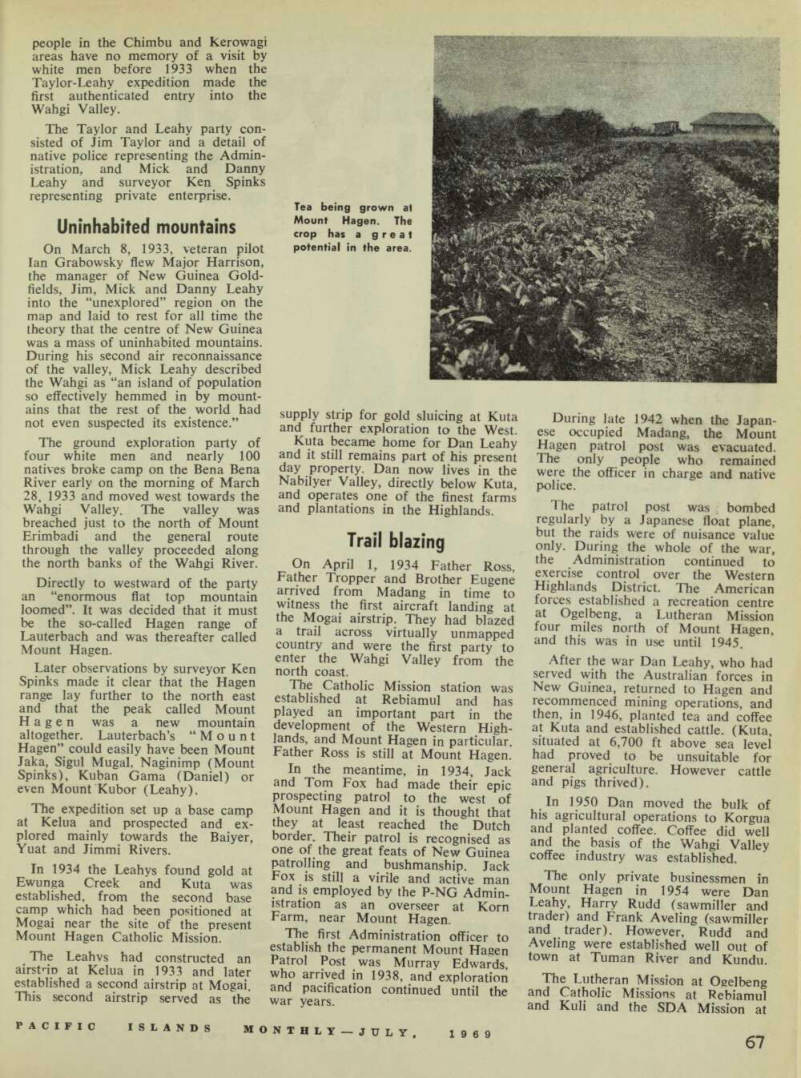
Tea being grown al Mount Hagen. The crop has a great potential in the area.
Kimininga were at this time the only other outside influences on daily life.
With the establishment of coffee plantations in 1955, 1957 and 1958, the European population increased greatly, and business began to develop. In 1955 the only regular airline service was operated by Qantas on Friday of each week and landed at every DC3 airstrip between Lae and Wabag—weather permitting.
Since Madang is close to the Wahgi Valley, the developing plantations used it as a seaport, and heavy chartering of DC3 and Bristol air craft became commonplace.
Before the Highlands Highway became fully operative, Hagen air port, which was in the middle of the town, supplied all of the goods and equipment required for Western and Southern Highlands development.
The airport was rated as the seventh busiest airport in Australasia. In 1962, it was decided to move the airport to Kagamuga, seven miles outside Mount Hagen, and the new strip was opened in 1965.
Plantation and other private enter prise development demanded a paral lel development by the Administration in the provision of public utilities and service departments.
Trade stores had been operated since 1954 but the first general stores opened in 1961. Today the Hagen district is amply catered for by stores and shops, garages and automotive retailers, hairdressers, accountants, survey offices and a host of others.
Only one in Australasia
Industries have been established and oil installations, sawmills, build ing and joinery firms, a bakery, sheet metal and plumbing workshops, soft drink manufacturers, trucking com panies, welding and general engineer ing firms and others satisfy local needs.
As far as export primary produc tion is concerned, the English com pany of Stafford Allen, a member of the Albright and Wilson group, operates the only pyrethrum extrac tion in Australiasia, from a site at Kagamuga near Mount Hagen’s new airport. The pyrethrum concentrate is exported to the UK and from there is sold to companies through out the world for inclusion in insect sprays.
The growing of pyrethrum has pro duced a valuable cash crop for the Highlands people living above the altitude level of normal valley agri culture.
Five major coffee mills are operated by private companies and these
process the native coffee crop in its entirety, and a major portion of the plantation estate coffees. New Guinea coffee is shipped all over the world and annual production currently runs at approximately 18,000 tons.
Due to it’s locality, climate, topo graphy and it’s decidedly colourful native people, the Western High lands has become a great tourist attraction.
The Hagen Show held once every two years has done a great deal to put Mount Hagen on the world tourist map. Five tourist companies with world-wide affiliations operate within the Western Higlands District and tours to any part of the territory can be arranged.
A unique local attraction, situated at Baiyer River, is the Hallstrom Park Bird of Paradise Sanctuary.
There, Birds of Paradise and other unique New Guinea fauna can be viewed in the midst of beautiful riverine rain forest.
Tom Ellis, who as District Com missioner inaugurated the Hagen Show, was a man of drive, vision and ability. For seven years Tom held the reins of district development and his guidance and enthusiasm will be felt for many years yet. He is today the Director of the Department of District Administration, in Port Moresby.
Many of the local native people have gone into business enterprises and a great number operate their own coffee and tea properties, own
trade stores, trucks, utilities and tractors and trailers. A number of trucking companies, operating both locally and on the Highlands High way are owned by New Guineans.
Business advice and assistance is freely given to these entrepreneurs by Europeans.
The growing of tea in conjunction with coffee has always been a favourite subject for discussion where ever planters have gathered. Even in 1954 Dan Leahy and Bob Gibbes were experimenting with tea culture but not to any serious extent.
Tea industry
The tea industry was pioneered by Ivor Manton, of Mount Hagen Tea Growers, Coconut Products Ltd. on their Kudjip, Aviamp and Kinding estates, and Kurumul Plantations on their Kurumul and Minjigina estates.
Kurumul opened their processing plant in 1966, Ivor Manton opened his in 1967 and CPL, theirs in late 1968.
As one knowledgeable tea expert has stated: “The potential of the Highlands tea industry is limited only by the amount of land which the Administration will allocate to it”.
Native growers are producing tea equal in quality to the plantation produced tea and their green leaf is purchased and processed by the plantation mills. The industry has a great potential and its revenue earn-
Tourism is becoming big in Mount Hagen. From the ranges on either side of the valley, visitors get this view of expanding Mount Hagen township in the distance.
ing capacity will most certainly boost the economy of the territory.
In pastoral matters things are look ing up. Many native cattle projects —small nucleus herds—are operating successfully.
The Administration cattle station at Baiyer River is a focal point in the Highlands, and cattle bred on Baiyer River are sold to native farmers throughout the Highlands.
Land in the Jimmi River valley is being opened to private enterprise and this will be the first true alloca tion of pastoral land to private enter prise in the Western Highlands District.
District Advisory Councils, Town Advisory Councils, Local Govern ment Councils, Farmers and Settlers Association branches and the West ern Highlands Chamber of Com merce, all of which are multi-racial, have assisted the Administration in positive development with constructive suggestions, planned surveys of economic problems and donations of self help labour and cash or kind.
In only 35 years, Mount Hagen has emerged from the Stone Age to become the administrative, com mercial and industrial hub of the New Guinea Highlands.
The firm-muscled, proud, confident warrior of yesterday has become the proud and able Member of the House of Assembly, Local Government councillor or businessman of today.
The Highlands have a bright future and the quality of the people, both native and European, who live here will make the task of development to the stage of economic viability an easy one.
ANGLICAN evangelists in Papua- New Guinea are going to start taking agricultural courses as part of their training so that they can help villagers exploit their resources better.
This has been decided by the Chapter of the Pacific Province of the Society of St, Francis, which met in Port Moresby recently. (A chapter is the chief meeting of a Franciscan province and in this case is made up of leading friars from the society’s houses in Papua-New Guinea and Australia.) Anglican evangelists receive train ing in religious subjects and instruc tion methods from the Franciscans at their college at Jegarata, near Popondetta. Now, at the request of the Bishop of New Guinea, the Franciscans have agreed to take over the nearby Denis Taylor Farm School, which the diocese finds it can no longer staff.