Hagen
pp. 57-67 · Read in the full issue
Men Of
Mount
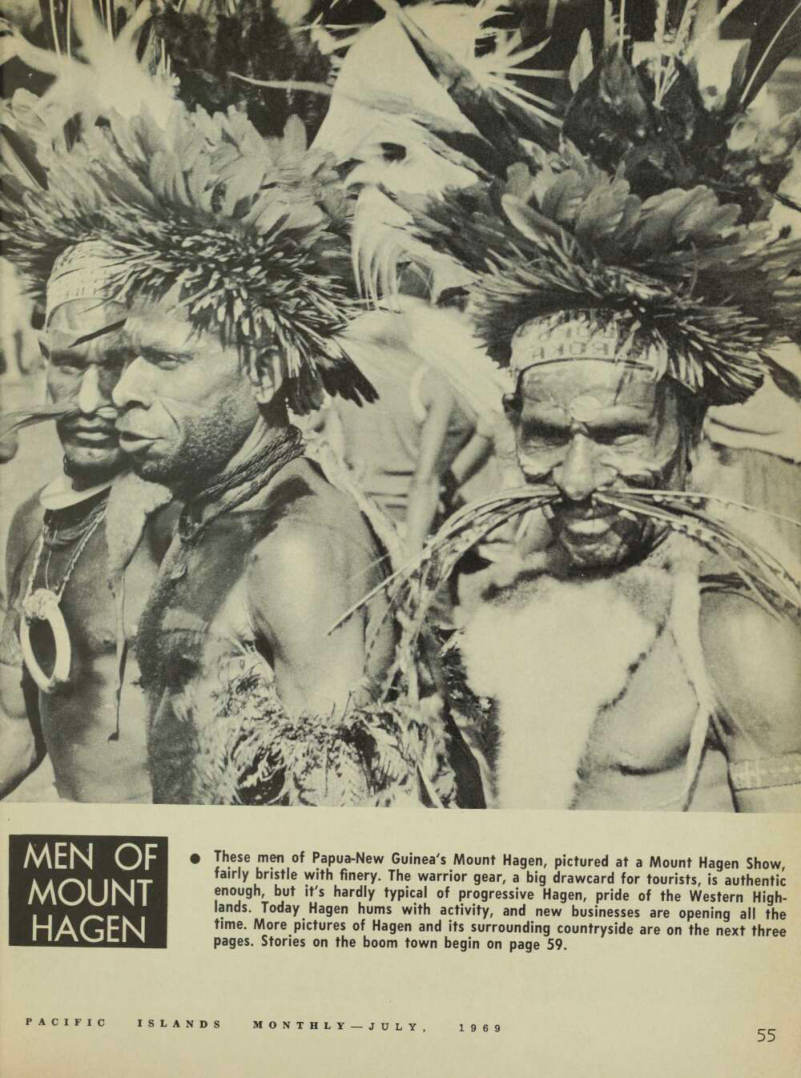
• These men of Papua-New Guineas Mount Hagen, pictured at a Mount Hagen Show, fairly bristle with finery. The warrior gear, a big drawcard for tourists, is authentic enough, but it's hardly typical of progressive Hagen, pride of the Western High lands. Today Hagen hums with activity, and new businesses are opening all the time. More pictures of Hagen and its surrounding countryside are on the next three pages. Stories on the boom town begin on page 59.
Hagen In
Showtime
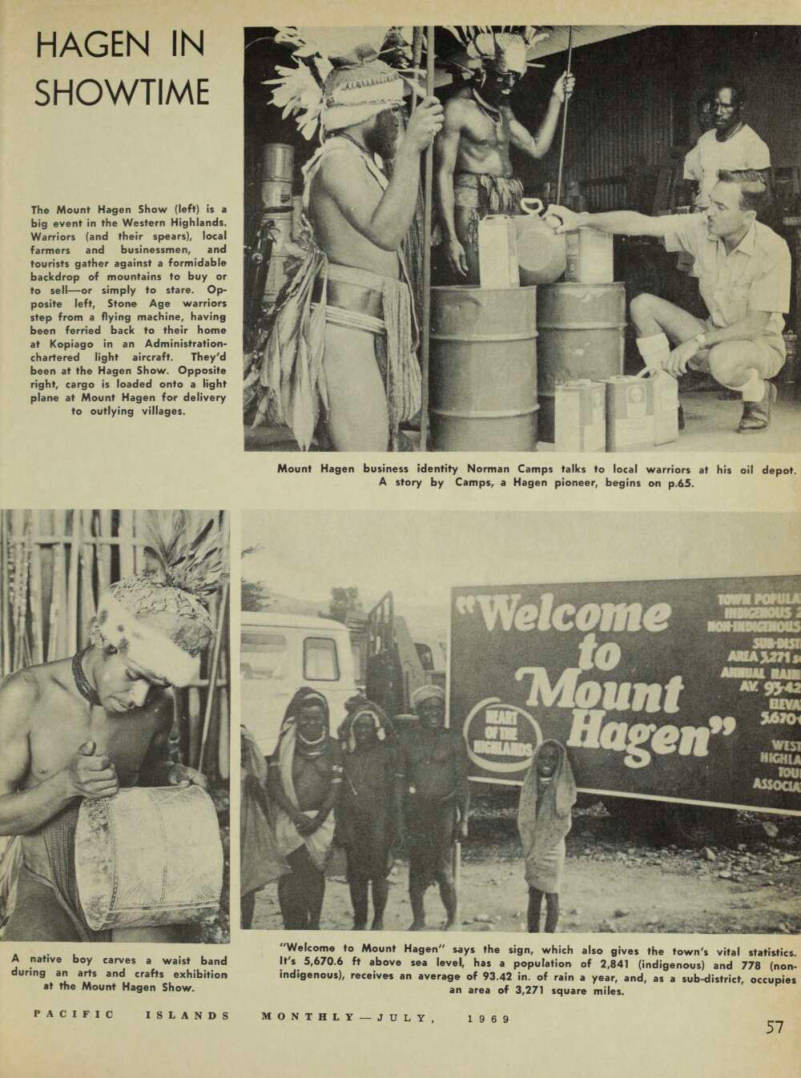
The Mount Hagen Show (left) is a big event in the Western Highlands.
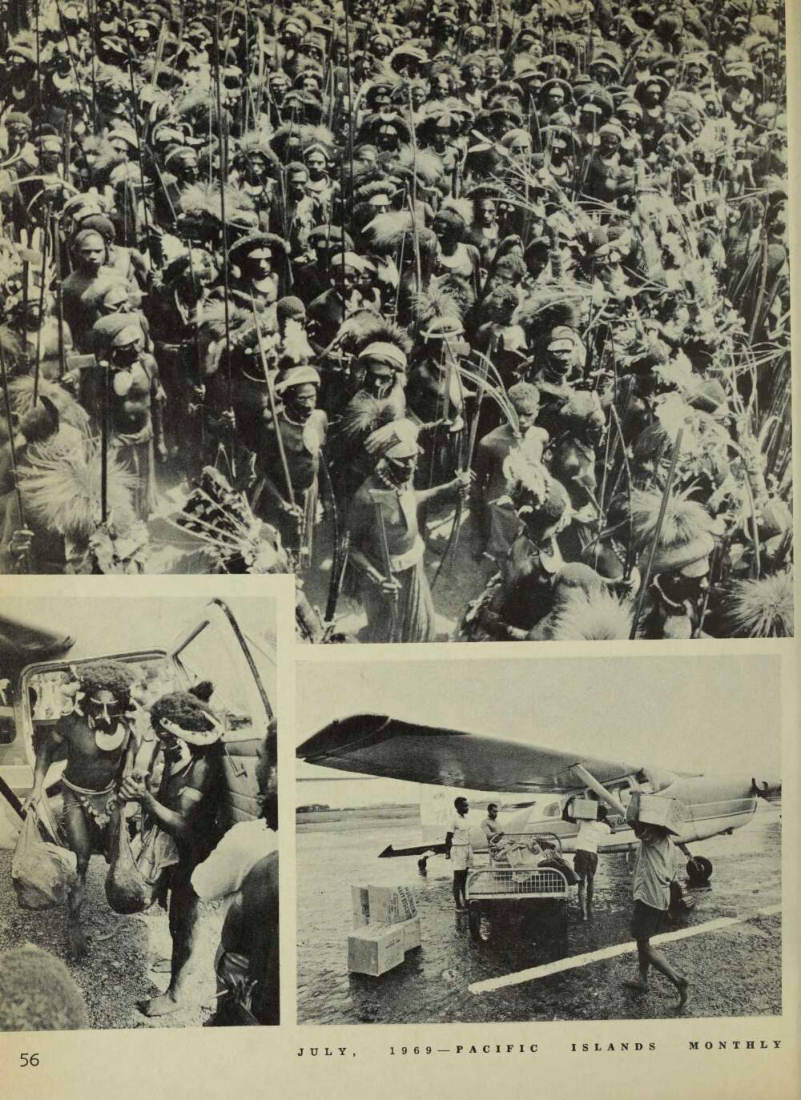
Warriors (and their spears), local farmers and businessmen, and tourists gather against a formidable backdrop of mountains to buy or to sell—or simply to stare. Op posite left, Stone Age warriors step from a flying machine, having been ferried back to their home at Kopiago in an Administration chartered light aircraft. They'd been at the Hagen Show. Opposite right, cargo is loaded onto a light plane at Mount Hagen for delivery to outlying villages.
A native boy carves a waist band during an arts and crafts exhibition at the Mount Hagen Show.
Mount Hagen business identity Norman Camps talks to local warriors at his oil depot.
A story by Camps, a Hagen pioneer, begins on p. 65.
"Welcome to Mount Hagen" says the sign, which also gives the town's vital statistics.
It's 5,670.6 ft above sea level, has a population of 2,841 (indigenous) and 778 (non indigenous), receives an average of 93.42 in. of rain a year, and, as a sub-district, occupies an area of 3,271 square miles.
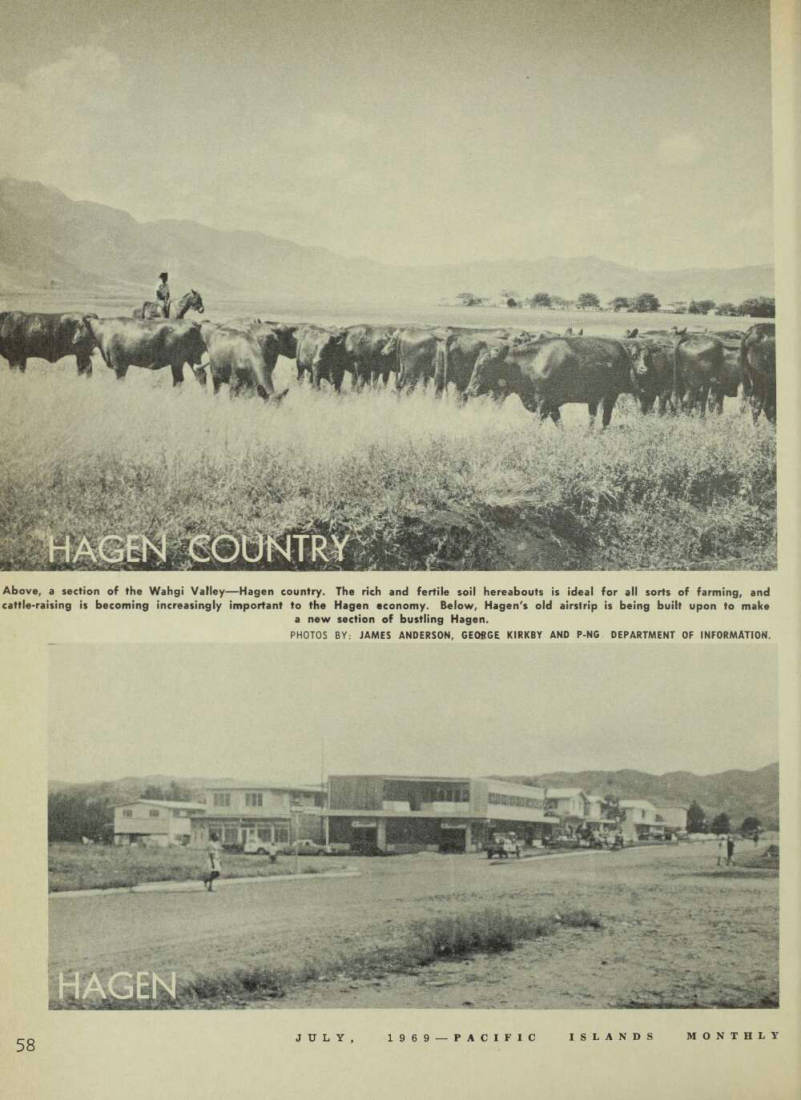
Hagen Country
Above, a section of the Wahgi Valley—Hagen country. The rich and fertile soil hereabouts is ideal for all sorts of farming, and cattle-raising is becoming increasingly important to the Hagen economy. Below, Hagen's old airstrip is being built upon to make a new section of bustling Hagen.
PHOTOS BY: JAMES ANDERSON, GEORGE KIRKBY AND P-NG DEPARTMENT OF INFORMATION.
Hagen
Mount Hagen—where a classroom once turned into a bar
• Fashion-conscious ladies can now have their hair permed in Mount Hagen, boom town of P-NG's Western Highlands and locale in August of the Mount Hagen Show—one of the South Pacifi's greatest attractions.
But Mount Hagen wasn't always so civilised, and on the following pages two local residents tell the story of Mount Hagen's growth.
By Neo Hill
“The city of the future!” enthused Mr. Caine, the Liberian member of the United Nations visiting mission to Papua-New Guinea last year. He was referring to Mount Hagen, the largest town and Ad ministrative centre of New Guinea’s Western Highlands. He seemed to be pretty impressed with Mount Hagen,
The residents of the town and its outlying areas greeted Mr. Caine’s statement with as many jeers as cheers, the cynics maintaining that, in comparison with Liberia, any town in the territory would look good.
All very well, but why compare Mount Hagen with Liberia anyway?
Why not compare Mount Hagen now with the Mount Hagen of several years ago, and see what progress has been made.
Let’s do that—and decide, if we can, whether progress has made Mount Hagen a better place to live in.
Only a handful of the town’s present population of about 800 Europeans has shared in even a fraction of the story of Mount Hagen’s growth, even though the entire history is a very short one.
Epic walk
This area was not entered by white men until 1933, when the Leahy brothers and Jim Taylor made their epic walk from the Asaro Valley, in the Eastern Highlands.
And progress didn’t follow them at a gallop exactly.
But gradually things began to move, and in the middle 50’s the planters began to arrive—men such as Norman Camps and Neptune Blood. Today Norman Camps is one of Hagen’s business leaders.
The arrival of the planters saw the beginnings of social activity in the area. With the opening of the Mount Hagen Primary “A” School in 1956 came the opening of the Mount Hagen Country Club. The school— in those days a single classroom— was the country club (after school hours, of course!) and the fact that the club and the school continued to share premises until 1958 indicates that the teacher and his 12 pupils raised no objection that the class
room’s removable blackboard served to conceal a well-stocked bar! Neither did Protestant churchgoers object to having to clear up the remains of Saturday night festivities before they could hold their Sunday morning services, because the school-cum-club also happened to be the church!
By the end of the 50’s, the Hagen Country Club had established itself on its own premises, Protestant Church services were being held in a real church (of native materials), and the “A” School had a classroom of permanent materials.
October, 1960, saw the establish ment of Mount Hagen’s first bank, when the Commonwealth Bank set up a sub-branch on the edge of what was then the Hagen airstrip. The coffee growers, who had formed the Mount Hagen branch of the High land Farmers and Settlers’ Associa tion in 1958, were now making steady progress; so were the missions in the area. And the Administration was extending its activities in all
fields, with a gradual increase of the number of government officers in Mount Hagen.
Most of the officers lived with their families in a small cluster of houses which was the nucleus of what is known today as Hagen’s “suburbia”. Strictly speaking, you have to have a town before you can have suburbs, and it was not until 1961 that Mount Hagen really began its transformation from an outpost into a town.
That was the year that saw establishment of Mount Hagen’s first hotel (originally owned by Messrs.
Cole, Parsons and Zebrebious); its first two general stores (Robert Cheung, and Trudy and Henry Fleck); its first bakery (Paul Ander son); its first garage workshop (Ottley Bros.); and its first “proper” coffee processing factory (Mount Hagen Coffee Processors Ltd.). Pro gress indeed!
Since that watershed year of 1961 Mount Hagen’s development has
A bird's eye view of booming Mount Hagen.
accelerated at a rate which has left old-time residents breathless.
One of the hardest things to keep up with is the number of houses built in the past few years. While in 1961 everyone knew where everyone else lived, these days Hagen residents are no longer confined to living either in “suburbia” or on “the other side of the strip”. Today a large number live in “Siberia” (so called even in Treasury correspondence!) and even the old “suburbia” has expanded beyond all recognition.
Street signs and house numbers would make things a lot easier, par ticularly for the taxi drivers who frequently drive around in bewildered circles, their meters ticking up outrageous sums. But although some of the older streets were given names long ago, no signs have yet been erected, and some newer streets have not been named yet. As for the numbering of houses—that seems a very long way off.
But although visitors to Hagen are frequently heard to complain about the difficulty of finding their way around the town, they now have no cause to complain about the standard of accommodation the town offers, or of other facilities.
Dining in style
The Mount Hagen Hotel has ex panded tremendously since Steam ships Trading Company took it over in 1964 and spent over $160,000 in extensions and improvements. Today, the hotel provides accommodation for 48 guests, and many of the town’s residents go there regularly for the counter lunches, which give the customer very good value for his money in this town of high prices.
Then there is the Hagen Park Motel, which started up in 1966 with two units, and now has comfortable accommodation for 52 guests.
These days, the Hagen housewife who gets tired of home cooking can, if she has an amenable husband, dine out in style—either at the hotel or motel, or at the town’s Chinese res taurant or its “Coffee Shop”.
Hagen is becoming increasingly conscious of the growing tourist trade, and gone are the days when the visitor had to hitch rides. These days, hire cars and taxis are avail able, and at least three firms will arrange tours for visitors to the area.
The largest of these is Central New Guinea Tours, which started up in Mount Hagen in 1965. Since then, this business has increased enormously, and so has its fleet of cars and buses.
Central New Guinea Tours has plans to build a tourist lounge at the Kagamuga airstrip, which makes
one realise just how far we have come since the days when the visitor, stepping from his plane on Hagen’s old airstrip, frequently picked up his suitcase and walked!
But planes stopped landing on the old airstrip in the middle of town in 1965, when Hagen’s new airport at Kagamuga—the seventh busiest in Australasia—was opened. The old strip has now disappeared under new roads and retail stores.
Thongs are "out"
0 , , „ So many shops have sprung up all over Mount Hagen m the past few years that the housewife, who once had to write away for most of her requirements, including essentials now rarely needs to look beyond what the town has to offer. All the big firms are there, and many smaller The woman who wants “something decent to wear” no longer has to rely only on David Jones’ mail order catalogue, for she has the choice of three dress shops in Mount Hagen, The first of these was opened by Coltra Enterprises in 1962. It has extended its premises twice, for the
Hagen women no longer feel adequately clad in the little cotton dress and thongs that were acceptable a few years ago. Thongs are definitely “out”, as the Hagen Shoe Shop has proved in the few years it has been in business, “Out”, too, are rats-tail hairdos and un-madeup faces. The most popular place for purchasing make up is the Hagen Pharmacy, and one has to climb a flight of stairs if one wants to have one’s hair cut, set. permed, straightened, bleached or tinted at Sassy Coiffures.
The menfolk aren’t badly off either, xh have their own barb and even if his styles are more restricted than some of the b|ades would like, th have no camplaints about the range o( at Wally Smith . s men swear store
PIGHty of choiC6
Then they have a choice of two places where they can buy their daily newspaper; and a choice of four garages if something goes wrong with their car. They can drown their sorrows at one of three well patronised drinking spots—the hotel.
Highlands girls such as these may not have their hair per med at Sassy Coif fures, but they have a charm that's all their own. And it brings in the tourists.
No need to stay at home
Hagen Country Club, and the Hagen Golf Club, if they have not been invited, or cannot afford, to join the new and exclusive Pioneer Club, whose membership is restricted to 100.
Apart from all this, there are sporting activities for all tastes —including cricket, football, tennis, golf and bowls. And while organised entertainment (apart from the inevit able dances) is mainly confined to rather ancient movies at the country club or at the council chambers, there is no need for anyone to stay at home.
True, Hagen lacks culture, but the local dramatic group is doing its best to remedy this and we do have the occasional art show.
What we do need in Hagen is a good library; those people who patronise the town’s present library in a gloomy section of the old District Office are beginning to com plain that they know its few books off by heart. But for those people who actually buy books, the stores in town stock a good selection of first-class paperbacks; and for those people who prefer music to reading, there is an excellent record shop offering anything from Slim Dusty to Sibelius.
Even those who neither drink, dance, play sport, read or listen to music need not be bored in Mount Hagen these days, since the town has enough organisations to satisfy even the most inveterete “joiners”.
There are also Guides, Brownies, Cubs, the Police Boys’ Club and numerous other ways of ensuring that our offspring have plenty to occupy their idle moments—if they have any after they have finished their homework each night.
School improvements
The present-day Hagen “A” School is a far cry from the one-teacher twelve-pupils establishment of 1956.
Today’s school still stands on the original site, but now it is a complex of modern buildings containing seven teachers and more than 200 pupils.
The pre-school, too, has come a long way from its origins in the Hagen Country Club. These days about 30 three-to-five-year-olds spend their mornings in a well-equipped building and playground under the supervision of a trained teacher and her two assistants.
And for those working mothers
You can get born there!
whose children are too young for pre-school there are a number of private child-minding establishments.
A further incentive to the young Hagen matron to do her bit towards increasing the population is the fact that these days she does not need to go to Goroka, or further afield, to have her babies. Until fairly recently, the only European babies actually born in Mount Hagen were those whose mothers left things a bit too late, but since the new Western Highlands District Community Hospital was opened in 1966, with its paying section, things have changed considerably.
Furthermore, Hagen residents no longer have to suffer agonies from toothache until they can make their way to Goroka. These days routine extractions and fillings are carried out by the dentist based at the Mount Hagen Hospital.
There is plenty of money around the new Mount Hagen. The Common wealth Bank, has over the years, expanded its staff from two to 15.
And for the person who prefers not to “Bank Commonwealth” there is a choice of three others.
While only a few years ago there was little choice of jobs in Mount Hagen, development has been so rapid that today the variety of occupations is as great as the variety of the town’s amenities. Which is yet another way of underlining the tremendous difference between the Hagen outpost of the 50’s and the thriving town of today.
But back to the beginning. Has progress made Mount Hagen a better place to live in?
Gone forever
Those who crave action would obviously settle for the Hagen of today. Those who prefer a placid existence would choose the Hagen of earlier years—but not of those first years. Many of Hagen’s older resi dents feel that perhaps the early 1960’s were Hagen’s best years. In those years, they maintain, Hagen provided just enough to make life reasonably comfortable. Today there is too much a “go ahead atmos phere”, the frontier town has gone forever, and the fast new pace of development has not enabled new character to develop.
Mount Hagen may well be “the city of the future”, but meanwhile we have to live through today.