To the Point
pp. 54-57 · Read in the full issue

Are Gambling Laws Irritating
Everyone But The Gamblers?
School was over for the day, and my pupils had gone home. I use the word “pupils” because this story dates back to the days before we started calling the kids in primary schools “students”. As I walked down the little thatched schoolroom towards the door, I noticed a small oblong of cardboard under one of the desks and stooped to pick it up
It was one of those little cards bearing a coloured picture and a text from the Bible, which used to be, and perhaps still are, given to children who go to Sunday school.
This one depicted a gambolling lamb and carried the words, ‘The Lord is my Shepherd”.
I turned it over. On the back of the card, neatly drawn in red ink, was a representation of the seven of diamonds. My mind registered a connection between this pheno menon and the fact that of late there had been a tendency for certain members of my class to have a gener ous supply of pencils while others had none at all.
This incident happened not only before pupils became students and before bail-points displaced ink, but before paternalism became disreput able. Next morning I was heavily paternal, and without undue trouble the rest of the card pack was rounded up and confiscated.
Memento was ace of spades
My pupils were very gracious about it. They explained that they didn’t really mind losing their labori ously manufactured cards; the pack had lost its usefulness as the regular players learned to recognise the court cards from the pictures and texts on what, with wholly unconscious irony, they referred to as the “back” of the cards.
I let them keep the ace of spades as a memento. Appropriately enough it had on its obverse side a spray of forget-me-nots and the words “Prepare to meet thy God”.
The addiction of Niuginians (even small Niuginians) to gambling is rather odd, because almost certainly there was no gambling in pre-contact days. In neither of the two Papuan languages with which I am familiar is there a word for it.
There is a word for drawing lots.
This was generally done by means of twiggs of varying length drawn from a closed fist which concealed their lengths. The winner was he who drew the longest twig, or the loser he who drew the shortest,
To the Point with Percy Chatterton
according to the object of the draw.
I have seen the same sort of thing done with black and white pebbles.
But I have never heard of this exer cise being used for gambling, and the fact that the word for it was not extended to cover gambling with cards in post-contact days suggests that it was not so used.
Generally, in Papua at any rate, the word “kasi”, a corruption of the English word “cards”, has been used both as a noun, meaning “playing cards”, and as a verb, meaning “to gamble”. The reaction of most Papuans when told that Europeans sometimes play cards without gambling is one of polite incredulity.
On the other hand, while in pre war days Papuans rarely if ever played cards without gambling, they rarely if ever gambled without playing cards. It was their war-time con tacts with our gallant fighting men which opened up to them new gambling horizons.
How to draw the line?
The younger brothers and sisters of the pupils whose story I have told above didn’t waste time on hand made card packs. They just drew two lines in the dust with a stick, toed one of them, and tossed pennies towards the other. When all had thrown, the player whose penny was closest to the line swiped the lot.
This, I felt, was a bit unfair to me. No schoolmaster, however much of a martinet he may be, can con fiscate a couple of lines drawn in the dust. However, I had the con solation that by moving over into a
money economy they had saved me from a classroom problem—that of the unequal distribution of the tools of learning.
In pre-war Papua, playing cards “for money or money’s worth” was prohibited under Native Regulations, For the police the practical problem was to prove that, in any particular ca f> „ mon fy or money’s worth had actually been changing hands in the card game they had raided, Sophisticated defendants could make Quite hard for them when they B ot mto cour *-
A Us6Tui I3W
But in the rural areas this problem rarely arose. I once knew a kiap who wa s building a wharf with prison labour. When the supply of murd erers and other malefactors ran short, he would send out a police posse to raid the nearest card party Brought into court they invariably pleaded guilty and within minutes were on their way to the wharf.
They took their fate Q uite P hila sophically. The work was not un duly hard, the food was reasonably good, nagging wives had been lefl behind in the village, and in the lon* evenings there was generally a quid game of cards with the warders, witl no danger of being arrested.
Gambling in pre-war Papua, thougl rife, could hardly be said to be t social problem. In the lives of mosi of those who gambled, money wa! still, as it were, an optional extra Subsistence farming, hunting anc fishing provided the necessities ol life; money was used for the trim mings, and if it was lost at Lucky
10 serious family hardship was aused. In the towns and on the ilantations, wage-earners were em iloyed on a pay-and-rations basis riiich protected them from gambling way life’s necessities.
In present-day Niuguini the situ ion is very different.
In the urban areas wage-earners eceive a straight cash wage. In the illages near the towns subsistence arming is a dying art. Even in ome of the rural areas the swing ver from subsistence farming to ash cropping has reached a point t which it is the proceeds from the ale of cash crops rather than the reduce of the food gardens which eplenish the family larder. In this ituation gambling can create family ardship.
In 1962, when the drinking laws under review, one experienced *apuan woman welfare assistant ex ressed the view that gambling was greater menace to family welfare lian drink.
Whether she still thinks so after six ears of legalised drinking I don’t now. But when a slice of the pay acket is left behind in the pub nd another slice is lost in the Lucky” school, the impact on mum nd the kids can be pretty tough.
Women gamblers
Moreover, it is not only the men I'ho gamble. Their wives, living in mall, easily-cleaned low-cost houses, nd relieved of the burden of food rowing and of chores such as water arrying and firewood gathering, are smpted to devote their new-found nsure to the excitements of “Lucky”.
However, by and large the coastal eople of Niugini have learned to ive with gambling. The move in 965 for a tightening of the anti ambling laws came from the High mds, where the impact of this aspect f western culture is more recent.
Introduced by Sinake Giregire, lember for Goroka, it was supported lainly, though not exclusively, by lembers from the Highlands, and tie arguments in its favour were lainly from the standpoint of conomic development rather than tiat of social consequences—although ome coastal members who supported t did stress the latter aspect, and oth coastal and Highland members minted out the frequency with which :ambling led to fighting.
But the main argument ran some hing like this: You tell us that we aust develop our country economic lly. How can we do this when our •eople prefer sitting in the shade •laying cards to planting and tend ng cash crops out in the sun?
A difficult argument to counter, and members who spoke against the bill mainly concerned themselves with pointing out that outlawing playing cards, which was what Mr. Giregire’s bill aimed at, wouldn’t necessarily stop gambling.
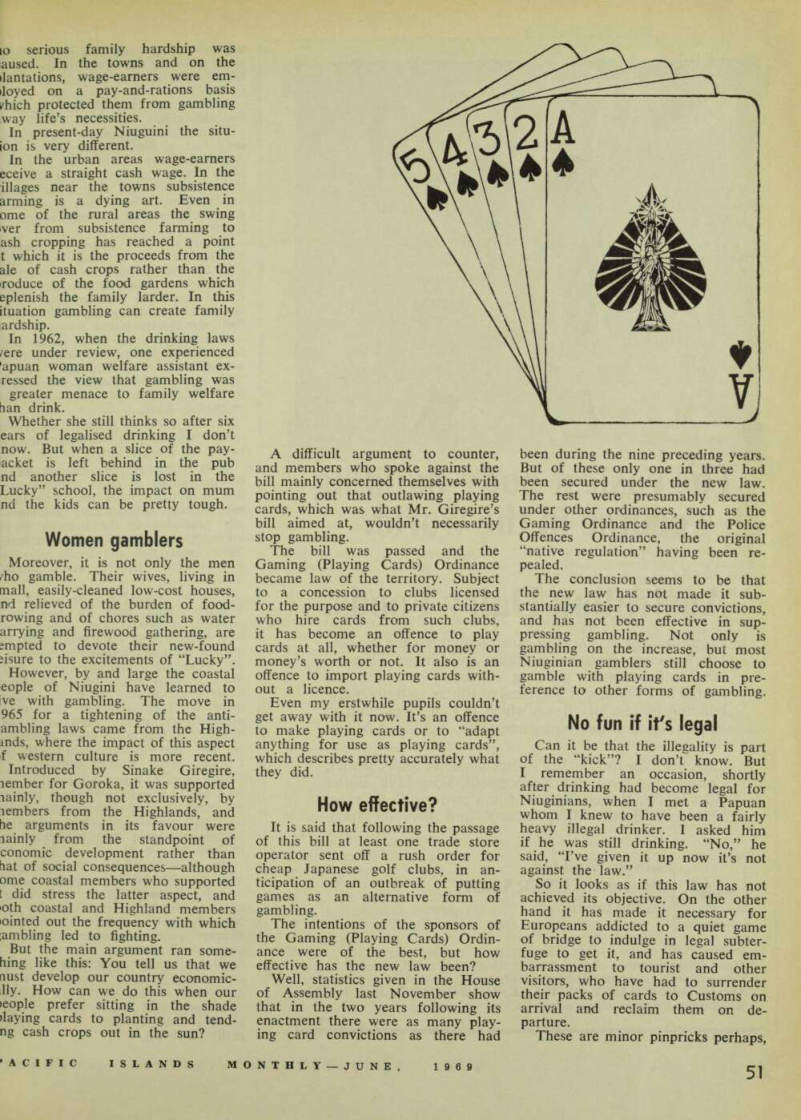
The bill was passed and the Gaming (Playing Cards) Ordinance became law of the territory. Subject to a concession to clubs licensed for the purpose and to private citizens who hire cards from such clubs, it has become an offence to play cards at all, whether for money or money’s worth or not. It also is an offence to import playing cards without a licence.
Even my erstwhile pupils couldn’t get away with it now. It’s an offence to make playing cards or to “adapt anything for use as playing cards”, which describes pretty accurately what they did.
How pffprtivp?
nuw eiietiive.
It is said that following the passage of this bill at least one trade store operator sent off a rush order for cheap Japanese golf clubs, in anticipation of an outbreak of putting games as an alternative form of gambling.
The intentions of the sponsors of the Gaming (Playing Cards) Ordinance were of the best, but how effective has the new law been?
Well, statistics given in the House of Assembly last November show that in the two years following its enactment there were as many playing card convictions as there had
been during the nine preceding years, But of these only one in three had been secured under the new law.
The rest were presumably secured under other ordinances, such as the Gaming Ordinance and the Police Offences Ordinance, the original “native regulation” having been re pealed.
The conclusion seems to be that the new law has not made it sub stantially easier to secure convictions, and has not been effective in sup pressing gambling. Not only is gambling on the increase, but most Niuginian gamblers still choose to gamble with playing cards in pre ference to other forms of gambling.
M n x. m :r ;*/ c ri ° Tun ' ,T 5 le 9 ai Can it be that the illegality is part of the “kick”? 1 don’t know. But I remember an occasion, shortly after drinking had become legal for Niuginians, when I met a Papuan whom j knew tQ have been a £ irly heavy illegal drinker. I asked him if he was still drinking. “No,” he said, “I’ve given it up now it’s not against the law.”
So it looks as if this law has not achieved its objective. On the other hand it has made it necessary for Europeans addicted to a quiet game of bridge to indulge in legal subter fuge to get it, and has caused em barrassment to tourist and other visitors, who have had to surrender their packs of cards to Customs on arrival and reclaim them on de parture.
These are minor pinpricks perhaps,
and would be justifiable if the law were achieving the result its sponsors hoped from it. But it looks as if it isn’t.
Is there any cure for this disease?
Probably not.
Even those Niuginians who have only had a fleeting glimpse of the Australian way of life are a little likely to be impressed when we tell them that gambling is bad for them as they were a few years ago when we told them that drinking was bad for them.
Those who are going to gamble will gamble. Our Gaming and Police Offences Ordinances may be expected to be neither more or less successful in containing the problem than their Australian counterparts, on which they are closely based.
One thing we can do is to set our faces firmly against any moves that would make the situation worse, such as the establishment of casinos or the legalisation of poker machines or betting shops.
I think that we should also resist moves to establish anything in the nature of a State lottery.
It is true that the amounts spent by individuals in such lotteries are not large. But it is also true that such an exercise could only be financi ally profitable to the treasury if a lot more people participated in it than those expatriates and locals who at present buy tickets in southern lotteries.
In other words, a State lottery in Niugini would have to be “pro moted” to attract the support of large numbers of Niuginians who at present are not interested in this way of “investing” their money. And most of them would be people who could ill-afford even the modest sums involved. The argument that they might foresake the excitements of “Lucky” if they were given this out let for their gambling instincts is, I think, pretty wishful thinking.
Basically, I suppose, it all goes back to the invention of steel. It was the substitution of steel axes for stone ones which gave a new dimension of leisure to people with few clues as to how to use it.
The cure, insofar as there is one, may lie in promoting better ways of using leisure, and there are quite a few voluntary organisations in Niugini which are trying to do this.
Money spent in assisting them is money well spent.
Of course, we might start a “Back to the Stone Age” movement, with the motto, “What was good enough for Neanderthal man is good enough for us,” but I doubt if it would really catch on.
A corner of
Fiji became a
Persian Marke t
It was an event without pre cedent in the South Seas. A
unique, mind-boggling spectacle.
An auction of magnificent Per sian carpets, some of them exhi bition pieces, held in a hot, dusty, noisy Suva warehouse.
The red-faced auctioneer —“I’m not i professional auctioneer, but I’ll do ny best”—winced each time his Fijian assistants held a Tabriz or Tamout carpet upside down. And he winced more noticeably when the bids were made.
“I couldn't take an offer of $600!
Fhis has four years work in it—and t’s an old carpet . . . Who’ll start aff at $2,000?”
No-one was starting off at $2,000 —the highest price of the day went for a signed Keshan carpet, for which Mrs. Elaine Barrett, wife of Legislative Council member, Mr. Wes Barrett, paid a princely $1,600. She also bought a Sarouk carpet, at 51,250. Bargains, both of them.
Not cricket!
You had to sympathise with the auctioneer, Mr. Samuel Wennek, of London, a consultant on oriental art and carpets with the Union of Inter national Consultants. It just wasn’t cricket, having to auction those beautiful works of art to the caca phonous accompaniment of carpenter ing sounds and to people who knew little about their real value. In Fiji, of all places.
The carpets were intended for exhibition in Fiji during 1968, but were ordered for auction when the intending financiers, Walker Brothers, of London, were declared bankrupt in 1967.
Most of the items went at prices well below value—and certainly well below the price one might pay in one of the world’s Persian carpet em poriums.
Three-quarters of the potential buyers were expatriates, obviously bent on picking up a bargain to take “back home”. They were the ones who mumbled knowingly over the exhibits before Mr. Wennek finally managed to call the gathering to order.