grants-in-aid
pp. 48-51 · Read in the full issue


Education in P-NG needs more than grants-in-aid
By Father E. J. Fallon
When, in the 1950’5, Canberra adopted the policy of universal primary education for Papua-New Guinea, a movement was initiated which has brought about, in the last 15 years, a prodigious growth in the number of territory schools. Implementation of the policy was slow at first, but gained speed when the Administration realised the educational potential of the Christian Missions.
per many years the missions had virtually carried alone the burden of educating the children of the territory, and among their ranks were many expatriate men and women who would do more for education were funds available.
The Administration, therefore, stepped up its programme of grants in-aid to make it possible for the missions to expand their work of education, and particularly to train and to pay local teachers.
The wisdom of this policy is now evident. Despite the small percentage of the education budget allocated to grants-in-aid (in 1967 total grants in-aid was less than one-quarter of money expended by the Education Department on wages alone), the praiseworthy efforts of the Depart ment of Education in establishing schools have been outstripped by the missions, which in 1967 taught 131,803 primary school children as against 72,420 taught by the Adminis tration, and employed 3,013 registered indigenous primary teachers, as against 1,562 employed by the Ad ministration.
However, conditions change, and what was once a remedy can, if too long applied, become an agent of harm. The policy of grants-in-aid
which played such a vital role in building the territory’s flourishing system of education, has created a situation in which a new policy has become imperative. Grants-in-aid can no longer maintain the system they have helped to create.
New type of teacher
Mr. To Liman, Ministerial Mem ber for Education, pin-pointed one of the reasons for this, when he drew attention to the fact that there is to day a new type of teacher working in mission schools. Prior to World War 11, those mission schools which were giving a full primary education as we understand it were almost entirely in the hands of expatriates. Many other schools were in existence which taught literacy in the vernacular (and let none underestimate the boon this was and is to the people of the terri tory), as well as a smattering of English, Such schools were an instru ment of religious education more than anything else, and their teachers were moved to accept their task most often from religious motives.
Today, recognised mission schools run by indigenous teachers are a far cry from such institutions. The schools are now in the hands of pro-
fessional teachers who have spent many years in preparing themselves for the task.
While most of these teachers have chosen to work in a mission school through a sense of loyalty and grati tude to the mission, this does not alter the fact that they have entered the teaching profession as a means of obtaining profitable employment. And these are the men and women who are becoming increasingly unhappy with their condition.
Conscious that they are doing a work which is in fact the work of the Administration, they are disturbed to see themselves being left well be hind by their fellows teaching in Ad ministration schools, as the standard of living of educated indigenous per sons steadily rises. They see them selves falling into the position of being treated, in effect, as second-rate teachers, which they know they are not.
There is no fear of their walking out “en masse”, or of their betraying the trust of the people whose children they teach (were the mission teachers of Bougainville, for example, to leave teaching, 90 per cent, of the children of that island who are now at school would be without schooling). But
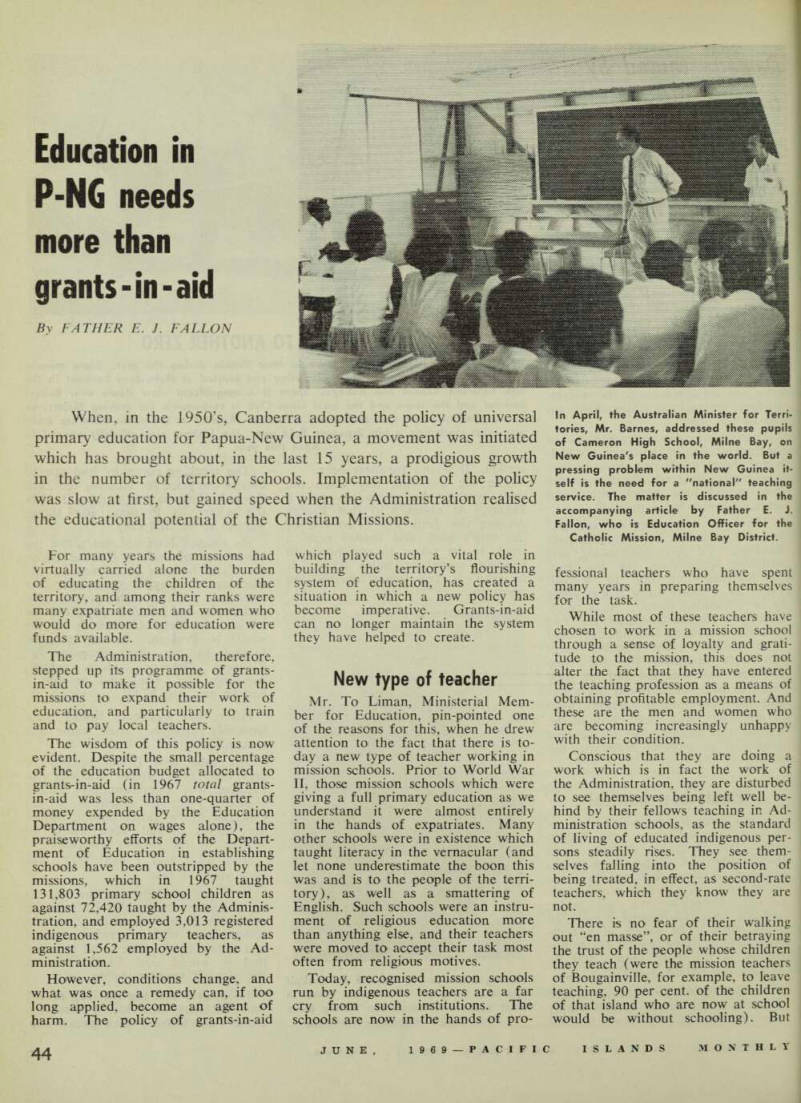
In April, the Australian Minister for Terri tories, Mr. Barnes, addressed these pupils of Cameron High School, Milne Bay, on New Guinea's place in the world. But a pressing problem within New Guinea it self is the need for a "national" teaching service. The matter is discussed in the accompanying article by Father E. J.
Fallon, who is Education Officer for the Catholic Mission, Milne Bay District.
Illogicalities of system
the teachers are becoming rather exasperated with a system whose illogicalities are evident to them.
Rights of parents
The circumstance that they are teaching a particular form of the Christian religion is sometimes men tioned as a factor which disqualifies mission teachers from receiving wages from public monies. The teachers feel that this objection has no validity in P-NG, where the Administration itself teaches the tenets of the Christian religion in its schools.
Once this policy of Christian in struction for all school children has been accepted, it would be logical to give effective acknowledgement of the rights of parents by allowing religious instruction and acts of worship in schools to be of a par ticular faith, in those cases where all the children attending the school are of the one persuasion, and to restrict religious instruction to the “agreed syllabus” only where the children are of differing faiths.
A further objection is sometimes made that, whereas the spending of public monies requires adequate con trols, mission teachers, working in a non-government system, are not sub ject to such controls. Here again, the mission teacher sees little validity in the objection, taken the situation in P-NG.
Future bright
The mission teacher was trained either in an Administration Teachers’
College or in a college operated under Administration supervision; he sat for a public Teachers’ Certificate Examination; he teaches in a school opened only because it fitted Ad ministration planning for opening of new schools and complied with all regulations regarding Certificates of Recognition for Schools; he works to an Administration syllabus; he fol lows a time-table suggested by the Department of Education; his teach ing is subject to inspection by officers of the Department of Education . . . all in all, the only difference between his school and an Administration school is the fact that, in an area his school is the fact that, in an area in which the Administration was un able to help, a certain mission was able to find the funds to build the school and answer the needs of a particular group of Papuans or New Guineans anxious to have schooling for their children.
The controls mentioned above
ould seem to the mission teacher > be quite adequate to ensure that üblic monies are being spent as in :nded.
Despite such objections, the future ; bright. The dissatisfaction which ad been growing of late among local ;achers in mission schools has given r ay to a new hope, now that Can erra has appointed an advisory ommittee on education which will >ok into wages for teachers in lission schools and into the possi ility of setting up the one teaching ;rvice from which appointments will e made to all schools, whether Ad linistration or Mission.
The members of the committee re eminently qualified for their task, nd all who have at heart the educa on of the children of the territory ;el assured that soon a new policy ill be introduced that will be as ise and as timely and as far reaching i its effects as was the earlier policy f enlisting the aid of the missions trough grants-in-aid.
-Ng School Statistics
Information supplied by Minister ;>r External Territories, Mr. Barnes, i the House of Representatives re eals the latest school figures. The linister said: There are an estimated 415,000 hildren in Papua-New Guinea in the ix to 12 years age group, and an stimated 198,000 in the 13 to 16 ge group. Of primary age group 35.000 are in mission schools and 5.000 are in Administration schools.
To place the remaining children in lis category in schools would require bout 500 more schools and about ,000 more teachers.
In certain areas, more especially lose areas opened up in recent years, ommunities are not yet served by rimary schools. In those areas where lere is a primary school, but where pplicants exceed the places available, tie headmaster makes the selection n the basis of age, maturity, and pparent intelligence.
In the secondary group, 7,500 are i mission schools and 12,350 are in administration schools.
Planned enrolments for Adminis ration secondary schools have been chieved though some classes are arger than desirable and some ccommodation is unsatisfactory. An dequate picture of the position in lission secondary schools is not yet ivailable since details of 1969 en olments are not yet available from Jl missions.