Datsuns Or Dignity-That's The Choice
pp. 27-28 · Read in the full issue
Facing The Us Trust Territory
By Judy Tudor
Every cliche in the American lexicon went the rounds in April when the Micronesian Political Status Commission of the US Trust Territory announced that it would aim for a self-governing state in tree association with the United States. The infant Micronesian Congress had upstaged the Congress of the United States, it was said; the Micronesian baby had taken the first giant steps towards nation hood. And so on.
Unfortunately for Micronesian political aspirations, the US still seems to be in a position to do the up-staging. The operative phrase in the Status Commission’s announce ment is “free association with the US”, which, in practical terms, means that the US will be expected to give aid and cash.
It is probable that the US will fall into line with other colonial powers who have had to pay in order to shed some of their responsibilities; but how much and in what form will likely lead to long negotiations.
The whole situation could be in fluenced by the value the US puts on its anti-ballistic missile base at Kwajalein in the Marshalls. This is an important link in US world defence strategy and it has, for many years, been a sore point with the Marshallese who are land-sensitive.
Alternatives
It has been no secret that the status commission expects the US to pay dearly for the use of Micronesian land, including Kwajalein. In their thinking about a self-governing state this, in fact, is considered their greatest economic asset —and, heaven knows, the scattered islands of Micro nesia have very few of them.
The status commission was created by the Congress of Micronesia in 1967. It consists of six members of the Congress, under the chairmanship of Lazarus Salii, from Angaur, in the Palau Group, The commission has been studying future alternatives since its inception; has consulted experts in the field of political advancement of emerging peoples; in 1968 travelled to the Virgin Islands, Washington and Puerto Rico (Puerto Rico is also in “free association” with the US); and, finally, in early 1969. set off to see how other Pacific territories were tackling similar problems.
American and Western Samoa, Fiji, Papua-New Guinea, Okinawa were studied; so was the Cook Islands set up with New Zealand.
One interesting result of these visits was the impression expressed by Senator Salii that a parliamentary system, presumably on the British pattern, might suit Micronesia better than the present US system. One reason for this was that it would be cheaper to operate.
When members of the commission returned to Saipan they split up into two parties and visited the outer islands to conduct public hearings; to report on the commission’s work and to try to explain the commission’s recommendation for a self-governing state in free association with the US.
By making their recommendation now, possibly years before anything concrete can be achieved, the com mission is providing a target upon which the people of Micronesia can
set their sights. To this extent what it has done is praiseworthy.
But the path to self-government is going to be hard, for all the usual reasons and for some that are uniquely Micronesia’s. In less than 100 years, the Micronesians have had four different administering powers — Spain, Germany, Japan and the United States. The Micronesians got a lousy deal from the first three; and some pretty muddled thinking from the fourth.
With this sort of background it is a minor miracle that there are even six men in the Congress of Micronesia who are capable of plotting a path to any sort of political future.
Of the four great powers who have administered the present Trust Territory, only Japan made it economically viable. Between the two world wars, hundreds of thousands of Japanese colonists raised sugar cane, operated mills and distilleries, worked phosphate and engaged in fisheries —all for the direct benefit of Japan.
During the war everything that the Japanese had built was destroyed and was never restored.
Not welcome
The Americans made no attempt to re-establish agriculture on the former scale and as the Micronesians themselves were incapable of it, the result is that today nearly all agri culture is at subsistence level.
In the first few years of occupancy, the US regarded the territory as a top-secret security area —a status to which it has reverted from time to time. Outside visitors were not welcome; investment or enterprise from outside was not permitted.
What enterprise there was, was in the hands of Micronesians.
As a result of this policy the whole territory, up to four years
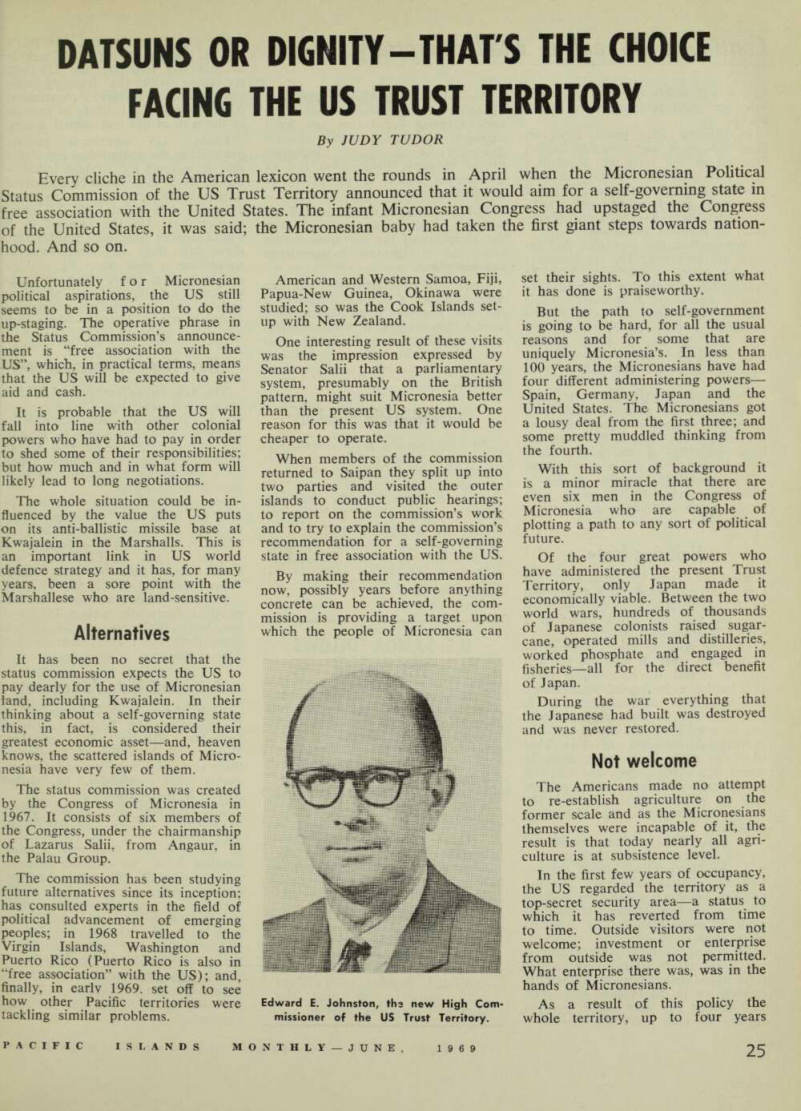
Edward E. Johnston, the new High Com missioner of the US Trust Territory.
Continued US aid is vitally necessary
ago, was probably the most economi cally and politically backward in the Pacific.
In the last four years, however, there has been some outside capital invested in the territory, there has been a growing interest in the development of such get-rich-quick industries as tourism; and, con currently, there has been encourage ment of political awareness.
Nonetheless, the problems that re main are immense. The six members of the status commission can be regarded as the elite of the politically elite Congress of Micronesia. Their task is to convince the other 95,000 inhabitants, scattered in over 2,000 individual islands, in three million square miles of ocean, that what the commission wants, the people want also.
Politically, the territory is now divided into six districts, each with different problems, different languages and a different outlook and with the large majority of the people con cerned only with their own village affairs, seemingly content to live a subsistence existence if outsiders with larger ideas will only leave them to it.
Unifying force
Most of these Micronesians are far more concerned with their own local land troubles and disputes than they are with the larger issues of a united Micronesia.
One purpose of the Congress of Micronesia when it was set up was that it would be a unifying force and inspire a feeling of nationalism.
Some people believe that it is achieving this purpose but how valid this is, only time will show.
Artificial concepts of this kind have too often been swept away in places like Africa, once the colonial power has withdrawn. At the present time the greatest unifying force in the Trust Territory is the American presence.
In spite of the miracles performed by the Japanese during their occupa tion, the Micronesian islands are not rich in natural resources. Failing another Japanese occupation nothing like that ant-like activity and develop ment is ever likely to be achieved there again.
Main and virtually only export is copra, of which 40 per cent, comes from the Marshall Islands. Generally, exports are in the vicinity of 13,G00-14,000 14,000 tons per year and it goes to Japan—the only accessible market.
Possibilities are the development of cattle raising, fisheries and vege table farming for Guam and local markets, but failing some mineral discovery or a greatly increased tourist industry, there seem few of the normal means of supporting an independent state.
For this reason, continued US aid will be vitally necessary—as even the members of the commission who were for straight-out independence acknowledged.
Even with continued aid Chairman Salii could see a bit of belt-tightening but he thought that Micronesians were tough enough to make sacrifices and go without store food and other US luxuries in order to build a structure that their economy can support.
Traditionally divided
As someone else put it—there will have to be fewer Datsuns; while people out in the villages will have to learn that if they accept all western consumer goods, they are giving up their liberty and dignity.
For my money, I wouldn’t like to bet that, in the final analysis, people as traditionally divided in outlook as the present elements that make up the Trust Territory, will
prefer dignity to Datsuns. But that’s for the future. The present task is to find out how far the US will go along with the idea of self government and free association.
And how much it is likely to provide in the way of aid and annual grants.
Failing US agreement to its proposition the commission has stated that it will go for straight indepen dence. How this would be supported economically appears not to have exercised the minds of the com mission yet. On the face of it, it would appear hopeless. Nonetheless, these days there are more ways of supporting a state than by striking oil or cutting copra. Flags of con venience for international shipping; registry of tax-evading companies; football pools; lotteries—these are just a few of them.
New High Commissioner
The US Trust Territory of Micro nesia has a new High Commissioner.
He is 51-year-old Mr. Edward E.
Johnston who has lived in Hawaii for the past 22 years and whose appointment has been freely tipped since the Nixon Administration took over in Washington.
Mr. Johnston is a businessman and has also had government ex perience in Hawaii where he was Secretary of Hawaii—equivalent to the present post of Lieutenant-Gov ernor —in 1958-59, just before Hawaii assumed statehood.
He has been prominent in Re publican Party affairs since 1955 and has been chairman of the Hawaii State Republican Party for the last four years.
President Nixon's request
With the new US Secretary of the Interior, Mr. Walter J. Hickel and Mrs. Elizabeth P. Farrington, Director of the Office of Territories, their respective families and Depart mental staff members, he visited Saipan in early May.
The visit was made at the request of President Nixon. According to Mr. Hickel, who will report back to the President, the new admini stration plans “to establish a close rapport with the Micronesian people, to seek their counsel and to deter mine what they want for their political future , . . our special con cern is to give the Micronesians a greater voice and representation in the administration of the islands”.
The date when the Johnstons, who have two teenage daughters, will take up residence in Saipan has not been announced.